What R-value measures, and the table this page uses
R-value is thermal resistance: how strongly the pad slows conductive heat loss between your body and the ground. Higher numbers insulate more, the scale is roughly linear — an R 4 pad resists about twice as much heat flow as an R 2 pad — and since the ASTM F3340 standard was adopted in 2020, the big brands all test the same way, so a 4.2 from one maker really can be compared with a 4.5 from another. Older or no-name pads without an ASTM figure are guesswork, and this page's table is only as honest as the number printed on the pad. The table itself is the published temperature correspondence: 10 °C calls for R 1, −1 °C for R 2, −4 °C for R 3, −12 °C for R 4, −18 °C for R 5, −26 °C for R 6, −32 °C for R 7 and −40 °C for R 8. The rule this page applies to temperatures between the rows is the cautious one: take the warmest row at or below your expected low, because the pad must survive the coldest night, not the average one.
Minimum R = the table R of the warmest row at or below the expected low — Cold sleeper: minimum R + 1 — Stacked R = pad R + foam R (about 2) — R-values add exactly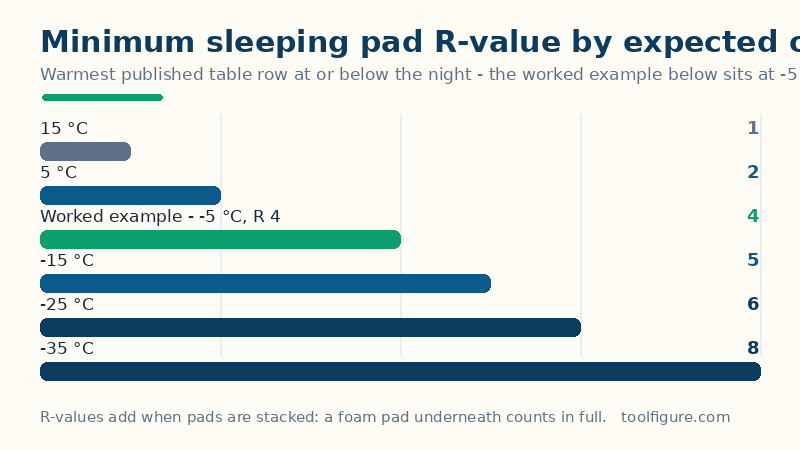
The same bands in the other direction, as the familiar season map: under R 2 is warm weather, when the ground stays mild all night; R 2 to 3.9 is where many three-season pads sit, fine for mild spring, summer and fall nights; R 4 to 5.4 is colder nights and people who sleep cold; R 5.5 and up is extremely cold ground, snow camping and winter trips. Note the quiet trap inside that map: sleeping bag temperature ratings are predicated on a pad near R 5, so if you sleep cold in temperatures where your bag should keep you warm, the pad — not the bag — is often the missing piece.
Worked example: a −5 °C night, average sleeper, owning an R 3 pad
For a coldest night of −5 °C, the minimum pad is R 4 — the cold-nights band. The working: the warmest table row at or below −5 °C is −12 °C, which calls for R 4 (the −4 °C row's R 3 is for a warmer night than the one expected, so it does not count). A cold sleeper on the same night needs R 5, one point up. The stacking check on an owned R 3 pad: R 3 plus a foam pad at about R 2 stacks to R 5, which covers the R 4 minimum — so this trip needs a foam pad underneath, not a new inflatable pad. The same rule across the range:
| Expected low | Minimum R (average sleeper) | Cold sleeper |
|---|---|---|
| 15 °C (59 °F) | 1 | 2 |
| 10 °C (50 °F) | 1 | 2 |
| 5 °C (41 °F) | 2 | 3 |
| 0 °C (32 °F) | 2 | 3 |
| −5 °C (23 °F, worked example) | 4 | 5 |
| −10 °C (14 °F) | 4 | 5 |
| −15 °C (5 °F) | 5 | 6 |
| −20 °C (−4 °F) | 6 | 7 |
| −30 °C (−22 °F) | 7 | 8 |
| −35 °C (−31 °F) | 8 | 9 |
| −45 °C (−49 °F) | 8+ (stack pads) | 8+ (stack pads) |
Check two rows by hand. At 5 °C the warmest row at or below 5 °C is −1 °C, which calls for R 2 — not R 1, because the 10 °C row's R 1 is for a night warmer than the one expected. At −20 °C the warmest row at or below −20 °C is −26 °C, which calls for R 6, and a cold sleeper needs R 7. And the Fahrenheit cross-check on the worked example: 23 °F is (23 − 32) × 5/9 = −5 °C exactly, so it lands on the same R 4. The jump from 0 °C (R 2) to −5 °C (R 4) looks steep, but that is what the table says — there is no R 3 row between −4 °C and −12 °C in the published correspondence, and the cautious rule takes the colder row, not the nearer one.
How to read your result, and its limits
Three checks before trusting the figure. First, enter the coldest night, not the average: a pad that is right for the average night fails on the coldest one, and ground that has been cold for days stays colder than the night air above it. Second, R-value says nothing about comfort, thickness or weight: two pads with the same R-value keep you equally warm on the same ground even if one is twice as thick, and a thick pad with a low R-value is a comfortable cold night, not a warm one. Third, cold sleepers move one band up, and the guidance is explicit about it: women and other cold sleepers are usually advised an additional point of R-value, which is why this page offers the step as an input rather than burying it in the table — if you know you sleep cold, say so and take the higher figure, because an over-warm pad costs a little weight and an under-warm one costs the whole night.
Common mistakes
- Blaming the sleeping bag for a cold night. Bag ratings assume a pad near R 5 — on a thin summer pad, the ground steals the warmth the bag was rated to keep.
- Sizing the pad to the average night. The pad must survive the coldest night of the trip; the average night is the wrong input.
- Reading thickness as warmth. Thickness is comfort; R-value is insulation. A thick low-R pad is a comfortable cold night.
- Trusting a non-ASTM R-value at face value. Before the 2020 standard every maker measured differently; a pad without an ASTM figure is a claim, not a comparison.
Related tools: Sleeping Pad Size Calculator — Your sleeping pad size from height and sleep position — the size to buy, its length, and the width that suits how you sleep; Sleeping Bag Size Calculator — Your sleeping bag size from height and sleep position — the minimum length, the size that covers it, and the comfort rating for your coldest night; Tent Size Calculator — Your tent size from sleepers and comfort — the floor area you need and the rating that covers it — with the packs-inside allowance.
Frequently asked questions
What R-value do I need for camping?
For warm summer nights above about 15 °C, R 1–2 is enough. For typical three-season camping, R 3–4. For shoulder seasons with frost, R 4–5. For snow, R 5.5 and up. If you sleep cold, add one point — this page's cold-sleeper option does exactly that.
Can I stack two sleeping pads to increase the R-value?
Yes — R-values add exactly. A foam pad at about R 2 under an inflatable pad adds its full R 2, which is the standard winter trick: an R 3 pad plus foam stacks to R 5. This page's stacking check does that arithmetic for a pad you already own.
Does a higher R-value pad make me overheat in summer?
No — R-value fights the ground, not your metabolism. A warm pad on a warm night costs a little weight and pack space, not sleep; if you sleep hot, vent the bag or quilt instead of dropping the pad's R-value.
Why do I feel cold even though my sleeping bag is rated for the temperature?
Because bag ratings assume a pad near R 5 underneath. On a thin pad the ground draws heat away faster than the bag can hold it, so the bag never reaches its rating — the pad, not the bag, is usually the missing piece.
