Three steps: watts, hours, fans
The whole calculation is two multiplications. Watts divided by 1,000 is kilowatts; kilowatts times the hours a day times the number of fans is the day's energy; the day's energy times 365 days is the year's energy; the year's energy times the price is the year's money. The month is the year divided by 12, not the day times 30 — the two differ by a few cents, and the year-divided-by-12 figure is the one this page uses, so it agrees with the yearly total exactly:
energy per day (kWh) = watts ÷ 1,000 × hours a day × fans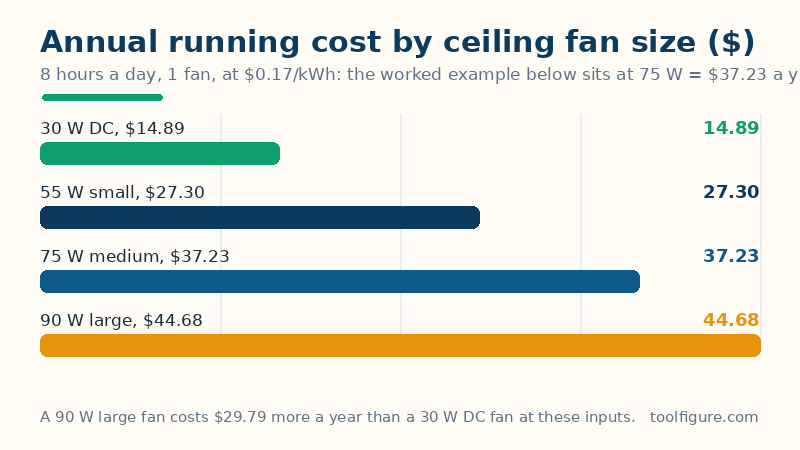
annual cost ($) = energy per day × 365 × electricity priceThe watts on the box are the high-speed figure, and most fans spend their lives below it. A standard 52-inch residential ceiling fan draws 15 to 100 W depending on motor type and speed setting — about 60 to 75 W for an AC motor on high, 20 to 45 W for a DC motor — and the low speed is roughly 30 W. That spread is the whole story: the same fan costs about a cent an hour on high and half a cent on low, and a house with three fans running costs three times a house with one. Enter the watts for the speed you actually use; the label's high-speed figure is the ceiling, not the usual.
Worked example: 75 W, 8 hours a day, 1 fan, $0.17/kWh
A 75 W ceiling fan running 8 hours a day uses 0.075 × 8 = 0.600 kWh a day, costing $0.10. An hour is 0.075 kWh, costing 1.3¢. A month is 219.0 ÷ 12 = 18.3 kWh, costing $3.10. A year is 0.6 × 365 = 219.0 kWh, costing $37.23. The table above shows the same maths for the other fan sizes at 8 hours a day: a 30 W DC-motor fan costs 0.5¢ an hour and $14.89 a year, a 55 W small fan costs 0.9¢ an hour and $27.30 a year, and a 90 W large fan costs 1.5¢ an hour and $44.68 a year. Three fans at these settings cost $111.69 a year — the same as one fan running around the clock — and at 4 hours a day one fan costs $18.62 a year, at 12 hours $55.84. Four published cross-checks reproduce exactly: wattcostcalc's 75 W ceiling fan at 8 hours a day and 17.5 cents costs $0.013 an hour, $0.105 a day and $38.32 a year — this page gives the same 0.075 kWh an hour, 1.3¢, $0.11 a day and $38.32 a year, while its $3.15 a month is the day times 30 and this page's year-divided-by-12 month is $3.19; costtorun's 70 W ceiling fan at 10 hours a day and 15 cents costs $0.01 an hour, $0.11 a day and $38.32 a year — this page gives the same 0.7 kWh a day and $0.11 a day, and $38.33 a year, one cent above their $38.32 on the year's rounding; perch-labs' 55 W small fan costs $0.009 an hour and $2.11 a month at 16 cents — this page gives the same 0.9¢ an hour, while its $2.11 a month is the day times 30 and this page's year-divided-by-12 month is $2.14; and renogy's 75 W fan at 8 hours a day and 16 cents costs $0.012 an hour, $0.096 a day and $2.88 a month — this page gives the same 1.2¢ an hour and $0.10 a day, and $2.88 on the day-times-30 month.
How to read your result, and its limits
Four cautions keep the number honest. First, the month is the year divided by 12: 219.0 kWh a year is 18.3 kWh a month and $3.10, while the day times 30 would give 18.0 kWh and $3.06 — a four-cent difference that is only a convention, and the year-divided-by-12 figure is the one that adds up to the yearly total. Second, a fan cools people, not the room: it moves air over skin, which feels cooler, but the room itself is unchanged — and the motor's own heat warms it very slightly — so a fan running in an empty room spends money on nothing, and switching it off when nobody is in the room is the one saving that costs no comfort at all. Third, the speed setting decides the bill: the same fan costs about 30 W on low and 75 to 90 W on high, so a fan left on high all night costs roughly three times a fan on low — and a DC-motor fan at 20 to 45 W costs roughly half an AC fan at the same speed. Fourth, the electricity price is the all-in rate: the total on the bill divided by the kilowatt-hours on the bill, including delivery charges. For the vacuum that runs while the fan spins, the vacuum cleaner cost calculator prices the clean by watts and minutes; for the cooling the fan lets you turn down, the air conditioner cost calculator prices it watt by watt from its BTU rating and SEER; and for the cost of running anything else in the house, the electricity cost calculator prices any appliance by watts and hours.
Common mistakes
- Leaving the fan on in an empty room. A fan cools the person under it, not the air: an empty room with a fan running is a room being very slightly warmed by the motor, at 1.3¢ an hour. Switch it off when nobody is in the room.
- Pricing the high-speed watts for a fan that runs on low. The same fan draws about 30 W on low and 75 W on high — pricing the label figure for a fan that lives on low triples the answer. Enter the watts for the speed you actually use.
- Multiplying the daily cost by 30 for the month. Thirty days is not a twelfth of a year: the day times 30 gives $3.06 a month at the worked example's inputs, while the year divided by 12 gives $3.10. Use the year-divided-by-12 figure, which is the one that adds up.
- Comparing a fan with air conditioning on watts. A 75 W fan and a 1,200 W air conditioner look close only if the hours are ignored: the fan is $37.23 a year at 8 hours a day, while central air conditioning runs $120 to $150 a month — roughly fifty times the fan. A fan also lets you raise the thermostat, which is where the real saving sits.
- Adding the standing charge to every hour. The daily supply charge is payable whether the fan runs or not. Only the per-kWh rate belongs in the per-hour maths — the fixed charge is a separate line on the bill.
Frequently asked questions
How much does a ceiling fan cost per hour?
A 75 W ceiling fan costs 1.3¢ an hour at $0.17 per kWh, and a 30 W DC-motor fan costs 0.5¢ — wattcostcalc gives $0.013 an hour for the same 75 W fan at 17.5 cents. Any normal ceiling fan costs under 2¢ an hour; the hours, not the watts, are what decide the bill.
Is it expensive to leave a ceiling fan on all day?
No, but it adds up: a 75 W fan running 24 hours a day uses 1.8 kWh a day, costing $0.31 a day and $111.69 a year at $0.17 per kWh. Three fans at 8 hours a day cost the same $111.69 a year — and a fan left running in an empty room spends all of it on nobody, since a fan cools people, not the room.
Is a ceiling fan cheaper than air conditioning?
By about fifty times: a 75 W fan costs $37.23 a year at 8 hours a day, while central air conditioning typically runs $120 to $150 a month — and the fan's real saving is letting you raise the thermostat a few degrees, which cuts the air conditioner's own hours. The fan is the cheap half of the pair, not a replacement for it on the hottest days.
Does a ceiling fan cool the room?
No: it moves air over your skin, which feels cooler, but the air in the room stays the same temperature — the motor's own heat warms it very slightly. That is why the fan belongs off when nobody is in the room, and why a fan and an air conditioner are a pair: the fan makes a warmer room feel comfortable, so the air conditioner can run less.