One quantity, many dialects
An angle — how far a direction has turned — is measured in dialects that grew up in different trades. Geometry and navigation use degrees. Calculus, physics and every programming language's trig functions use radians. Surveyors use gradians (gon). Rotations are counted in turns. Astronomers and opticians split degrees into arcminutes and arcseconds. Ballistics and optics work in milliradians, while gunnery uses the close-but-different NATO mil. They are all the same quantity wearing different costumes, and this page undresses it: any angle restated in all eight units at once, worked through the radian with every factor defined, with the sine, cosine and tangent beside every answer.
How the conversion works, with every factor defined
Radians = value × the from-unit's factor · Converted value = radians ÷ the to-unit's factorDegree π/180 · Gradian π/200 · Turn 2π · Arcminute π/10,800 · Arcsecond π/648,000 · Milliradian 0.001 · NATO mil 2π/6,4001 rad = 57.3° = 63.66 grad · 1 mrad = 1.0186 mil · 1 turn = 360° = 400 grad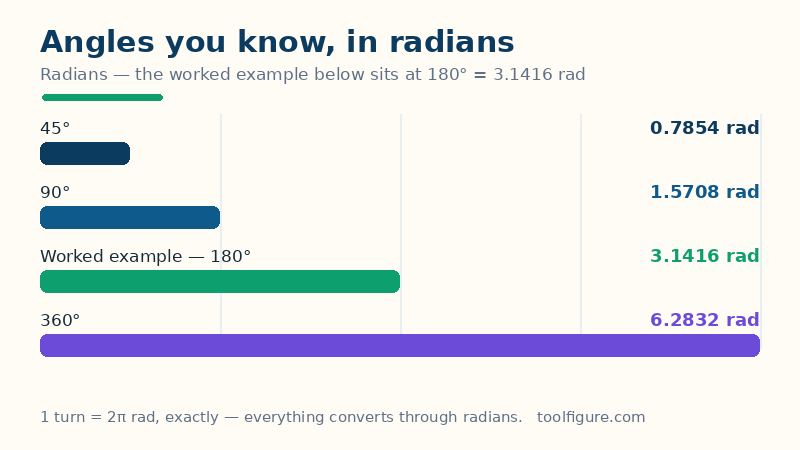
These factors are definitions, not measurements. A full circle is 2π radians by the definition of the radian itself — the angle whose arc equals the radius — so one degree is π/180 radians and one radian is 180/π = 57.3 degrees. Gradians split the circle into 400, arcminutes split each degree into 60 and arcseconds split each minute into 60, so a circle is 1,296,000 arcseconds. The page's honest distinction is the last one: a true milliradian is 0.001 radians — 2,000π ≈ 6,283.19 of them per circle — while the NATO mil is defined as 1/6,400 of a circle, 2π/6,400 radians. They differ by about 1.9%, and 1 mrad is 1.0186 mil, so this page carries both rather than merging them. Every trig value below is computed from the angle's radian value, because the sine of 45 degrees and the sine of 0.7854 radians are the same sine — the functions only ever see radians.
Worked example: 180 degrees
The defaults above convert 180 degrees — a half turn, the angle every student meets first. Through the base unit: 180 × π/180 = 3.1416 rad. Dividing by each unit's factor: 200 grad, 0.5 turn, 10,800 arcmin, 648,000 arcsec, 3,141.59 mrad and 3,200 mil. The trig row reads sin = 0.000000, cos = -1.000000, tan = -0.000000 — the unit circle's leftmost point, where the sine is zero and the cosine is minus one. Three habits follow from the method. First, the quick mental version — degrees times 0.01745 is radians — gives 3.141 for 180°, close enough for setting an angle but not for checking trig homework. Second, always convert before feeding trig functions in code: Math.sin(45) in JavaScript is the sine of 45 radians, not 45 degrees — convert to 0.7854 first. Third, learn the circle's landmarks in both dialects: 90° is 1.5708 rad and 1,600 mil, 45° is 0.7854 rad and 800 mil.
The conversions people actually ask for
| Conversion | Answer | How it is worked |
|---|---|---|
| 180° in every unit (worked example) | 3.1416 rad | 180 × π/180 — worked in full above |
| 90° to radians | 1.5708 rad | 90 × π/180 |
| 90° to NATO mils | 1,600 mil | 90 × π/180 ÷ (2π/6,400) |
| 45° to radians | 0.7854 rad | 45 × π/180 |
| 1 radian to degrees | 57.3° | 180/π |
| 1 radian to gradians | 63.66 grad | 200/π |
| 360° to radians | 6.2832 rad | 360 × π/180 |
| 360° to arcseconds | 1,296,000″ | 360 × 3,600 |
| 1 milliradian to degrees | 0.0573° | 0.001 × 180/π |
| 1 NATO mil to degrees | 0.0563° | (2π/6,400) × 180/π |
| 1 milliradian to NATO mils | 1.0186 mil | 0.001 ÷ (2π/6,400) |
| 1 arcsecond to degrees | 0.0003° | 1 ÷ 3,600 |
Three rows deserve a second look. The 1-radian row is the one students should memorise: 57.3° is not a round number, which is exactly the point — the radian is natural, not convenient, and every programming language quietly assumes it. The milliradian-versus-mil pair is why the honest page carries both units: 0.0573° versus 0.0563° looks like a rounding error, but at artillery ranges that 1.9% is the difference between a hit and a miss, and the page's 1.0186 conversion is the bridge. And the arcsecond row carries a stated rounding: one arcsecond is about 4.85×10⁻⁶ radians, which this page's four-decimal display prints as 0 rad — the true value is in the prose, the display rule is in the limits below.
How to read your result, and the limits
Results show four decimal places below 10 and two above — more precision than most angle settings justify, so round to the precision of the instrument for real use. Four limits belong with the page. Angles are not normalised: 720° converts as two turns, 0.5 of nothing is lost — enter a negative angle for a clockwise turn; both are converted as given, not wrapped into 0–360°. The tangent explodes near 90°: tan(90°) is not a big number, it is an undefined one — the page prints a very large finite value there, and you should read it as "approaches infinity", not as a measurement. Tiny angles hit the display floor: below 0.00005 of a unit the page prints 0 — one arcsecond is 0.0003° but 0 rad at four decimals, so work in the unit that fits the size of your angle. And DMS is not entered directly: 45°30′ is forty-five and a half degrees — enter 45.5, because this page converts single decimal values, not degrees-minutes-seconds triples.
Related tools: Unit Converter — Convert length, weight, temperature and volume — km to miles, kg to pounds, °C to °F, litres to gallons; Density Converter — kg/m³ to lb/ft³, g/cm³ to lb/in³, lb/gal and more — every answer in all nine units, through the exact definitions; Scientific Calculator — Type full expressions with powers, roots, trig and logs — solved in the right order.
Frequently asked questions
How do I convert degrees to radians?
Multiply by π/180, about 0.0174533. 180° becomes 3.1416 rad; 90° becomes 1.5708 rad. To go back, multiply radians by 180/π, about 57.3 — so 1 rad is 57.3°. This page restates every angle in all eight units at once and shows the working.
What is the difference between a milliradian and a NATO mil?
A true milliradian is 0.001 radians — 2,000π, about 6,283.19 of them per circle. A NATO mil is defined as 1/6,400 of a circle, 2π/6,400 radians. They differ by about 1.9%: 1 mrad is 1.0186 mil, and 1 NATO mil is 0.0563° versus a milliradian's 0.0573°. This page carries both, stated openly.
Why do programming languages use radians?
Because the radian is the natural unit: in calculus, the derivatives of sin and cos are only the clean forms (cos, −sin) when angles are in radians. So Math.sin(0.7854) in JavaScript is the sine of 45° — but Math.sin(45) is the sine of 45 radians. Convert first; this page gives the trig row beside every answer.
How many arcseconds are in a degree?
3,600 — sixty arcminutes per degree, sixty arcseconds per arcminute, so a full circle is 1,296,000 arcseconds. Astronomers and opticians live in these units. Note the display rule: one arcsecond is about 4.85×10⁻⁶ radians, which this page's four-decimal format prints as 0 rad — the true value is stated in the limits section.