The dose is per litre — everything else is multiplication
Chemical disinfection guidance is always written per litre or per quart, because the chemical has to reach a concentration in the water, not a total in the bottle. The standard iodine figures, following the public-health guidance for emergency disinfection, are: 2% iodine tincture, 5 drops per litre of clear water and 10 per litre of cloudy water; 5% Lugol's solution, 2 drops per litre clear and 4 cloudy; iodine tablets (tetraglycine hydroperiodide), 1 tablet per litre clear and 2 cloudy. Cloudy water doubles the dose because suspended sediment both shields organisms and consumes iodine before it can work — which is why straining cloudy water through a clean cloth first is part of the method, not an optional extra.
Dose = water (litres) × drops or tablets per litre, rounded UP to a whole drop or tablet — Wait = 30 minutes, doubled for cloudy water, doubled again for cold water (below 15 °C) — 2% tincture: 5 clear / 10 cloudy per litre — 5% Lugol's: 2 clear / 4 cloudy per litre — Tablets: 1 clear / 2 cloudy per litre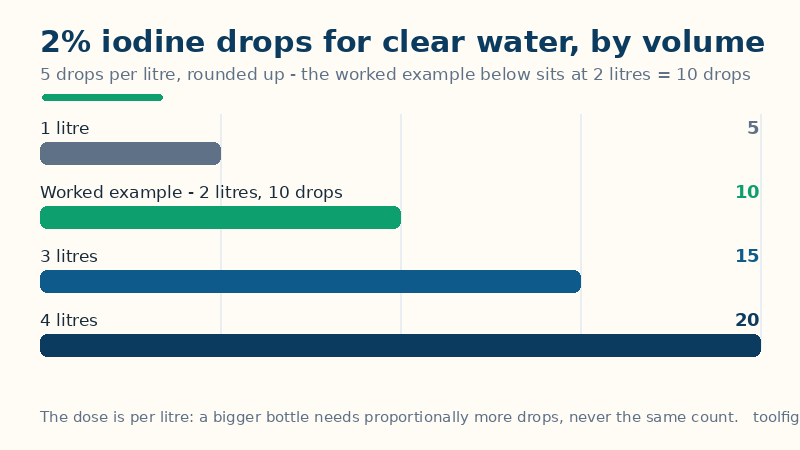
The wait rule on this page is the cautious form of the published guidance: at least 30 minutes before drinking, longer when the water is cold or cloudy, because iodine works slower in cold water and has more to do in cloudy water. Doubling for each adverse factor — cloudy alone 60 minutes, cold alone 60, both together 120 — keeps one rule for every combination instead of a table of exceptions, and it never gives a wait shorter than the guidance allows.
Worked example: 2 litres, clear, warm, 2% iodine tincture
Two litres of clear, warm water with 2% iodine tincture: dose = 2 litres × 5 drops per litre = 10 drops, and the wait is the base 30 minutes — neither the cloudy doubling nor the cold doubling applies. Stir well after adding the drops, and rinse the cap threads with a little treated water, because any untreated water left on the rim or threads is water you will still drink untreated. The same rule across the range:
| Water, method | Dose | Wait |
|---|---|---|
| 1 litre, clear, warm, 2% tincture | 5 drops | 30 min |
| 1 litre, cloudy, warm, 2% tincture | 10 drops | 60 min |
| 2 litres, clear, warm, 2% tincture (worked example) | 10 drops | 30 min |
| 2 litres, cloudy, cold, 2% tincture | 20 drops | 120 min |
| 2 litres, clear, warm, 5% Lugol's | 4 drops | 30 min |
| 3 litres, clear, warm, iodine tablets | 3 tablets | 30 min |
| 5 litres, cloudy, warm, iodine tablets | 10 tablets | 60 min |
| 0.5 litres, clear, warm, 2% tincture | 3 drops | 30 min |
Check the last row by hand, because it is the row most people get wrong: 0.5 litres × 5 drops = 2.5 drops, and there is no such thing as half a drop in the field, so the page rounds up to 3 drops. Rounding down would under-dose the water; rounding up over-doses it by half a drop in half a litre, which is harmless. The same rounding applies to tablets: a 2.5-litre bottle needs 3 tablets, not 2, because the third litre — even partial — still needs its full tablet.
How to read your result, and its limits
Three limits decide whether this result is enough. First, iodine does not kill Cryptosporidium, a hardy protozoan common in the same streams campers drink from — if Crypto is a known risk where you are, boil the water or filter it to 1 micron instead of, or as well as, iodising it. Second, iodine is short-term only: weeks on a trip, not months as a household supply, and it should be avoided entirely with an iodine allergy, thyroid disease or pregnancy. Third, the dose assumes the bottle on the label: a 2% tincture is not a 10% povidone-iodine, and a drop from a different dropper is a different size — if your bottle is not one of the three methods here, do not guess a conversion from this page; use the dose printed on that bottle. Within those limits, the arithmetic is exact: the dose scales linearly with litres, and the wait is the one rule above, applied without exception.
Common mistakes
- Dosing the bottle, not the litres. "10 drops" is the answer for 2 litres of clear water with 2% tincture, not for any bottle of any size — a 3-litre bottle needs 15.
- Drinking before the wait ends. Iodine needs contact time; drinking at 10 minutes because the water looks clear throws away the treatment.
- Treating cloudy water without straining it. Sediment shields organisms and eats iodine — strain through a clean cloth first, then dose for cloudy water anyway.
- Using iodine as a permanent supply. It is a trip method for weeks, not a household method for months, and it is the wrong method entirely where Cryptosporidium is the risk.
Related tools: Hiking Water Calculator — Your hiking water from hours, heat and effort — litres to carry, 1-litre bottles and the pack weight, with a delay hour and camp water included; Camp Stove Boil Time Calculator — How long your camp stove takes to boil water — from the physics, with altitude and efficiency, plus the safe-drinking hold; Camp Stove Fuel Calculator — Your camp stove fuel from group, days and stove type — grams and whole canisters for canister stoves, fluid ounces for white gas, cold and wind included.
Frequently asked questions
How many iodine drops purify a litre of water while camping?
With 2% iodine tincture, 5 drops per litre of clear water and 10 per litre of cloudy water, with a 30-minute wait for clear warm water — doubled to 60 minutes if the water is cloudy or cold. With 5% Lugol's solution the dose is 2 drops per litre clear and 4 cloudy; iodine tablets are 1 per litre clear and 2 cloudy.
How long must I wait after adding iodine to drinking water?
At least 30 minutes for clear, warm water. This page doubles the wait for cloudy water and doubles it again for cold water below 15 °C, so cloudy and cold together means 120 minutes — iodine works slower in cold water and has more to do in cloudy water, so the wait, not just the dose, has to grow.
Does iodine purification kill Cryptosporidium?
No. Iodine kills bacteria and viruses and inactivates Giardia given enough contact time, but it does not reliably kill Cryptosporidium. Where Crypto is a risk, boil the water or filter it to 1 micron instead of, or as well as, treating it with iodine.
Can I use iodine drops for drinking water long-term?
No — iodine treatment is for short-term use on trips, measured in weeks, not as a permanent supply, and it should be avoided with an iodine allergy, thyroid disease or pregnancy. For a longer stay, boil, filter, or use a method rated for continuous use.
