What a salary conversion actually is
This salary converter turns pay quoted in any one period into every other period at once — hourly, weekly, bi-weekly, semi-monthly, monthly and yearly — through one identity: annual pay equals the hourly rate times hours per week times weeks per year. At $25 an hour, 40 hours a week, that is $52,000 a year. Gross pay only. Pay is quoted in whichever period flatters the advert: hourly for warehouse and retail roles, annual for office roles, monthly for rental applications. Converting between periods is one multiplication, not a judgement about the job. The whole page rests on a single identity: annual pay = hourly rate × hours per week × weeks per year. Every other period is that annual figure cut into pieces — weekly is annual ÷ weeks per year, monthly is annual ÷ 12, bi-weekly is annual ÷ 26, semi-monthly is annual ÷ 24, daily is weekly ÷ days per week. If you enter a figure that is already in one of those periods, the page first rebuilds the annual figure from it and then cuts it the same way, so converting backwards (salary to hourly) is the same arithmetic run in reverse.
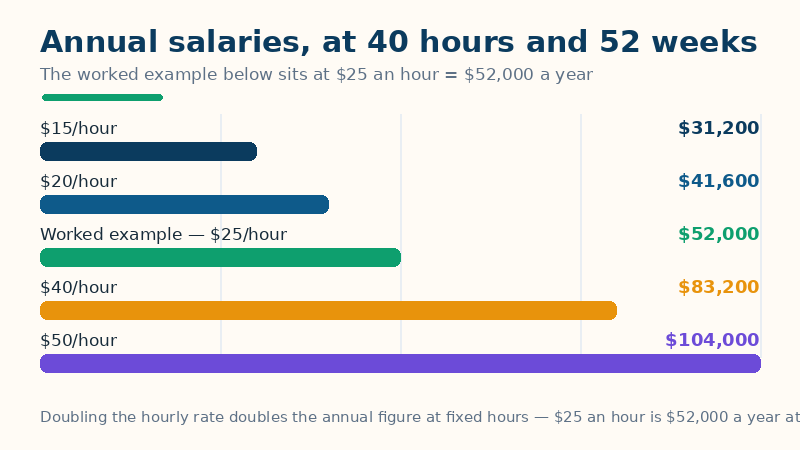
Worked example: $25 an hour, full time
Take a wage of $25.00 per hour, worked 40 hours a week for 52 paid weeks a year. The annual figure is $25.00 × 40 × 52 = $52,000.00. Cut that into periods and the full picture is: $1,000.00 a week, $2,000.00 bi-weekly, $2,166.67 semi-monthly, $4,333.33 a month, and $200.00 a day on a 5-day week ($1,000.00 ÷ 5). The paid hours behind it are 40 × 52 = 2,080 hours a year — the 2,080-hour rule behind the shortcut that $25 an hour is roughly $50,000 a year (doubling the hourly rate and reading it as thousands; the exact figure, $52,000, is 4% higher, and the gap matters once the rate climbs). Run the same wage at 50 paid weeks instead of 52 — two weeks of unpaid time off — and the annual figure falls to $25.00 × 40 × 50 = $50,000.00, a $2,000 difference the headline rate never shows.
Working backwards: a $60,000 salary as an hourly rate
Divide the salary by the paid hours behind it. At 40 hours and 52 weeks, $60,000 ÷ 2,080 = $28.85 an hour ($28.8461 before rounding). That is the rate to compare against an hourly offer — but only if the hours match. A $60,000 salary tied to a 50-hour week is $60,000 ÷ (50 × 52) = $23.08 an hour, which loses to a $25 hourly offer despite the bigger headline. The same trap runs the other way: a part-time wage can look small annually while beating a salary hourly. At $22.50 an hour, 38 hours a week and 50 paid weeks, the annual figure is $22.50 × 38 × 50 = $42,750.00 ($855.00 a week, $3,562.50 a month, $1,644.23 bi-weekly — the annual figure spread over the standard 26 pay periods) — and with paid vacation, 52 weeks, the same pattern would be $44,460.00, a $1,710 difference for two weeks nobody worked.
Common hourly rates as annual salaries
All rows assume 40 hours a week and 52 paid weeks (2,080 hours). Monthly is annual ÷ 12, which is why it is always a little more than four weekly paychecks: a month averages 4.33 weeks.
| Hourly rate | Weekly | Monthly | Annual |
|---|---|---|---|
| $15.00 | $600.00 | $2,600.00 | $31,200.00 |
| $18.00 | $720.00 | $3,120.00 | $37,440.00 |
| $20.00 | $800.00 | $3,466.67 | $41,600.00 |
| $25.00 | $1,000.00 | $4,333.33 | $52,000.00 |
| $30.00 | $1,200.00 | $5,200.00 | $62,400.00 |
| $35.00 | $1,400.00 | $6,066.67 | $72,800.00 |
| $40.00 | $1,600.00 | $6,933.33 | $83,200.00 |
| $50.00 | $2,000.00 | $8,666.67 | $104,000.00 |
How to read your result
The large figure is the annual equivalent, and the table underneath restates your pay in every period so the comparison you actually need — this offer against that offer — is on one screen. Three checks before you trust it. First, gross is not take-home: every figure here is before income tax, social security and Medicare or their local equivalents, and before any deduction for a retirement plan or health insurance, so the money that reaches a bank account is lower; the paycheck calculator on this site works out the after-tax side. Second, benefits are invisible here: a salaried role often carries paid vacation, health insurance and a retirement match worth roughly a fifth to a third of pay on top of the headline, while an hourly role may carry none of those — two equal gross figures can be very unequal jobs. Third, overtime is not priced in: the page assumes every hour is paid at the same rate, so a role with regular time-and-a-half hours past 40 needs the overtime calculator, not this one. Set weeks per year honestly — 52 only if vacation and holidays are paid; 50 or fewer if they are not — because that single field is where most hourly-to-salary comparisons quietly go wrong.
How this differs from the paycheck calculator
The paycheck calculator on this site answers a different question: what lands in your bank account after tax and deductions. This page answers the earlier question: what is this pay, restated in another period, before anything is taken out. Use this page to compare offers and to translate a wage into the monthly figure a landlord asks for; use the paycheck calculator once an offer is chosen and the take-home figure is what matters.
Related tools: Paycheck Calculator — Take-home pay per paycheck after tax and FICA — a clear US estimate; Overtime Pay Calculator — Regular pay, time-and-a-half overtime pay and the weekly, monthly and yearly totals; Time Card Calculator — The week's clock-in times turned into total hours, overtime and gross pay — every day shown separately.
Frequently asked questions
How do I convert an hourly wage to an annual salary?
Multiply the hourly rate by hours per week and by weeks per year: annual salary = hourly rate × hours per week × weeks per year. At $25 an hour, 40 hours a week and 52 paid weeks, that is $25 × 40 × 52 = $52,000 a year. The worked example on this page shows every intermediate period as well.
Why is monthly pay more than four weekly paychecks?
Because a month averages 4.33 weeks, not 4. There are 52 weeks in a year and 12 months, so monthly pay is annual pay ÷ 12 — at $1,000 a week that is $4,333.33 a month, not $4,000. Budgeting on four weeks a month understates a monthly income by about 8%.
Does this converter include taxes?
No. Every figure here is gross pay, before income tax, social security, Medicare and any other deduction. Take-home pay is lower, and by a different amount in every country and tax situation — use the paycheck calculator on this site for the after-tax figure.
How do I handle unpaid time off or part-time hours?
Set weeks per year to the weeks you are actually paid for: 50 if two weeks of vacation are unpaid, fewer for seasonal work. And set hours per week to your real pattern, not 40 by habit. At $22.50 an hour, 38 hours and 50 paid weeks, the annual figure is $42,750 — not the $46,800 a 40-hour, 52-week assumption would give.