One chart, three decisions: total, split, refills
Dutch oven charcoal cooking is decided by three numbers, and only the first comes from a chart. The total is the published temperature chart: for a given oven diameter and target temperature, a fixed count of standard briquettes holds that temperature in calm, mild weather. The split is the cooking method: baking wants most of the heat from above, so about two-thirds of the coals go on the lid; roasting wants even heat, so the coals split half and half; stewing wants most of the heat from below, so one-third goes on top; frying wants all of it underneath. The refills are the clock: briquettes hold their heat about 45 to 60 minutes, and this page counts a fresh load every 45 minutes, the conservative end, so a cook that runs long is never caught with dying coals. Two rules of thumb cross-check the chart rather than replacing it: twice the oven diameter in inches is roughly the 350°F total, and each briquette added or removed moves the oven about 25°F.
First load = chart total for oven size and temperature — Baking split = chart split (about 2/3 on top) — Roasting split = half and half — Stewing split = 1/3 on top, 2/3 underneath — Frying split = all underneath — Loads = ceil(cook minutes ÷ 45) — Total briquettes = loads × first load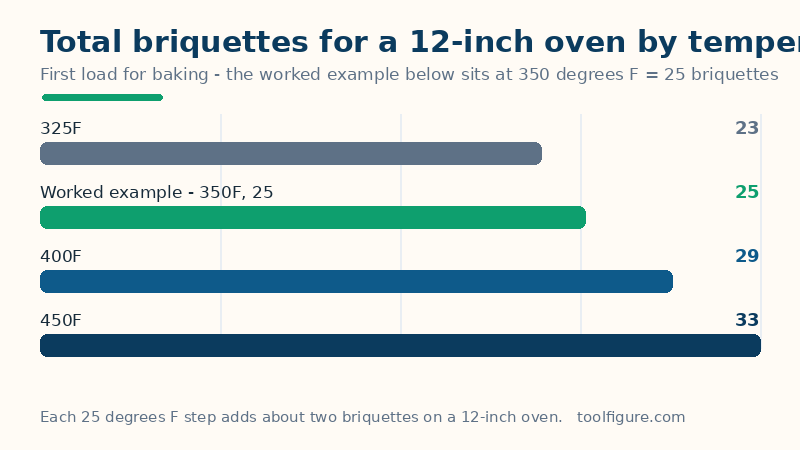
Every variable in that box is an input on this page, except the chart itself, which is printed in full below so the number you are trusting is visible, not hidden. The chart split is the baking split: check it against the rule — a 12-inch oven at 350°F takes 25 briquettes, 17 on top and 8 underneath, and 17 is 68% of 25, the two-thirds baking ratio. The method splits for roasting, stewing and frying are applied to the same chart total, so the total never changes with the method, only where the coals sit.
Worked example: 12-inch oven, 350°F, baking, 1.5 hours
A 12-inch oven at 350°F for baking takes 25 briquettes for the first load — 17 on the lid, 8 underneath — with 1 refill for a 1.5-hour cook, 50 briquettes in total. The working: the chart total for 12 inches at 350°F is 25, split 17 on top and 8 underneath for baking. Cook time 1.5 hours is 90 minutes; loads = ceil(90 ÷ 45) = 2, so refills = 1, and total = 2 × 25 = 50 briquettes. The same arithmetic on other ovens and methods:
| Oven, temperature, method, cook time | First load (top / bottom) | Refills | Total |
|---|---|---|---|
| 8-inch, 350°F, baking, 1 hour | 16 (11 / 5) | 1 | 32 |
| 10-inch, 400°F, roasting, 1 hour | 25 (13 / 12) | 1 | 50 |
| 12-inch, 350°F, baking, 1.5 hours (worked example) | 25 (17 / 8) | 1 | 50 |
| 12-inch, 375°F, stewing, 2 hours | 27 (9 / 18) | 2 | 81 |
| 14-inch, 450°F, frying, 0.75 hours | 40 (0 / 40) | 0 | 40 |
| 16-inch, 325°F, baking, 3 hours | 37 (25 / 12) | 3 | 148 |
Check the stewing row by hand: the chart total for 12 inches at 375°F is 27, and the stewing split puts one-third on top — round(27 ÷ 3) = 9 on the lid, 18 underneath. Cook time 2 hours is 120 minutes; loads = ceil(120 ÷ 45) = 3, so refills = 2, and total = 3 × 27 = 81. Check the roasting row the same way: the chart total for 10 inches at 400°F is 25, split half and half as ceil(25 ÷ 2) = 13 on top and 12 underneath, and 1 hour needs ceil(60 ÷ 45) = 2 loads, so 50 in total. The full chart, totals with top and bottom splits, for every size and temperature this page covers:
| Oven | 325°F | 350°F | 375°F | 400°F | 425°F | 450°F |
|---|---|---|---|---|---|---|
| 8-inch | 15 (10/5) | 16 (11/5) | 17 (11/6) | 18 (12/6) | 19 (13/6) | 20 (14/6) |
| 10-inch | 19 (13/6) | 21 (14/7) | 23 (16/7) | 25 (17/8) | 27 (18/9) | 29 (19/10) |
| 12-inch | 23 (16/7) | 25 (17/8) | 27 (18/9) | 29 (19/10) | 31 (21/10) | 33 (22/11) |
| 14-inch | 30 (20/10) | 32 (21/11) | 34 (22/12) | 36 (24/12) | 38 (25/13) | 40 (26/14) |
| 16-inch | 37 (25/12) | 39 (26/13) | 41 (27/14) | 43 (28/15) | 45 (29/16) | 47 (30/17) |
Every cell's top and bottom add to its total — 21 + 11 = 32 for the 14-inch oven at 350°F, 30 + 17 = 47 for the 16-inch oven at 450°F — so the chart is internally consistent before any method split is applied.
How to read your result, and its limits
Three limits decide whether the count is enough. First, the chart assumes calm, mild weather and standard briquettes: a stiff wind strips heat from the lid, cold air raises the count, and lump charcoal burns hotter and faster than briquettes, so the same number does not hold across fuels — in wind or cold, add a few briquettes and check sooner. Second, the 45-minute refill is conservative by design: briquettes hold usable heat 45 to 60 minutes, so a cook counted at 45-minute loads may finish with coals to spare, which is the safe direction for the error to fall. Third, counting is not measuring: a lid thermometer, or the hand test held above the coals, overrules the chart whenever they disagree, because briquette size, brand and age all move the real temperature — the chart is the starting count, not a guarantee. Placement matters as much as count: bottom coals go in a ring under the edges with the centre left empty, so heat radiates inward, and lid coals spread evenly around the rim with a smaller ring near the handle.
Common mistakes
- Splitting evenly for baking. Baking wants about two-thirds of the heat from above; an even split bakes the bottom and leaves the top pale.
- Counting one load for a long cook. A 3-hour cook at 45-minute loads needs 4 loads, not 1 — the refills are most of the charcoal, and forgetting them is the commonest reason a meal stalls halfway.
- Putting a bottom coal in the centre. Heat radiates inward from the ring, so a centre coal overheats the middle while the edges lag — leave the centre empty.
- Trusting the count over the thermometer. Wind, brand and briquette age all move the real temperature; when the thermometer disagrees with the chart, the thermometer wins.
Related tools: Camp Stove Fuel Calculator — Your camp stove fuel from group, days and stove type — grams and whole canisters for canister stoves, fluid ounces for white gas, cold and wind included; Camp Stove Boil Time Calculator — How long your camp stove takes to boil water — from the physics, with altitude and efficiency, plus the safe-drinking hold; Camping Food Calculator — How much food to pack from trip days, group size and daily calories — total weight, per-person weight and per-day weight, with a safety buffer for delays.
Frequently asked questions
How many briquettes does a 12-inch Dutch oven need at 350°F?
25 briquettes for the first load: 17 on the lid and 8 underneath, for baking. That is the published chart figure, and the rule of thumb agrees — twice the 12-inch diameter is 24, within a briquette of the chart's 25.
How often do I replace Dutch oven coals?
About every 45 minutes: briquettes hold usable heat roughly 45 to 60 minutes, and this page counts refills at the conservative 45-minute end. A 1.5-hour cook needs 1 refill, a 3-hour cook needs 3.
Should the top-to-bottom split change with the cooking method?
Yes. Baking takes about two-thirds of the coals on top, roasting splits them half and half, stewing puts one-third on top and two-thirds underneath, and frying puts every coal underneath. The total never changes with the method — only where the coals sit.
Does wind or cold change the briquette count?
Yes. The chart assumes calm, mild weather and standard briquettes: a stiff wind strips heat from the lid and cold air raises the count, so add a few briquettes and check sooner in either condition, and let a lid thermometer overrule the chart whenever they disagree.
