Three steps: watts, minutes, blends a week
The whole calculation is three multiplications, and the minutes are the one people get wrong. Watts divided by 1,000 is kilowatts; kilowatts times the minutes divided by 60 is the energy of one blend; the energy per blend times the blends a week times 52 weeks is the year's energy; the year's energy times the price is the year's money. The month is the year divided by 12, not the week times 4 — the two differ by a few cents, and the year-divided-by-12 figure is the one this page uses, so it agrees with the yearly total exactly:
energy per blend (kWh) = watts ÷ 1,000 × minutes ÷ 60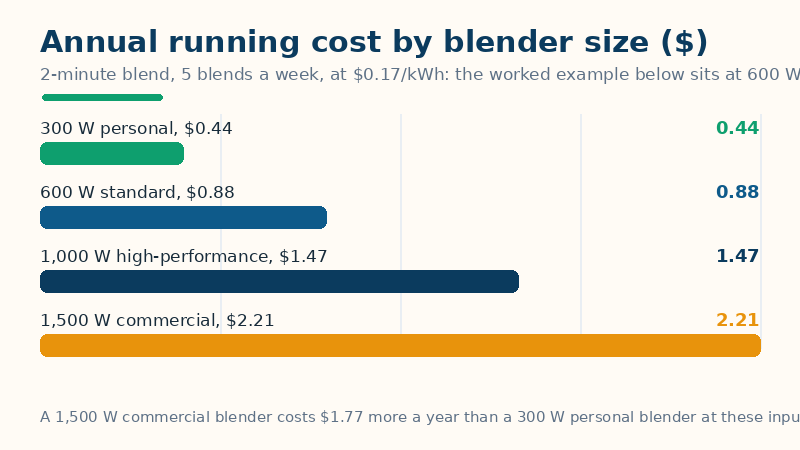
energy per week (kWh) = energy per blend × blends a weekannual cost ($) = energy per week × 52 × electricity priceThe watts on the label are the maximum draw, at full speed under the heaviest load, and the blender does not draw them for long. A personal blender draws about 300 W, a standard blender about 600 W, a high-performance blender about 1,000 W and a commercial blender up to 1,500 W — and a smoothie takes one to three minutes, a frozen blend up to five. What matters is the blends a week: one blend is 0.020 kWh, but seven blends is 0.140 kWh, and the blender that runs every day will always cost more than the one that runs twice a week.
Worked example: 600 W, 2 minutes a blend, 5 blends a week, $0.17/kWh
A 600 W blender blending for 2 minutes uses 0.6 × 2 ÷ 60 = 0.020 kWh, costing 0.3¢. A week is 0.020 × 5 = 0.100 kWh, costing $0.02. A month is 5.2 ÷ 12 = 0.4 kWh, costing $0.07. A year is 0.100 × 52 = 5.2 kWh, costing $0.88. The table above shows the same maths for the other blender sizes at a 2-minute blend and 5 blends a week: a 300 W personal blender costs 0.2¢ a blend and $0.44 a year, a 1,000 W high-performance blender costs 0.6¢ a blend and $1.47 a year, and a 1,500 W commercial blender costs 0.9¢ a blend and $2.21 a year. One hour at full power costs 10.2¢ at these settings, and ten years of blending at this pace costs $8.84. A 1-minute blend costs $0.44 a year and a 5-minute blend $2.21; blending every day costs $1.24 a year, once a week $0.18. Four published cross-checks reproduce exactly: wattcostcalc's 400 W blender at 0.1 hours a day and 17.5 cents costs $0.07 an hour, $0.007 a day, $0.21 a month and — at one hour a day — $2.10 a month and $25.55 a year — this page gives the same $0.07 an hour, $0.007 a day and $0.21 a month, while its $2.10 a month and $25.55 a year at one hour a day are the day times 30 and 365, against $2.12 and $25.48 on the week-times-52 year this page uses; kitchendemy's 600 W blender at 15 minutes a day and 15 cents uses 0.15 kWh a day and costs $0.0225 a day — this page gives the same 0.15 kWh a day and $0.02 a day, while its $0.675 a month is the day times 30 against this page's $0.68; ecoflow's 600 W blender at 10 minutes a day and 35 Australian cents uses 0.1 kWh a day and costs 3.5 Australian cents a day — this page gives the same 0.1 kWh a day and 3.5¢ a day, while its $1.05 a month is the day times 30 against this page's $1.06, and its $12.60 a year is the month times 12 against this page's $12.74; and kitchendemy's 1,400 W Vitamix at 3 minutes a day and 15 cents uses 0.07 kWh a day and costs about 1 cent a day — this page gives the same 0.07 kWh a day and $0.01 a day — while its table's 1,500 W frozen smoothie at 2 minutes is 0.05 kWh, the same figure this page gives.
How to read your result, and its limits
Four cautions keep the number honest. First, the label watts are the maximum, not the running draw: a Vitamix rated at 1,380 to 1,500 W draws that at full speed under the heaviest load, and a light smoothie at medium speed draws less — so the figure on this page is the ceiling for the watts you entered, and the real blend may cost a little less. Second, the minutes are the whole story: a 1-minute blend costs $0.44 a year and a 5-minute blend $2.21 at the worked example's inputs — the frozen blend that takes five times as long costs five times as much, whatever the watts on the box. Third, the blends a week are the count, not the days: 5 blends a week is 260 blends a year, so the year is the week times 52 — 5.2 kWh and $0.88 — while multiplying one blend by 365 days would give $1.24, as if you blended every single day. Fourth, the electricity price is the all-in rate: the total on the bill divided by the kilowatt-hours on the bill, including delivery charges. For the chopping that comes before the blending, the food processor cost calculator prices the chop by watts, minutes and uses a week — one 5-minute use at 600 W is 0.05 kWh and 0.9¢, about three blends — for the water boiled alongside the smoothie, the electric kettle cost calculator prices the boil by watts and minutes; and for the cost of running anything else in the house, the electricity cost calculator prices any appliance by watts and hours.
Common mistakes
- Pricing the label watts for a whole hour. A 600 W blender for an hour is 0.6 kWh and 10.2¢, but a 2-minute blend is 0.020 kWh and 0.3¢ — the hour figure is thirty blends, not one. Price the minutes, not the hour.
- Multiplying one blend by 365 days. Five blends a week is 260 blends a year, not 365: $0.0034 × 365 gives $1.24, while the real year is $0.88. Count the blends a week, then multiply by 52.
- Comparing blenders on watts. A 1,500 W commercial blender and a 600 W standard blender look far apart on watts, but the blend is 2 minutes either way: 0.05 kWh against 0.020 kWh, 0.9¢ against 0.3¢ — and the bigger blender may finish the same smoothie in half the time, so the cost per blend can be closer still. Compare kilowatt-hours per blend, not watts.
- Guessing the minutes. A 1-minute shake and a 5-minute frozen blend differ fivefold in energy — $0.44 a year against $2.21 — so time one blend with your phone instead of guessing, and enter the minutes you actually blend.
- Adding the standing charge to every blend. The daily supply charge is payable whether the blender runs or not. Only the per-kWh rate belongs in the per-blend maths — the fixed charge is a separate line on the bill.
Frequently asked questions
How much does a blender cost per use?
A 600 W blender costs 0.3¢ a blend for a 2-minute smoothie at $0.17 per kWh — 0.020 kWh a blend, $0.88 a year at 5 blends a week. A 1-minute shake costs $0.44 a year and a 5-minute frozen blend $2.21.
How many watts does a blender use?
Most home blenders draw 150 to 1,800 W: a personal blender about 200 to 400 W, a standard blender about 300 to 1,000 W and a high-performance blender about 1,000 to 1,800 W. The watts on the label are the maximum draw at full speed under load — a light smoothie draws less.
Does a blender use a lot of electricity?
No: 5 blends a week is 5.2 kWh a year and $0.88 at $0.17 per kWh — less than a 60 W bulb left on 5 hours a day, which costs $18.62 a year. A blender is one of the cheapest appliances in the house to run.
Is it cheaper to blend smoothies at home than buy them?
The electricity is the smallest part: one blend costs 0.3¢ of electricity at the worked example's inputs, against several dollars for a shop smoothie. The fruit and yoghurt decide the cost of a home smoothie, not the power.