The bundle rule, and why the rate is the input
Camping firewood guides agree on the shape of the answer even when they disagree on the exact number: about 1 to 2 bundles per night for a typical evening fire, 3 when you cook over it or the weather turns cold and wet. The spread is real, not sloppy, because a bundle is not a standard unit of heat — it is a shop unit, about 0.75 cubic feet of split wood, roughly 6 to 8 pieces, about 8 pounds, burning for roughly 1.5 to 2 hours once the fire is going. A short fire after dinner therefore costs about 1 bundle, an evening spent sitting out until bed costs about 2, and a fire that also cooks dinner costs about 3. That is why this page asks for your burn rate instead of guessing it from the trip length: two trips of the same length can differ by half as much wood again, and the difference is entirely in how the evenings are spent.
Base bundles = nights × bundles per night — Cold/wet bundles = base × 1.25 — Bundles to buy = base (or cold/wet bundles) rounded UP to a whole bundle — Volume (cu ft) = bundles × 0.75 — Fraction of a cord = volume ÷ 128 — Cost = bundles × price per bundle — Bundles in a full cord = 128 ÷ 0.75 ≈ 171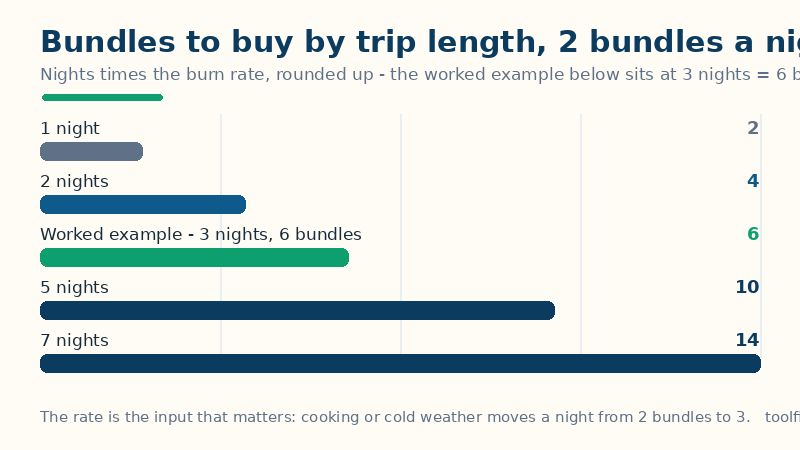
The rounding up is not tidiness, it is the purchase: wood is sold in whole bundles, so 4.5 bundles is a 5-bundle purchase and the cost follows the rounded figure, not the 4.5. The cord figure is there for the one case where bundles stop being the right unit — a longer trip, or a group buying in bulk — because a full cord is 128 cubic feet, which is about 171 shop bundles, and campground bundles at $7 each work out many times the price of bulk wood. If the trip is long enough that the cord fraction starts to look like a real number, buy bulk instead of bundles.
Worked example: 3 nights, 2 bundles a night
Three nights at 2 bundles a night need 6 bundles, costing $42.00 at $7 a bundle, taking up 4.50 cubic feet — 0.035 of a cord, about 36 to 48 split pieces. The working: base = 3 × 2 = 6 bundles exactly, so no rounding is needed. Volume = 6 × 0.75 = 4.50 cu ft. Cord fraction = 4.50 ÷ 128 = 0.035. Cost = 6 × $7 = $42.00. Tick the cold-and-wet box and the same trip changes honestly: 6 × 1.25 = 7.5, rounded up to 8 bundles, costing $56.00 and taking 6.00 cubic feet — the uplift costs two bundles, which is exactly the bundle you would otherwise have been short on the last night. The same arithmetic on other trips, all at $7 a bundle and without the uplift unless stated:
| Trip | Base bundles | Bundles to buy | Volume | Cost |
|---|---|---|---|---|
| 1 night, 2 a night | 2 | 2 | 1.50 cu ft | $14.00 |
| 2 nights, 2 a night | 4 | 4 | 3.00 cu ft | $28.00 |
| 3 nights, 2 a night (worked example) | 6 | 6 | 4.50 cu ft | $42.00 |
| 3 nights, 3 a night (cooking) | 9 | 9 | 6.75 cu ft | $63.00 |
| 7 nights, 2 a night | 14 | 14 | 10.50 cu ft (0.082 cord) | $98.00 |
| 3 nights, 2 a night, cold/wet | 7.5 | 8 | 6.00 cu ft | $56.00 |
Check the week row by hand: 7 × 2 = 14 bundles, 14 × 0.75 = 10.50 cu ft, 10.50 ÷ 128 = 0.082 of a cord, and 14 × $7 = $98.00. And check the cold row: 3 × 2 = 6, 6 × 1.25 = 7.5, and 7.5 rounds up to 8 — the half bundle is the whole point of rounding up, because you cannot buy it and you cannot burn it.
How to read your result, and its limits
Three checks before trusting the figure. First, the rate is yours to set, not a law: hardwood burns roughly 40 to 50 percent longer than softwood like pine, wet or unseasoned wood burns through far faster than dry, and a fire ring in wind can double the rate against a sheltered pit — if any of those describe your trip, move the rate before you trust the total. Second, kindling and a firelighter are not in the count: a bundle of split logs will not start on its own, so bring starter separately. Third, do not haul wood from home: moving firewood spreads pests such as the emerald ash borer, so most parks require wood bought within about 50 miles or certified heat treated — buy at the campground or a nearby seller, which is also why the price input is per bundle at the campground, not per cord at home.
Common mistakes
- Buying for the evenings you imagine. A trip sized for short fires that turns into long fires runs out on the last night — size for the evenings you actually have, or tick the uplift.
- Counting fractions as purchases. 4.5 bundles is a 5-bundle purchase; the cost follows the rounded figure, not the fraction.
- Forgetting that cooking is a different fire. A fire that cooks dinner burns hotter and longer than a fire to sit beside — that is a 3-bundle night, not a 2-bundle night.
- Hauling wood from home to save money. It spreads pests, it breaks park rules, and the saving is small against the fine and the damage — buy local.
Related tools: Camp Stove Fuel Calculator — Your camp stove fuel from group, days and stove type — grams and whole canisters for canister stoves, fluid ounces for white gas, cold and wind included; Cooler Size Calculator — Your cooler size from group, days, drinks and food — the litres and quarts it must hold, the standard size to buy, and the ice inside it; Camping Food Calculator — How much food to pack from trip days, group size and daily calories — total weight, per-person weight and per-day weight, with a safety buffer for delays.
Frequently asked questions
How many bundles of firewood do I need per night camping?
About 1 for a short fire after dinner, 2 for a typical evening spent sitting out until bed, and 3 if you cook over the fire or the weather is cold and wet. A bundle burns roughly 1.5 to 2 hours, so match the rate to the length of your evening, not to a guide's average.
How many bundles of firewood are in a cord?
About 171. A cord is 128 cubic feet and a shop bundle is about 0.75 cubic feet, so 128 ÷ 0.75 = 170.7. That is why campground bundles at $7 each cost many times bulk wood — a week-long trip at 14 bundles is only 0.082 of a cord.
Can I bring firewood from home to the campsite?
You should not. Moving firewood spreads pests such as the emerald ash borer, and most parks require wood bought within about 50 miles or certified heat treated. Buy at the campground or a nearby seller, and use the campground price in the calculator.
Does hardwood or softwood change how much I need?
Yes — hardwood burns roughly 40 to 50 percent longer than softwood like pine, so the same evening costs fewer bundles. Wet or unseasoned wood goes the other way and burns through far faster. Set the bundles-per-night rate to your wood, not to the default, when either applies.
