Two numbers decide the cost: the payment and the extra
A student loan is a standard amortising loan: the same fixed payment every month, each payment covering that month's interest first and the rest cutting the principal. The monthly rate is the annual rate divided by 12, and the payment that clears a balance exactly at the end of a term is the amortisation formula:
monthly rate r = annual rate ÷ 100 ÷ 12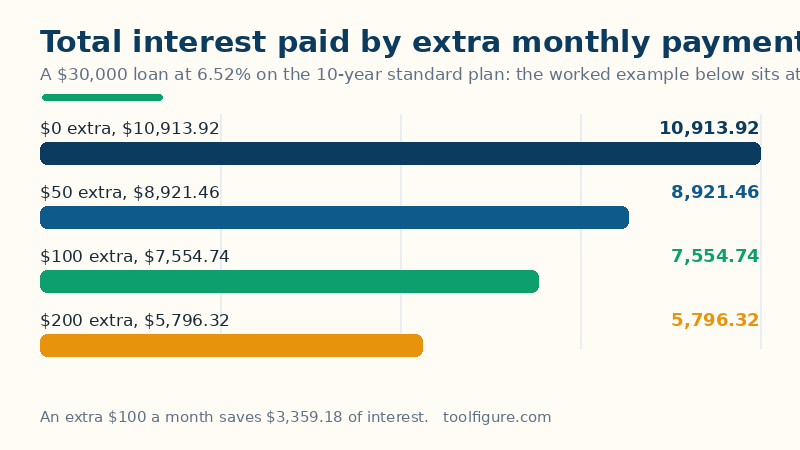
standard payment ($) = balance × r ÷ (1 − (1 + r)^−months)each month: interest = balance × r, then balance = balance + interest − paymentThere is no closed formula for the payoff with an extra payment that is as honest as the simulation, so this page walks the months one at a time — adding that month's interest, subtracting the payment, and stopping when the balance reaches zero — once at the standard payment alone and once with the extra added. The extra is applied straight to principal, which is why it cuts both the term and the interest: every extra dollar erases the interest that dollar would have cost for the rest of the loan.
Worked example: $30,000 at 6.52% on the 10-year plan
A $30,000 balance at 6.52% on the standard 10-year plan has a monthly rate of 0.0652 ÷ 12 = 0.005433 and 120 payments, so the payment is $30,000 × 0.005433 ÷ (1 − 1.005433^−120) = $340.95 a month. At that payment alone the loan clears in 120 months, with $10,913.92 of interest and $40,913.92 repaid in total — interest is 26.7% of everything repaid, and the first payment is $163.00 of interest and $177.95 of principal. Add $100 extra a month ($440.95 a month) and the same simulation clears the loan in 86 months, with $7,554.74 of interest and $37,554.74 repaid — 34 months sooner and $3,359.18 less interest, and interest falls to 20.1% of everything repaid. The extra table shows the same loan at $50 extra (100 months, $8,921.46 of interest, $1,992.46 saved) and $200 extra (67 months, $5,796.32 of interest, $5,117.60 saved). Two published cross-checks reproduce exactly: OnlyCalculators' student loan calculator gives the same $30,000 at 6.52% over 10 years as $340.95 a month, $10,913.92 of interest and $40,913.92 in total; and OneLessChoice's $37,000 at 6.5% example — a $420 payment, which is the standard 10-year payment of $420.13 rounded down by 13 cents — takes 121 months and $13,421.59 of interest at $420 a month, and 81 months and $8,715.91 with $150 extra, saving $4,705.68 and 40 months, which is their "about 3 years early and roughly $4,700 saved".
How to read your result, and its limits
Four cautions keep the number honest. First, the term sets the cost more than the rate does: the same $30,000 at 6.52% costs $10,913.92 of interest over 10 years and $30,881.17 over 25 years — the 25-year payment is only $138.01 a month lower, but the interest nearly triples, which is why the term table is on the page. Second, federal loans accrue interest daily, and payments are applied to fees and interest before principal, so a servicer's payoff figure can differ from this page by a few dollars — the months and the saving are the figures to trust, not the last cent. Third, the rate in the worked example is an example: 6.52% is the rate in OnlyCalculators' published example, and federal undergraduate Direct Loan rates are set per award year — use the rate on your own loan, and a private loan follows its own contract. Fourth, extra payments are only right when payoff in full is the plan: under Public Service Loan Forgiveness or forgiveness at the end of an income-driven plan, the remaining balance is wiped out anyway, so extra payments shrink the amount forgiven and are wasted — this page is for borrowers who plan to pay the loan off in full. Since 1 July 2026, new federal borrowers have two repayment options — the Standard Repayment Plan and the income-driven Repayment Assistance Plan — while borrowers who took loans out before that date keep access to the existing plans; this page models the fixed-payment standard plan, not an income-driven one.
Common mistakes
- Judging a loan by its monthly payment. The 25-year plan's $202.94 looks $138.01 a month cheaper than the 10-year plan's $340.95, but it costs $19,967.25 more interest. Compare total interest, not the monthly figure.
- Paying extra while chasing forgiveness. On an income-driven plan heading for forgiveness, every extra dollar reduces the amount that would have been forgiven. Pay extra only when the plan is to clear the loan in full.
- Assuming the extra is small because it is monthly. $100 a month is $1,200 a year — and on the worked example's loan it saves $3,359.18, nearly three times what was paid extra, because each dollar kills the interest it would have cost for years.
- Forgetting the payment must beat the interest. At $30,000 and 6.52% the first month's interest alone is $163.00. A payment below that never reduces the balance — the loan grows instead of shrinking.
- Using the borrowed amount instead of the balance owed. Interest capitalised while you were in school is already in the balance. Enter what you owe now, not what you originally borrowed.
Related tools: Debt Payoff Calculator — Compare snowball vs avalanche payoff on up to three debts, with interest totals; College Savings Calculator — How much should you save for college? Project your 529 balance against the inflated four-year cost — the gap, and what closes it; Loan Calculator — Monthly payment, total interest, amortization schedule and extra-payment effect.
Frequently asked questions
What is the monthly payment on a $30,000 student loan?
On the standard 10-year plan at 6.52% the payment is $340.95 a month — $10,913.92 of interest and $40,913.92 repaid in total over 120 months. Stretch the same loan to 25 years and the payment falls to $202.94, but the interest rises to $30,881.17. OnlyCalculators' published example gives the same $340.95, $10,913.92 and $40,913.92.
How much does paying $100 extra a month save on a student loan?
On the worked example's $30,000 loan at 6.52%, $100 extra a month ($440.95 instead of $340.95) clears the loan in 86 months instead of 120 — 34 months sooner — and saves $3,359.18 of interest ($7,554.74 instead of $10,913.92). At $200 extra it is 67 months and $5,796.32 of interest, a $5,117.60 saving.
What happens if my payment does not cover the interest?
The balance grows instead of shrinking. At $30,000 and 6.52% the first month's interest alone is $163.00, so any payment at or below that never reduces what you owe — the page says so instead of returning a payoff date. Raise the payment above the monthly interest, or the loan never clears.
Should I pay extra if I am going for loan forgiveness?
No. If you are pursuing Public Service Loan Forgiveness or forgiveness at the end of an income-driven repayment plan, the remaining balance is wiped out anyway, so extra payments shrink the amount forgiven and are wasted. This calculator is for borrowers who plan to pay their loans off in full. Since 1 July 2026 new federal borrowers choose between the Standard Repayment Plan and the income-driven Repayment Assistance Plan; earlier borrowers keep the existing plans.