One acceleration, three dialects
Acceleration says how fast velocity changes — metres per second, per second, in the SI unit — and every field that measures it has its own dialect for the same quantity. Physics problems speak in m/s², pilots and ride engineers speak in g, car reviews speak in 0–100 km/h times, and geophysicists speak in gals, because the Earth's gravity varies by only a fraction of a percent across its surface and they need a unit small enough to see it. This page restates any acceleration in all eight units at once, worked through the metre per second squared with every factor defined, so a figure in any dialect can be read in any other. It also answers the question the conversion alone cannot: held for a time you enter, how much speed does this acceleration actually add?
The formula
answer = metres per second squared ÷ (metres per second squared in one "to" unit)
Two terms, both visible on the page. value is the number you enter. metres per second squared in one "from" unit is the definition of the unit you are converting from: 1 for the metre per second squared itself, 1/3.6 for the kilometre per hour per second, 0.3048 for the foot per second squared, 0.0254 for the inch per second squared, 0.514444 for the knot per second, 0.44704 for the mile per hour per second, 9.80665 for standard gravity, and 0.01 for the gal. answer is the result in the unit you asked for. The foot and inch factors are exact because the foot itself is defined as 0.3048 m; the knot and mile-per-hour factors follow from the exact definitions of the nautical mile and the mile; and standard gravity is exact by definition — 9.80665 m/s² was fixed by international agreement in 1901 as a reference value, not measured at any particular place, which is why it never changes even though real local gravity does.
Worked example
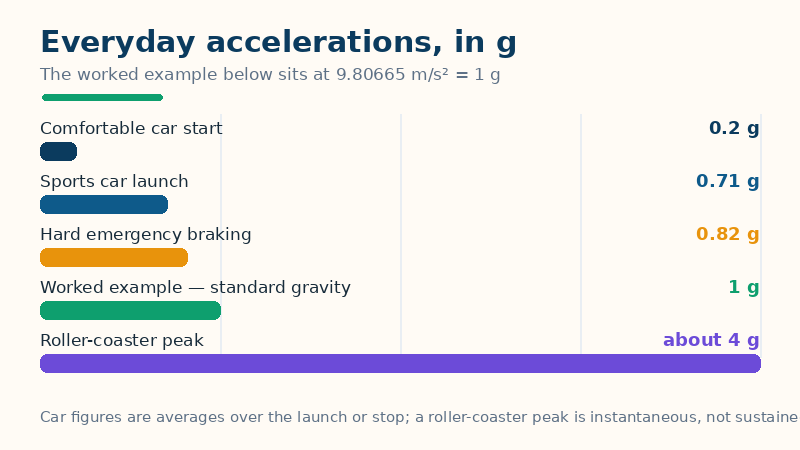
Convert 9.80665 metres per second squared to standard gravity — the acceleration of a falling object at the Earth's surface, and the reference every g-force figure is measured against — the way the tool does it.
Step 1 — get to metres per second squared. The input is already in m/s², so the base value is 9.80665.
Step 2 — divide by the target factor. One g is 9.80665 m/s², so 9.80665 ÷ 9.80665 = 1.
Step 3 — read the display. The page prints six decimals below 0.001, four below 10 and two above, so the headline reads 1 g, and the detail line shows the working: 9.8067 m/s² = 1 g — worked through metres per second squared: 9.8067 m/s² ÷ the Standard gravity factor.
Check it. Multiplying back, 1 × 9.80665 = 9.80665 m/s² exactly, and the table underneath restates the same acceleration in all eight units (9.8067 m/s², 35.3 km/h/s, 32.17 ft/s², 386.09 in/s², 19.06 kn/s, 21.94 mi/h/s, 1 g, 980.67 Gal), so the from/to choice only changes which row is the headline. And the speed-gain line finishes the job for this acceleration: held for the default 5 seconds, it adds 49.03 m/s — 176.52 km/h — to velocity, which is why a falling object is already travelling at highway speed five seconds after it is dropped.
Conversions worth memorising
Every row below is the tool's own output, checked figure by figure:
| From | To | Result |
|---|---|---|
| 1 m/s² | feet per second squared | 3.2808 ft/s² |
| 1 m/s² | g-force | 0.102 g |
| 1 m/s² | gals | 100 Gal |
| 1 g | metres per second squared | 9.8067 m/s² |
| 2 g | metres per second squared | 19.61 m/s² |
| 1 ft/s² | metres per second squared | 0.3048 m/s² |
| 1 ft/s² | g-force | 0.0311 g |
| 1 km/h/s | metres per second squared | 0.2778 m/s² |
| 25 km/h/s | metres per second squared | 6.9444 m/s² |
| 25 km/h/s | g-force | 0.7081 g |
| 0–100 km/h in 5 s | acceleration | 5.5556 m/s² (0.5665 g) |
| 0–60 mph in 6 s | acceleration | 4.4704 m/s² (0.4559 g) |
| −8 m/s² (hard braking) | g-force | −0.8158 g |
| 1 Gal | g-force | 0.001 g |
Three rows deserve a second look. The first two are the pair every student needs: divide m/s² by 9.80665 to get g, multiply to go back — and the often-quoted 0.102 is simply 1 ÷ 9.80665, not a second fact to memorise. The car rows are the reality check on review figures: a car that reaches 100 km/h in 5 seconds averages 5.5556 m/s², just over half a g, and a car that reaches 60 mph in 6 seconds averages 4.4704 m/s² — both far below the 1 g of free fall, which is why even a fast launch never feels like falling. And the braking row is the sign lesson: −8 m/s² converts to −0.8158 g with its minus sign kept, because a negative acceleration is a direction, not an error — the car is slowing, and the sign says which way the velocity is changing.
Three traps worth knowing
Standard gravity is not local gravity. The 9.80665 m/s² in this converter is a defined reference, fixed in 1901 so that g-force figures mean the same thing everywhere. Real gravity at your location varies from about 9.764 m/s² at the equator at altitude to about 9.834 m/s² at the poles — a spread of roughly 0.7%. A g-force figure is therefore a comparison against the standard, not a measurement of the gravity where you stand; a gravimeter, not this converter, measures the local value, and it reports it in milligals, thousandths of the gal in this page's table.
An average acceleration is not the acceleration at any moment. The car rows above divide a speed change by a time, which gives the average over that interval. A real launch starts harder and fades as speed rises; a real braking event bites hardest at the start. The speed-gain line on this page assumes the acceleration holds steady for the whole time you enter — if it does not, the true speed gained is the area under the real acceleration curve, not this multiplication. For a launch or a stop, the average is the honest headline and the instantaneous figure is a different measurement.
Kilometres per hour per second is a rate of a rate, and it is easy to misread. A car gaining 25 km/h every second is accelerating at 6.9444 m/s², not at 25 m/s² — the "per second" applies twice, once to the kilometres per hour and once to the gain. The same trap hides in miles per hour per second: 60 mph gained in 6 seconds is 10 mi/h/s, which is 4.4704 m/s², not 10 of anything in SI units. Whenever a figure carries two "per" clauses, convert it through this page before comparing it with an m/s² figure.
How to read your result, and the limits
Results show six decimals below 0.001, four below 10 and two above — more precision than any accelerometer or stopwatch justifies, so round to the instrument for real use. Four limits belong with the page. Negative values are allowed here, deliberately: unlike the size converters on this site, an acceleration's sign is its direction, so −8 m/s² converts to −0.8158 g and the table keeps the sign in every row. Empty input clears quietly; type and the table rebuilds, delete and the page waits. Anything past a trillion in magnitude in any unit gets a clear error instead of a meaningless digit string. And this page converts units, not motion: it will restate any acceleration in any unit and work out the speed it adds over your time, but it will not tell you whether a vehicle, a person or a structure survives that acceleration — human tolerance, tyre grip and structural limits all live elsewhere, and a correct conversion of an unsurvivable figure is still unsurvivable.
Related tools: Speed Converter — Convert mph, km/h, m/s, ft/s, knots and Mach — every answer in all six units; Force Converter — Newtons to pound-force, kgf, kips and more — every answer in all ten units, through the exact definitions; Time Converter — Seconds to hours, minutes to days, weeks to months — every duration in all eight units at once, through the exact factors.
Frequently asked questions
How do I convert m/s² to g-force?
Divide by 9.80665. So 9.80665 m/s² is exactly 1 g, 19.6133 m/s² is 2 g, and 1 m/s² is 0.102 g. To go back, multiply by 9.80665: 3.5 g is 34.32 m/s². Standard gravity is a defined constant, fixed by international agreement in 1901, not a measurement of gravity at your location.
How many ft/s² are in 1 m/s²?
Exactly 3.2808, because 1 ft = 0.3048 m by definition, so 1 ÷ 0.3048 = 3.28084. Standard gravity is therefore 32.17 ft/s², and 1 ft/s² is 0.3048 m/s² and 0.0311 g.
What is a gal?
One gal, named for Galileo, is 1 cm/s², which is 0.01 m/s². Standard gravity is 980.67 Gal. Geophysicists use it because the Earth's gravity varies by only a fraction of a percent across its surface, so its variations are measured in milligals — thousandths of a gal, or 0.00001 m/s².
Can acceleration be negative?
Yes — the sign is the direction of the velocity change. Hard braking at −8 m/s² is −0.8158 g: the car is slowing, and the minus sign says the acceleration points opposite the direction of travel. This page keeps the sign in every row, unlike a size converter, where a negative value would mean nothing physical.