The physics, in one line each
Heating water takes a fixed amount of energy per degree, and a stove delivers energy at a fixed rate — everything else is bookkeeping. The specific heat of water is 4,186 joules per kilogram per degree Celsius, so the energy to heat a pot is its mass times 4,186 times the temperature rise. The temperature rise ends at the local boiling point, not at 100 °C: air pressure falls with altitude, so water boils at about 99 °C at 300 m, about 97 °C at 1,000 m, 93.3 °C at 2,000 m and 90.0 °C at 3,000 m. And the stove's rated watts are not the watts that reach the water — wind, an unshielded flame and a wide pot throw much of it away, which is why efficiency, not wattage, is the number that separates a three-minute boil from a seven-minute one.
Boiling point (°C) = 100 − altitude (m) ÷ 300 — Energy (joules) = mass (kg) × 4,186 × (boiling point − start temperature) — Effective power (watts) = stove power × efficiency ÷ 100 — Boil time (seconds) = energy ÷ effective power — 1 litre of water = 1 kg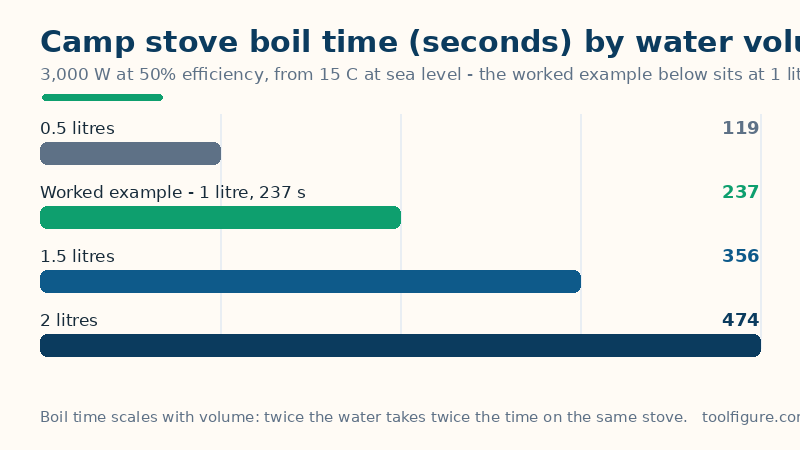
Every variable in that box is an input on this page: mass comes from the litres you enter, the boiling point from the altitude, the effective power from the stove rating and the efficiency you pick. Nothing is hidden in a preset — change any one of them and the answer moves by exactly the amount the formula says it should.
Worked example: 1 litre, 15 °C, sea level, 3,000 W, 50% efficiency
At sea level the boiling point is 100.0 °C, so the water must rise 85.0 °C. Energy = 1 kg × 4,186 × 85.0 = 355,810 joules = 355.8 kJ (98.8 Wh). Effective power = 3,000 W × 50% = 1,500 W. Boil time = 355,810 ÷ 1,500 = 237.2 seconds = 3 minutes 57 seconds. The safe-drinking hold at sea level is 1 minute of rolling boil, so the water is ready to drink after 4:57. The same stove at other settings:
| Change from the worked example | Boil time | Ready to drink |
|---|---|---|
| 0.5 litres instead of 1 | 1:59 | 2:59 |
| 1.5 litres instead of 1 | 5:56 | 6:56 |
| 2 litres instead of 1 | 7:54 | 8:54 |
| Start at 5 °C instead of 15 °C (cold stream water) | 4:25 | 5:25 |
| Efficiency 40% instead of 50% (open pot, some wind) | 4:57 | 5:57 |
| Efficiency 60% instead of 50% (lid on, windscreen up) | 3:18 | 4:18 |
| Camped at 3,000 m (boiling point 90.0 °C) | 3:29 | 6:29 |
Check the 3,000 m row by hand: the rise is only 75.0 °C, so the energy is 1 × 4,186 × 75.0 = 313,950 joules, and 313,950 ÷ 1,500 = 209.3 seconds = 3:29 — faster to the boil, as promised. But the hold above about 2,000 m is 3 minutes, not 1, so the ready time is 6:29, a minute and a half slower than the sea-level trip overall. That is the altitude twist in one row: the boil gets faster and the drink gets slower, and a page that only reports the boil time would have the practical answer backwards.
How to read your result, and its limits
Three things this model does not know. First, efficiency is an estimate, not a measurement: a lid and a windscreen are worth more than a bigger stove, and a canister stove in real cold loses pressure and output as the canister chills — if your boil runs long on a cold morning, the canister, not the formula, is usually the reason. Second, power is assumed steady: a stove turned down to simmer, or a flame blown sideways, delivers less than its rating for the whole boil. Third, the hold times are the public-health guidance — one minute of rolling boil below about 2,000 m (6,500 ft), three minutes above — and they assume the water was clear enough to treat by boiling at all; silty water should be settled or filtered first. The boil time itself is exact physics given the inputs; the uncertainty lives entirely in the efficiency you pick, so if the answer matters, time one boil at home and set the efficiency to match it — that calibrates the page to your actual stove and pot.
Common mistakes
- Judging the boil by steam, not by rolling bubbles. A pot steams well before it boils; the hold only counts once the whole surface is rolling.
- Lifting the lid to check. Every lift dumps the trapped heat and steam the lid was saving — it is the easiest way to add a minute to a boil.
- Comparing stoves by watts alone. A 3,000 W stove at 35% efficiency delivers 1,050 W to the water; an 1,800 W stove at 60% delivers 1,080 W. The smaller stove wins.
- Assuming altitude slows the boil. It speeds the boil and slows the cooking: water boils cooler up high, so pasta and rice take longer even though the pot boils sooner.
Related tools: Camp Stove Fuel Calculator — Your camp stove fuel from group, days and stove type — grams and whole canisters for canister stoves, fluid ounces for white gas, cold and wind included; Camping Water Purification Calculator — The iodine dose for your camp water — drops or tablets per litre, and the wait before drinking, doubled for cloudy or cold water; Hiking Water Calculator — Your hiking water from hours, heat and effort — litres to carry, 1-litre bottles and the pack weight, with a delay hour and camp water included.
Frequently asked questions
How long does it take to boil 1 litre of water on a camp stove?
About 3 minutes 57 seconds on a 3,000 W stove at 50% efficiency from 15 °C at sea level — 355.8 kJ of energy at 1,500 effective watts — plus a 1-minute rolling-boil hold, so about 4:57 until it is ready to drink. Wind, a missing lid and cold water all push it longer.
Does water boil faster at high altitude?
Yes, to the boil — the boiling point falls about 1 °C per 300 m, so at 3,000 m water boils at 90 °C and the same litre boils in 3:29 instead of 3:57. But the safe-drinking hold doubles to 3 minutes up there, so the water is ready later overall, at 6:29, and food cooks slower in the cooler water.
Why does my camp stove take longer to boil than its wattage suggests?
Because only part of the rated watts reach the water: wind, an open pot and a wide flame waste heat, so a stove rated 3,000 W at 50% efficiency delivers 1,500 W. A lid and a windscreen typically lift efficiency from about 35–40% to about 60%, which is worth more than buying a bigger stove.
How long should I boil water to make it safe to drink while camping?
Hold a full rolling boil for 1 minute below about 2,000 m (6,500 ft) and 3 minutes above that — that is the standard public-health guidance, and it covers the organisms boiling kills. Steam alone does not count: wait for big bubbles breaking across the whole surface before starting the clock.
