Three rules, one honest comparison
The whole calculation is three divisions and one subtraction, and the only thing that needs care is which of the three answers you obey. The traditional rule divides the annual income by twelve and multiplies by the months; the one-fifth rule divides the annual income by five; the affordability ceiling subtracts the upcoming obligations and the emergency buffer from the savings. The recommended budget is the smallest of the three:
traditional ($) = (annual income ÷ 12) × months of salary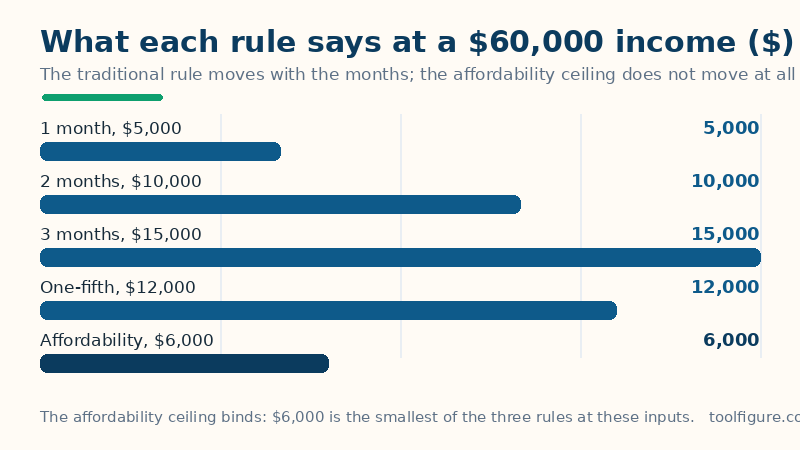
one-fifth ($) = annual income ÷ 5affordability ceiling ($) = savings − upcoming obligations − emergency bufferrecommended budget ($) = smallest of the three · stone = 80% of the budget, setting = 20%The table above prices the rules at the worked example's inputs: the traditional rule at 1 month is $5,000.00, at 2 months $10,000.00 and at 3 months $15,000.00; the one-fifth rule is $12,000.00; the affordability ceiling is $6,000.00 — and the recommended budget is $6,000.00, the affordability ceiling, because it is the smallest of the three.
Worked example: a $60,000 income and $15,000 of savings give a $6,000 budget
The monthly salary is $60,000 ÷ 12 = $5,000. The traditional 2-month rule is $5,000 × 2 = $10,000. The one-fifth rule is $60,000 ÷ 5 = $12,000. The affordability ceiling is $15,000 − $4,000 − $5,000 = $6,000. The recommended budget is the smallest of the three — $6,000 — split 80/20 into a $4,800 stone and a $1,200 setting, which add to $6,000. The one-fifth rule is not the gentler rule: at $60,000 it says $12,000, more than the classic 2-month rule's $10,000. On credit at 24% APR over 24 months, a $6,000 ring costs $317.23 a month, $7,613.52 in total — $1,613.52 of interest, 26.9% on top of the ring's price. The same three rules at other incomes show why the ceiling matters: at $40,000 the traditional rule says $6,666.67 and the one-fifth rule $8,000.00, at $80,000 they say $13,333.33 and $16,000.00, and at $100,000 they say $16,666.67 and $20,000.00 — but the recommended budget stays $6,000.00 at every income, because at $15,000 of savings the affordability ceiling binds at every income in the table and the salary rules rise while the ceiling does not move. A second example shows the other binding case: with $30,000 of savings, $5,000 of obligations and a $5,000 buffer, the affordability ceiling is $30,000 − $5,000 − $5,000 = $20,000, the traditional rule still says $10,000 and the one-fifth rule $12,000 — so the recommended budget is $10,000, the traditional rule, split into an $8,000 stone and a $2,000 setting, and on credit at 24% APR over 24 months that ring costs $528.71 a month, $12,689.04 in total, $2,689.04 of interest. Two published cross-checks reproduce. CalculatorZilo's Engagement Ring Budget Calculator runs the same $60,000 example — $15,000 of savings, $4,000 of obligations, a $5,000 buffer — and reaches the same three figures: $10,000.00 traditional, $12,000.00 one-fifth, $6,000.00 affordability. NovaCalculator's worked example is a $75,000 income: its comfort figure of 5% is $3,750.00, its traditional range of $6,250 to $12,500 is 1 to 2 months of $75,000 — $75,000 ÷ 12 = $6,250.00 a month — and this page's formulas give the same three figures. The recommended $6,000 sits at the top of the real median band: the Jewelry Store Directory puts the median US engagement ring spend at $5,200 to $6,000, with an average of about $5,500 — so the affordability ceiling at the worked example's inputs lands exactly where the typical couple actually spends.
How to read your result, and its limits
Four cautions keep the number honest. First, the two-month rule is advertising, not advice: the claim that you must spend two or three months' salary was invented by De Beers' advertising agency, N.W. Ayer, in the 1930s and 1940s to sell more diamonds — it never asks about your savings, your debts or the wedding bills behind the ring, which is why this page lets the affordability ceiling overrule it. Second, none of the three budgets includes the extras: the wedding band, sales tax, resizing and custom work sit outside the ring budget, so add roughly 5 to 10% for them, as CalculatorZilo advises, before calling the number final. Third, the 80/20 stone and setting split is a starting allocation, not a rule: it puts the money where the eye goes, but a simple solitaire can take far less than 20% for the setting and a pavé or halo setting far more — and a lab-grown diamond changes the stone side entirely, with the median spend running $2,800 to $3,800 once lab-grown adoption is counted, against $5,200 to $6,000 overall. Fourth, the credit line is the warning, not an option: at 24% APR a $6,000 ring costs $7,613.52, and financial planners overwhelmingly recommend paying cash rather than carrying store credit-card debt into a marriage. The ring is also outside the wedding itself: the wedding cost calculator splits a wedding budget across ten categories that already add to 100% without the rings, the honeymoon or the rehearsal dinner, so a $34,200 wedding, a $5,260 honeymoon and a $6,000 ring are $45,460 together, not $34,200 — and the salary converter turns the annual income behind every rule here into the monthly figure the saving plan is built from.
Common mistakes
- Following the two-month rule without checking the savings. At a $60,000 income the rule says $10,000, but with $15,000 of savings, $4,000 of obligations and a $5,000 buffer only $6,000 can be spent without debt — the $4,000 gap is a loan, not a budget.
- Counting the ceiling as the whole ring price. The $6,000 affordability ceiling is the stone and the setting only. The band, the tax, the resizing and the custom work add roughly 5 to 10% on top, so budget about $6,300 to $6,600 all in.
- Reading the one-fifth rule as the gentle one. At $60,000 it says $12,000 — more than the classic 2-month rule's $10,000, not less. It is a different tradition, not a discount.
- Financing the ring on store credit. At 24% APR over 24 months a $6,000 ring costs $7,613.52 — $1,613.52 of interest, 26.9% on top of the price — before the wedding bills behind it are even paid.
- Pricing the ring without the wedding behind it. The wedding's ten categories add to 100% without the rings. A wedding budget that stops at the wedding page is short by the ring and the honeymoon together — $6,000 and $5,260 at the worked example's inputs.
Related tools: Honeymoon Cost Calculator — What will the honeymoon cost? Price flights, hotel, meals and activities by trip length — and see the cost per day and per person.
Frequently asked questions
How much should an engagement ring cost?
Run the three rules and take the smallest: at a $60,000 income the traditional 2-month rule says $10,000, the one-fifth rule says $12,000 and the affordability ceiling from $15,000 of savings says $6,000 — so the recommended budget is $6,000. The real median US spend is $5,200 to $6,000, so the ceiling lands where the typical couple actually spends.
Is the two months' salary rule real?
No — it is advertising. The claim that you must spend two or three months' salary on an engagement ring was invented by De Beers' advertising agency, N.W. Ayer, in the 1930s and 1940s to sell more diamonds. It never asks about your savings, your debts or the wedding bills behind the ring, which is why the affordability ceiling overrules it on this page.
What is the one-fifth rule for engagement rings?
Divide the annual income by five: at $60,000 it gives $12,000. It is often presented as the modern, gentler alternative to the salary rule, but at $60,000 it is higher than the classic 2-month rule's $10,000 — a different tradition, not a discount.
What is not included in the ring budget?
The wedding band, sales tax, resizing and custom work — none of the three rules covers them. Add roughly 5 to 10% on top of the recommended budget for the extras, so a $6,000 ring budget is about $6,300 to $6,600 all in.