Four parts, added in the open
Scuba weighting guides agree on the shape of the answer even when their exact numbers differ: start from body weight, then add for the suit, the water and the tank. The formula here follows the rule of thumb the dedicated calculators publish — about 10% of body weight as the base, plus a suit allowance, plus a salt-water allowance, plus a tank allowance — with each part stated so the total can be checked by hand and argued with, which is the point: weighting is personal, and a formula that hides its parts cannot be corrected when the water disagrees with it.
Lead weight = 10% of body weight + suit allowance + water allowance + tank allowance, rounded to the nearest 0.5 kg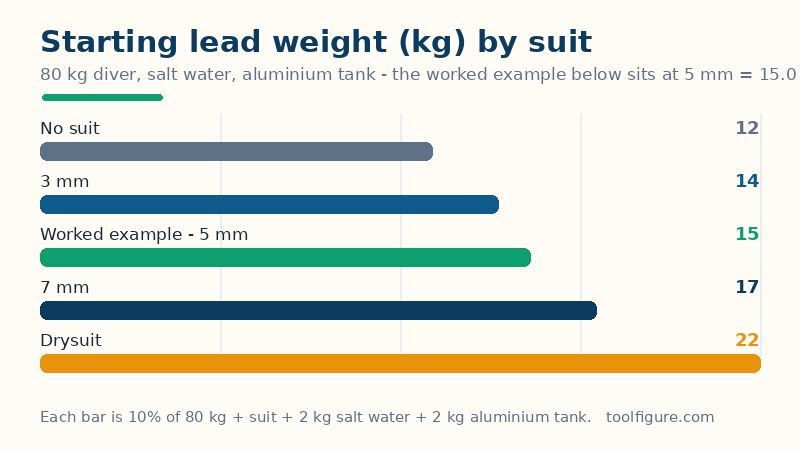
Each part has a physical reason. Body weight is the base because a heavier diver displaces more water, and the 10% figure is the published starting point for an average build — fat floats and muscle sinks, so a lean, muscular diver typically needs less than the formula says and a higher-body-fat diver typically needs more, and the buoyancy check below is what settles that. Neoprene is full of tiny trapped-air bubbles that push you upward, so every millimetre of wetsuit adds lead: 2 kg for a 3 mm suit, 3 kg for 5 mm, 5 kg for 7 mm, and about 10 kg for a drysuit, which traps far more air than any wetsuit. Salt water is about 2.5% denser than fresh water, so it pushes you up more — 2 kg extra against fresh water at these body weights. The tank matters because an aluminium AL80 becomes roughly 2 kg positively buoyant as its air is used, so the weight must cover the end of the dive, not the start; a steel tank stays near-neutral or slightly negative, so it takes 1 kg off instead. The difference between the two tanks is 3 kg, which matches the guides' warning that switching from aluminium to steel can mean removing 3 kg or more.
Worked example: 80 kg, salt water, 5 mm wetsuit, aluminium tank
An 80 kg diver in salt water wearing a 5 mm wetsuit with an aluminium tank needs 15.0 kg (33.1 lb) of lead as a starting estimate. The working: 10% of 80 kg is 8.0 kg; the 5 mm suit adds 3 kg; salt water adds 2 kg; the aluminium tank adds 2 kg; 8.0 + 3 + 2 + 2 = 15.0 kg, already on a 0.5 kg step, so no rounding moves it; and 15.0 × 2.20462 = 33.07 lb, rounded to 33.1 lb. The same arithmetic at other combinations shows how much each part moves the answer:
| Diver and dive | Working | Lead |
|---|---|---|
| 80 kg, fresh water, 3 mm, steel | 8.0 + 2 + 0 − 1 | 9.0 kg (19.8 lb) |
| 65 kg, salt water, 7 mm, aluminium | 6.5 + 5 + 2 + 2 | 15.5 kg (34.2 lb) |
| 100 kg, salt water, drysuit, steel | 10.0 + 10 + 2 − 1 | 21.0 kg (46.3 lb) |
| 60 kg, fresh water, no suit, steel | 6.0 + 0 + 0 − 1 | 5.0 kg (11.0 lb) |
Notice the second row: a lighter diver in a thick suit can need more lead than a heavier diver in a thin one — 65 kg in a 7 mm suit needs 15.5 kg, while 80 kg in fresh water with a 3 mm suit and a steel tank needs only 9.0 kg. Suit and water together can outweigh body weight, which is why a single percentage rule on its own misleads.
How to read your result, and its limits
Three things the number cannot do. First, the buoyancy check overrules the calculator: at the surface, fully geared, with a near-empty tank and an empty BCD, you should float at eye level on a normal breath and sink slowly as you exhale. If you float too high on a full breath, add weight in 0.5–1 kg steps; if you sink on a normal breath, take weight off. Do this check again at any new site, with any new suit or tank — the calculator's answer travels with the gear it was computed for, not with you. Second, a wetsuit compresses with depth: the neoprene bubbles that float you at the surface shrink as you descend, so you are less buoyant at depth than at the surface — which is why the check is done with a near-empty tank at the safety-stop depth in mind, and why being correctly weighted at the surface matters more than feeling comfortable at 5 metres. Third, experience changes the number: new divers often carry a little extra while their breathing and trim settle, and experienced divers often drop weight as their buoyancy control improves — if your logged weight for the same kit differs from this estimate by more than a couple of kilograms, trust your logbook and your instructor over the formula.
Common mistakes
- Weighting for a full tank. A full aluminium tank hides about 2 kg of buoyancy that appears as the air is used — weight for the end of the dive, when the tank is near empty, or you will be fighting to stay down at the safety stop.
- Copying another diver's weight. Two divers of the same weight in the same suit can need different lead because body composition, BCD, fins and experience all shift buoyancy — use your own check, not someone else's belt.
- Skipping the check at a new site. Fresh water to salt water alone adds about 2 kg at these body weights, and a new suit or tank changes the answer again — recheck whenever any part of the kit changes.
- Treating the estimate as a safety decision. This page estimates lead for planning; it does not teach buoyancy control, and it is no substitute for certification training or an instructor's judgement on the day.
Related tools: Wetsuit Size Calculator — The right wetsuit size from your height and weight, plus the suit thickness for your water temperature: one consolidated chart, honestly stated; Kite Size Calculator — Your kite size from weight and wind: ideal size, quiver range and board length; Bodyboard Size Calculator — Your bodyboard size from height, weight and level: the published table, looked up properly.
Frequently asked questions
How much weight do I need for scuba diving?
As a starting estimate, about 10% of your body weight plus allowances for your suit, the water and your tank: an 80 kg diver in salt water with a 5 mm wetsuit and an aluminium tank starts at 15.0 kg (33.1 lb). Confirm it with a surface buoyancy check before the dive — the check, not the formula, is the final answer.
Do I need more weight in salt water than fresh water?
Yes — salt water is about 2.5% denser, so it pushes you up more. At the body weights here that works out to about 2 kg extra in salt water, which is why the same 80 kg diver in a 3 mm suit needs 9.0 kg in fresh water with a steel tank but more in salt water with aluminium.
Why does my tank change how much lead I need?
An aluminium tank becomes roughly 2 kg positively buoyant as its air is used, so you must carry weight that covers the end of the dive, not the start. A steel tank stays near-neutral, so it takes about 1 kg off — switching from aluminium to steel can mean removing 3 kg or more.
How do I do a scuba buoyancy check?
At the surface, fully geared with a near-empty tank and an empty BCD, you should float at eye level on a normal breath and sink slowly as you exhale. If you float too high, add weight in 0.5–1 kg steps; if you sink on a normal breath, take weight off. Recheck at every new site and whenever your suit or tank changes.
