One luminance, four labels
Luminance is the brightness of a surface as the eye sees it — luminous intensity per unit of projected area, in candela per square metre, where one candela per square metre is one candela of intensity leaving each square metre of surface toward the viewer. It is the number behind every display specification: a dim cinema screen and a searing HDR television differ only in this figure. The candela per square metre itself is far too fine for some uses and far too coarse for others, so real specs are labelled in its aliases and relatives: nits for screens, foot-lamberts for cinemas, lamberts and stilbs wherever an old photometry table is still in use. This page restates any luminance in all eight units at once, worked through the candela per square metre with every factor defined, so a figure in any dialect can be read in any other. It also answers the question the conversion alone cannot: for a perfectly diffusing surface at this luminance, how much light leaves each square metre?
The formula
answer = candela per square metre ÷ (cd/m² in one "to" unit)
Two terms, both visible on the page. value is the number you enter. cd/m² in one "from" unit is the definition of the unit you are converting from: 1 for the candela per square metre itself and for the nit, 10,000 for the stilb, 1/π for the apostilb, 10,000/π for the lambert, 10/π for the millilambert, 3.4262590996 for the foot-lambert and 10.7639104167 for the candela per square foot. answer is the result in the unit you asked for. The nit needs no step at all: it is the candela per square metre under its display-industry name, which is why the two rows of the table always agree. The π in the lambert family is not decoration: a perfectly diffusing surface spreads its light over a hemisphere, and the π is the geometry of that spread, which is also why the exitance line below is a multiplication by π rather than a lookup.
Worked example
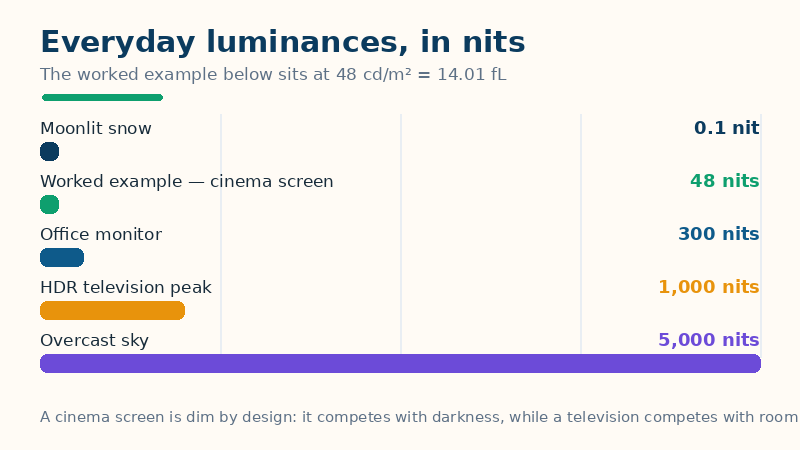
Convert 48 candela per square metre to foot-lamberts — the DCI cinema standard for peak white on a theatre screen, and the value a projection spec reaches for first — the way the tool does it.
Step 1 — get to candela per square metre. One candela per square metre is 1 cd/m², so 48 × 1 = 48 cd/m².
Step 2 — divide by the target factor. One foot-lambert is 3.4262590996 cd/m², so 48 ÷ 3.4262590996 = 14.01.
Step 3 — read the display. The page prints six decimals below 0.001, four below 10 and two above, so the headline reads 14.01 fL, and the detail line shows the working: 48 cd/m² = 14.01 fL — worked through candela per square metre: 48 cd/m² ÷ the Foot-lambert factor.
Check it. Multiplying back, 14.01 × 3.4262590996 = 48.00, the value we started from, to the display's two decimals. The full table for this example reads: 48 cd/m², 48 nit, 0.0048 sb, 150.8 asb, 0.0151 L, 15.08 mL, 14.01 fL and 4.4593 cd/ft². The exitance line reads 150.8 lm/m²: π × 48 = 150.8. That number is no coincidence — it is the apostilb row again, because a luminance in apostilbs is π times the same luminance in candela per square metre, which is exactly the Lambertian relation. And for a real white screen, which reflects about 90% of the light that falls on it, the illuminance needed to reach this luminance is 150.8 ÷ 0.9 = 167.55 lux — the bridge from this page to the illuminance converter, which is where that lux figure belongs.
Conversion table
The conversions display and lighting work reaches for most, each one the same two steps as the example:
| From | To |
|---|---|
| 100 cd/m² | 29.19 fL |
| 250 cd/m² | 72.97 fL |
| 1,000 cd/m² | 291.86 fL |
| 1 fL | 3.4263 cd/m² |
| 1 L | 3,183.1 cd/m² |
| 1 sb | 10,000 cd/m² |
| 1 asb | 0.3183 cd/m² |
| 1 mL | 3.1831 cd/m² |
| 80 cd/m² | 23.35 fL |
| 2,000 cd/m² | 583.73 fL |
| 14 fL | 47.97 cd/m² |
| 1 cd/ft² | 10.76 cd/m² |
Two exitance cross-checks for the π line, each one the same multiplication: a 300 cd/m² office monitor gives off 942.48 lm/m², and a 1,000 cd/m² HDR peak gives off 3,141.59 lm/m² — the second one is π × 1,000, stated as a measurement rather than a slogan. The table's own rows double as screen guidance: a calibrated monitor at 80–100 cd/m² sits at 23–29 fL, a bright office monitor at 300 cd/m² at 87.56 fL, and an HDR television's 1,000-nit peak at 291.86 fL.
Reading the result, and its limits
Three distinctions keep this page honest. First, luminance is not illuminance. The illuminance converter restates light falling on a surface — lux and foot-candles, lumens per square metre — while this page restates light leaving a surface toward the eye. A lux figure can never be converted to a nit without a reflectance, as the worked example's 167.55 lux shows, and a nit figure can never be converted to lux without one either; any table that appears to do so has silently assumed a perfectly white surface. Second, luminance is not luminous intensity: the candela measures intensity in one direction, and turning it into a luminance needs an area — the luminous intensity converter on this site handles the candela side, with the beam angle, and this page handles the per-square-metre side. Third, the Lambertian condition: the exitance line holds exactly only for a perfectly diffusing surface, and real screens are not perfectly diffusing — a glossy display concentrates its light toward the viewer, so its measured luminance in one direction exceeds π divided into its exitance. Check the surface before trusting any converted figure in a real lighting design, and remember that a correct conversion of the wrong luminance is still the wrong luminance.
Related tools: Illuminance Converter — Lux to foot-candles, phot and more — every answer in all six units, plus the lumens your room needs; Luminous Intensity Converter — Lumens to candela and back through the beam angle — plus the lux at your distance; Unit Converter — Convert length, weight, temperature and volume — km to miles, kg to pounds, °C to °F, litres to gallons.
Frequently asked questions
What is the difference between nits and cd/m²?
None at all: 1 nit = 1 cd/m² exactly. Nit is the display industry's name for the SI unit, from the Latin nitere, to shine. A television rated at 1,000 nits and a datasheet quoting 1,000 cd/m² describe the same brightness, and the two rows of this converter's table always agree.
How many foot-lamberts is a cinema screen?
The DCI standard for peak white is 14 fL, which is 48 cd/m² — the worked example on this page. Dolby Cinema runs brighter at 31.5 fL, which is 108 cd/m². A home television at 300 cd/m² is about 87.56 fL, far brighter than any cinema screen, because a television competes with room light and a cinema does not.
Why does π appear in the lambert and apostilb?
Because a perfectly diffusing surface spreads its light over a hemisphere, and the geometry of that spread contributes a factor of π. One lambert is 10,000/π cd/m² and one apostilb is 1/π cd/m², which is also why a luminance in apostilbs numerically equals the same surface's exitance in lumens per square metre — the π line on this page.
Can lux be converted to nits?
Not without a reflectance. Lux measures light falling on a surface and nits measure light leaving it toward the eye, and the link between them is the surface: illuminance = π × luminance ÷ reflectance. A white screen at 48 cd/m² with a reflectance of 0.9 needs 167.55 lux. The illuminance converter on this site handles the lux side; this page handles the nit side.
