Loaded weight sets the length, snow sets the step
Snowshoes work by spreading weight over snow, so the size follows the weight they carry — and that weight is everything, not just you. Body weight plus winter clothes, boots and pack is the loaded weight, and every sizing chart retailers publish is written against it: a day pack adds roughly 5–10 kg (11–22 lb), an overnight pack more, and forgetting the pack is the commonest way to buy a snowshoe that sinks. The bands this page uses, read from the published retailer charts, run: up to 120 lb (54 kg), 21 in (53 cm); 121–170 lb (55–77 kg), 25 in (64 cm); 171–220 lb (78–100 kg), 30 in (76 cm); over 220 lb (100 kg), 36 in (91 cm). Height does not enter the calculation — a tall light walker and a short heavy walker of the same loaded weight take the same length — and that is why this page asks for weight and gear, not height.
Loaded weight = body weight + gear weight (clothes, boots, pack) — Base length: up to 120 lb 21 in · 121–170 lb 25 in · 171–220 lb 30 in · over 220 lb 36 in — Packed trails: one size down · Mixed trails: base length · Deep powder: one size up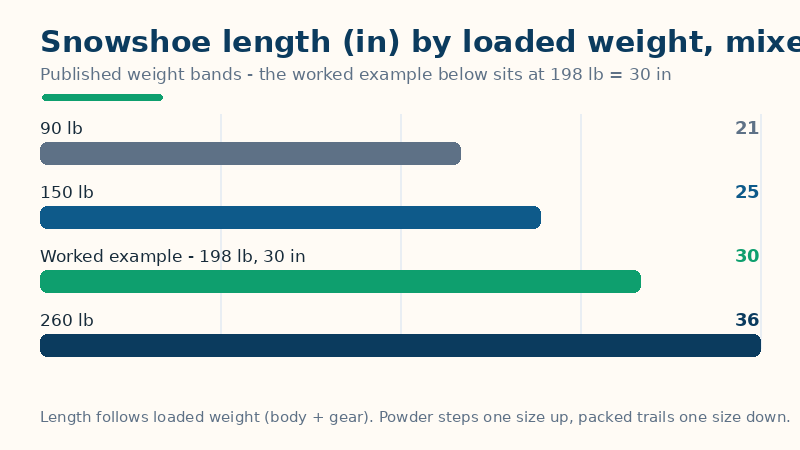
Retailer charts overlap on purpose, because snow condition moves the answer: one published chart gives 120–200 lb for 25 in and 170–250 lb for 30 in, so a 180 lb walker sits in both. This page resolves the overlap with a single rule instead of hiding it: the band gives one base length, and the snow you walk on most moves it one step — down for packed or groomed trails, where less floatation is needed, and up for deep fresh powder, where more surface area keeps you afloat. A walker who splits time evenly takes the base length, which is the mixed-trails answer.
Worked example: 80 kg body, 10 kg gear, mixed trails
A walker who weighs 80 kg and carries 10 kg of clothes, boots and pack should buy 30 in snowshoes (76 cm). The working: loaded weight = 80 + 10 = 90 kg. In pounds, 90 × 2.20462 = 198.4 lb. That falls in the 171–220 lb band, whose base length is 30 in, and mixed trails leave the base length unchanged, so the recommendation is 30 in (30 × 2.54 = 76 cm, rounded). The same loaded weight on different snow steps differently:
| Loaded weight | Snow | Base length | Size to buy |
|---|---|---|---|
| 90 lb (41 kg) | Mixed | 21 in | 21 in (53 cm) |
| 150 lb (68 kg) | Mixed | 25 in | 25 in (64 cm) |
| 198.4 lb (90 kg) | Mixed | 30 in | 30 in (76 cm) |
| 198.4 lb (90 kg) | Packed / groomed | 30 in | 25 in (64 cm) |
| 198.4 lb (90 kg) | Deep powder | 30 in | 36 in (91 cm) |
| 260 lb (118 kg) | Mixed | 36 in | 36 in (91 cm) |
Notice the three middle rows together: one walker, one loaded weight, three honest answers — because the snow, not the weight, is what changes between them. And notice the last row: above 220 lb the base is already the largest standard length, so a powder step cannot go further, and the answer for very heavy loads is a 36 in snowshoe with add-on tails, or a wider frame, rather than a longer one.
How to read your result, and its limits
Three checks before trusting the size. First, weigh the pack, do not guess it: the difference between a day pack and an overnight pack can move a walker across a whole band, and the bands are only as honest as the loaded weight fed into them. Second, length is not the whole fit: bindings are sized to boots, frames differ in width between makers, and a 25 in snowshoe from one brand can float differently from a 25 in from another — the maker's own chart for the exact model is the final check. Third, this page sizes adults: children under about 100 lb loaded weight use youth snowshoes (19–21 in), and very small children use 14–17 in models, which the adult bands above do not cover. Crampons, heel lifts and frame shape are quality choices, not sizing choices, and none of them rescue a length that is wrong for the loaded weight.
Common mistakes
- Sizing by body weight alone. Clothes, boots and pack are part of the load the snowshoe carries — leave them out and the snowshoe sinks on the first soft stretch.
- Sizing by height. Height never appears in a snowshoe chart; two walkers of the same loaded weight take the same length whatever their heights.
- Buying the largest size "to be safe". Oversized snowshoes are clumsy on packed trails, catch on each other, and tire the walker — the powder step exists so the base size stays walkable.
- Ignoring the snow step at a band boundary. Retailer charts overlap around 170–200 lb; the snow you actually walk on is what settles a boundary weight, not a second chart.
Related tools: Ski Size Calculator — A recommended ski length range from your height, ability level and skiing style, with the full ability table; Ice Axe Length Calculator — Your ice axe length from height — the range and the sold length in 5 cm steps — with the ankle test that settles it; Sleeping Bag Size Calculator — Your sleeping bag size from height and sleep position — the minimum length, the size that covers it, and the comfort rating for your coldest night.
Frequently asked questions
What size snowshoes do I need?
It follows your loaded weight — body weight plus clothes, boots and pack: up to 120 lb takes 21 in, 121–170 lb takes 25 in, 171–220 lb takes 30 in and over 220 lb takes 36 in, then one size down for packed trails or one size up for deep powder. For example, 80 kg body plus 10 kg gear is 90 kg (198.4 lb), which takes 30 in on mixed trails.
Do snowshoes size by weight or height?
By weight — loaded weight, including gear. Height does not appear in snowshoe sizing charts: two walkers of the same loaded weight take the same length whatever their heights, because the snowshoe's job is spreading that weight over the snow.
Should I size up snowshoes for powder?
Yes, one size up from the base length if you mostly break trail in deep fresh powder, where more surface area keeps you afloat. On packed or groomed trails, step one size down instead — the smaller snowshoe is easier to walk in and needs less floatation.
What size snowshoes for a child?
Children under about 100 lb loaded weight use youth snowshoes, typically 19–21 in, and very small children use 14–17 in models. The adult bands on this page start at 21 in for up to 120 lb and do not cover youth sizing.
