The formula: none — a height ladder, stated in full
Pool cue sizing has no formula to solve, because cues are sold in a handful of fixed lengths and the guides match a player to the nearest one by height. The ladder below is the consensus of the published height charts, with the boundaries in feet and inches and their centimetre equivalents. Note the two-piece/one-piece distinction: a standard two-piece cue is 58 in and the equivalent one-piece cue is 57 in, so the same size is quoted both ways depending on the cue's construction.
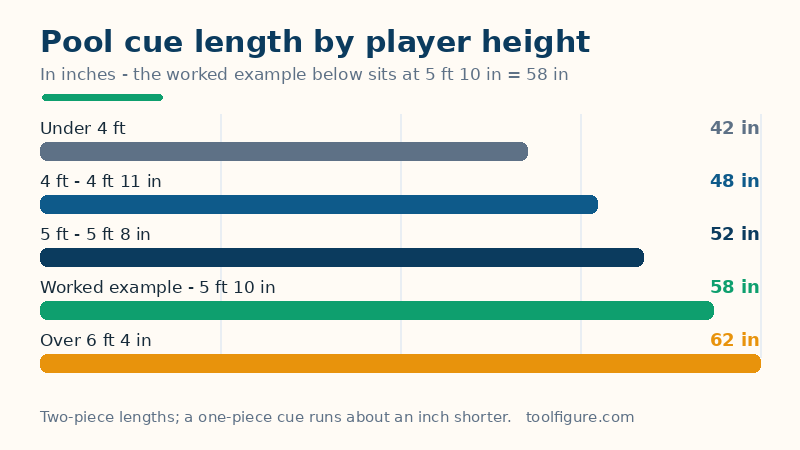
| Player height | Cue length |
|---|---|
| Under 4 ft (under 122 cm) | 42 in |
| 4 ft – 4 ft 11 in (122–150 cm) | 48 in |
| 5 ft – 5 ft 8 in (152–173 cm) | 52 in |
| 5 ft 8 in – 6 ft 4 in (173–193 cm) | 58 in |
| Over 6 ft 4 in (over 193 cm) | 62 in (or 58 in + extension) |
Spot checks against the table: 120 cm is 47.24 in, under 4 ft, so a 42 in cue (106.68 cm); 145 cm is 57.09 in, in the 4 ft–4 ft 11 in band, so 48 in (121.92 cm); 165 cm is 64.96 in, in the 5 ft–5 ft 8 in band, so 52 in (132.08 cm); 185 cm is 72.83 in, in the 5 ft 8 in–6 ft 4 in band, so 58 in (147.32 cm); 200 cm is 78.74 in, over 6 ft 4 in, so 62 in (157.48 cm) or a 58 in cue with an extension. Two honest disagreements sit inside this ladder and are worth stating: some guides put players from 5 ft 3 in to 5 ft 8 in on a 57 in cue rather than 52 in, and some put every player from 5 ft to 6 ft 4 in on a 58 in cue. This calculator follows the more detailed ladder above, which separates the shorter adults — the players a one-size answer serves worst — and flags the table-size cases where the next size up or down is the common choice.
Worked example: 178 cm (5 ft 10 in)
A player 178 cm tall takes a 58 in cue (147.32 cm) as a two-piece cue, or 57 in as a one-piece cue. The arithmetic is 178 ÷ 2.54 = 70.08 in, which is 5 ft 10 in, inside the 5 ft 8 in–6 ft 4 in band; and 58 × 2.54 = 147.32 cm. On an 8 ft standard home table that length is the default choice, and on a 7 ft table in a tight room the common compromise is a 52 in cue, because the shorter cue keeps the butt off the wall on the long shots. Weight is the other half of the choice and is not set by height: the usual starting weight is 19 oz inside the 18–21 oz range, and the common beginner tip is 12.5–13 mm.
How to read your result, and its limits
Three checks before buying. First, check the room, not just the table: the guides' room tables show a 48 in cue fitting a 7 ft table in an 11.3 × 14.5 ft room while a 58 in cue wants 12.9 × 16.1 ft for the same table — a cue that fits the player can still hit the wall if the room is too small. Second, remember the World Pool-Billiard Association floor: cues must be at least 40 in long for sanctioned play, and there is no official maximum, which is why extensions exist for players over 6 ft 4 in instead of a longer fixed size. Third, try before committing at a boundary: a player within a couple of centimetres of a band edge — 173 cm, 193 cm — should hold both neighbouring lengths, because bridge length and stance move the comfortable cue by as much as the band edge does. Break and jump cues are a separate purchase at 40–48 in and are not what this ladder sizes.
Common mistakes
- Buying 58 in regardless. The standard fits most adults, but a child or a player under 5 ft on a 58 in cue cannot form a proper bridge, and a tight room turns the standard cue into a wall hazard.
- Confusing one-piece and two-piece lengths. A 57 in one-piece cue and a 58 in two-piece cue are the same size class — comparing them as different sizes buys a duplicate, not an upgrade.
- Choosing by table size alone. Table size sets the room question, not the player question: a tall player on a 7 ft table still needs the longer cue, and a short player on a 9 ft table still needs the shorter one.
- Ignoring weight and tip. Length decides clearance and reach; the 19 oz starting weight and 12.5–13 mm tip decide how the cue feels. A right-length cue at the wrong weight still plays badly.
Related tools: Bowling Ball Weight Calculator — The right bowling ball weight from the 10% rule: body weight times 10%, adjusted for skill and capped at the 16 lb competition maximum; Golf Club Length Calculator — Recommended driver, wood, iron and putter lengths from your height and wrist-to-floor measurement, with the full height table; Fishing Rod Length Calculator — Your fishing rod length from what you fish for and your height: one length to shop, with the matching power and action.
Frequently asked questions
What is the standard pool cue length?
57–58 inches: 57 in for a one-piece cue and 58 in for a two-piece cue. That standard suits most adults from about 5 ft 8 in to 6 ft 4 in tall.
What cue length do I need for a 7 ft pool table?
The standard 57–58 in cue on a roomy 7 ft table, or a 52 in cue if the room is tight — the shorter cue keeps the butt off the wall on long shots. For a 7 ft table in an 11.3 × 14.5 ft room, the guides put a 48 in cue.
What if I am right on a height boundary?
Take the band your height falls in, and if you are within a couple of centimetres of the edge — 173 cm or 193 cm — hold both neighbouring lengths before buying, because bridge length and stance move the comfortable cue by that much.
Does cue weight matter more than cue length?
They decide different things: length decides clearance and reach, weight decides feel. Start at 19 oz inside the usual 18–21 oz range, with a 12.5–13 mm tip, and change one thing at a time from there.
