The formula: one cell in the height-by-width chart
The calculation is a lookup, and the calculator shows the cell it landed in so the answer can be checked by hand. Step 1, convert to centimetres and inches: height in inches times 2.54 gives height in centimetres, and width in centimetres divided by 2.54 gives width in inches — the charts below are built on those two units. Step 2, find the row and column: height falls in one of four bands (under 152 cm, 152–168 cm, 168–183 cm, over 183 cm) and boat width in one of four bands (under 23 in, 23–28 in, 28–32 in, over 32 in), and the cell where they meet is the recommended length. A measurement exactly on a boundary takes the narrower band — 168 cm reads the 152–168 cm row, 28 in reads the 23–28 in column. Step 3, pick the style grid: low-angle touring (the relaxed stroke, paddle kept low) and high-angle touring (the aggressive stroke, paddle kept high) have separate grids, and the high-angle grid runs about 10 cm shorter at almost every cell, because the steeper stroke reaches the water with less shaft. The full low-angle grid, in centimetres, is:
| Height \ Width | Under 23 in | 23–28 in | 28–32 in | Over 32 in |
|---|---|---|---|---|
| Under 152 cm | 210 | 220 | 230 | 240 |
| 152–168 cm | 215 | 220 | 230 | 240 |
| 168–183 cm | 220 | 220 | 230 | 240 |
| Over 183 cm | 220 | 230 | 240 | 250 |
The high-angle grid, in centimetres, is the same shape with 10 cm taken off at nearly every cell (5 cm at the tallest, narrowest corner):
| Height \ Width | Under 23 in | 23–28 in | 28–32 in | Over 32 in |
|---|---|---|---|---|
| Under 152 cm | 200 | 210 | 220 | 230 |
| 152–168 cm | 205 | 210 | 220 | 230 |
| 168–183 cm | 210 | 210 | 220 | 230 |
| Over 183 cm | 215 | 220 | 230 | 240 |
Worked example: 178 cm, 28 in boat, low-angle touring
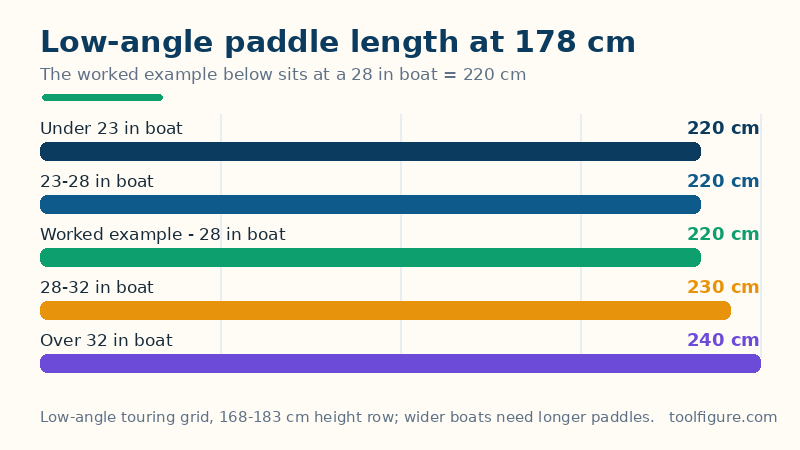
Take a paddler who is 178 cm tall with a kayak 28 in wide at its widest point, paddling low-angle. Step 1: no conversion is needed for the height, and 28 in is already the chart's unit. Step 2: 178 cm falls in the 168–183 cm row and 28 in falls in the 23–28 in column, so the low-angle cell reads 220 cm (86.6 in) and the high-angle cell for the same paddler and boat reads 210 cm (82.7 in) — the style choice is worth exactly 10 cm here. The same answer comes out of the inches input: 70 in × 2.54 = 177.8 cm, which falls in the same row and column and reads the same 220 cm low-angle and 210 cm high-angle, so the two units can never disagree by more than rounding. Other paddlers on the same grids read:
| Paddler and boat | Low-angle | High-angle |
|---|---|---|
| 160 cm, 24 in boat | 220 cm (86.6 in) | 210 cm (82.7 in) |
| 190 cm, 30 in boat | 240 cm (94.5 in) | 230 cm (90.6 in) |
| 150 cm, 20 in boat | 210 cm (82.7 in) | 200 cm (78.7 in) |
| 175 cm, 35 in boat | 240 cm (94.5 in) | 230 cm (90.6 in) |
Notice what the grids say about width: at 178 cm the length barely moves between a narrow and a medium boat (220 cm at both under 23 in and 23–28 in) and only climbs at the wide end (230 cm at 28–32 in, 240 cm over 32 in), because a wider boat puts the water further from the paddler's hands. Height matters most at the extremes — the shortest and tallest rows — and least in the middle, where most adult paddlers sit.
How to read your result, and its limits
Three checks before buying. First, torso length beats overall height when the two disagree: the charts use overall height because it is the measurement everyone knows, but a long-torso paddler sits higher above the water and genuinely needs a longer paddle than a same-height paddler with a short torso — if you know your seated torso length, a shop's torso chart outranks this page. Second, seat height is a hidden width: a high seat lifts the paddler and acts like a wider boat, so high-seat kayaks take the longer column even when the tape says the boat is narrow. Third, this page sizes touring paddles, not whitewater paddles: whitewater paddles run materially shorter than touring paddles for the same height, and junior paddlers below 120 cm need a shop's kids chart rather than this grid — and if your shop stocks only 10 cm steps, round to the nearest and, torn between two sizes, take the shorter one. For the rest of the kit, the surfboard volume calculator sizes a board from weight and skill, and the ski size calculator sizes skis from height, ability and style.
Related tools: Snowboard Size Calculator — A recommended snowboard length range from your height, ability level and riding style, with the full height table.
Frequently asked questions
What size kayak paddle do I need?
As a starting point, find your height row and boat-width column in the chart above: a 178 cm paddler with a 28 in boat reads 220 cm low-angle touring and 210 cm high-angle touring. Enter your own measurements above and the calculator shows both styles.
Does kayak width really change the paddle length?
Yes, but only at the wide end: at 178 cm the chart reads 220 cm for boats up to 28 in wide, 230 cm at 28–32 in and 240 cm over 32 in, because a wider boat puts the water further from your hands.
Should I choose a low-angle or high-angle paddle?
Low-angle is the relaxed touring stroke with the paddle kept low; high-angle is the more aggressive stroke with the paddle kept high, and it runs about 10 cm shorter at almost every cell. If you are unsure, the low-angle length is the safer first paddle.
What if I am between two paddle sizes?
Take the shorter one: the published advice for torn paddlers is to go shorter, saving a few ounces and sparing the shoulders, and the calculator's result is a starting length, not a fitting.
