Three steps: kilowatts, minutes a day, cost
The whole calculation is two multiplications. Watts divided by 1,000 is kilowatts; kilowatts times the hours a day is the day's energy; the day's energy times 365 days is the year's energy; the year's energy times the price is the year's money. The month is the year divided by 12, not the day times 30 — the two differ by a few cents, and the year-divided-by-12 figure is the one this page uses, so it agrees with the yearly total exactly:
energy per day (kWh) = watts ÷ 1,000 × hours a day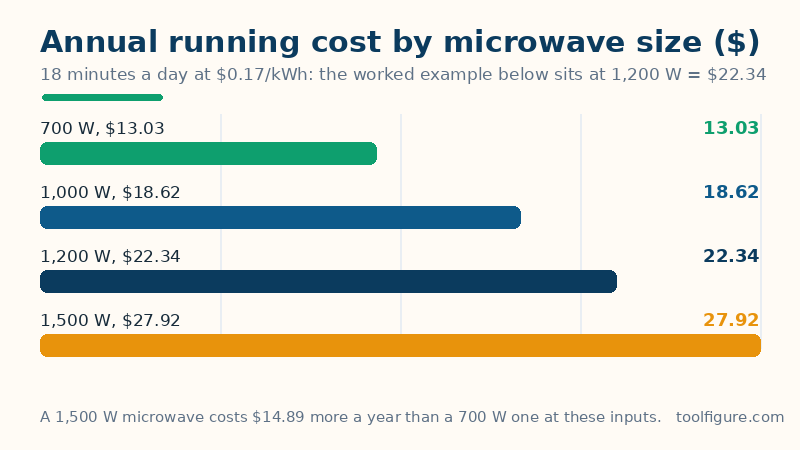
cost per hour ($) = watts ÷ 1,000 × electricity priceannual cost ($) = energy per day × 365 × electricity priceThe one number that trips people up is the watts itself. The number printed on the front of a microwave is its cooking power — the power delivered to the food — not what it draws from the socket. The draw runs about one and a half times the cooking power: a microwave sold as 650 W cooking power draws about 1,000 W, an 800 W one draws about 1,300 W and a 1,000 W one draws about 1,500 W. At the US average rate of 18.16 cents per kWh those draws cost $0.18, $0.24 and $0.27 an hour. Enter the draw — it is on the label on the back of the machine, or take the cooking power and multiply by 1.5 — or the answer comes out a third too low.
Worked example: 1,200 W drawn, 18 minutes a day, $0.17/kWh
A 1,200 W microwave used 18 minutes a day at $0.17 per kWh costs 1.2 × $0.17 = $0.20 an hour. A day is 1.2 × 0.30 = 0.360 kWh, costing $0.06. A month is 131.4 ÷ 12 = 11.0 kWh, costing $1.86. A year is 0.360 × 365 = 131.4 kWh, costing $22.34. The table above shows the same maths for the other microwave sizes at the same 18 minutes a day: a 700 W microwave costs $0.04 a day and $13.03 a year, a 1,000 W one costs $0.05 a day and $18.62 a year, and a 1,500 W one costs $0.08 a day and $27.92 a year. At 30 minutes a day the 1,200 W microwave costs $37.23 a year, and at 5 minutes a day $6.21. Three published cross-checks reproduce exactly: a 1,200 W microwave used 0.3 hours a day at $0.175 per kWh costs $0.21 an hour, $0.063 a day — the tool rounds the day to $0.06 — and $23.00 a year; the same use at $0.15 per kWh costs $0.18 an hour, $0.05 a day and $19.71 a year; and a 1,000 W cooking-power microwave drawing 1,500 W, used 10 minutes a day at 18.16 cents per kWh, costs $0.05 a day, $1.38 a month and $16.57 a year — about $17.
How to read your result, and its limits
Four cautions keep the number honest. First, the month is the year divided by 12: 131.4 kWh a year is 11.0 kWh a month and $1.86, while the day times 30 would give 10.8 kWh and $1.84 — a two-cent difference that is only a convention, and the year-divided-by-12 figure is the one that adds up to the yearly total. Second, full power only while cooking: a microwave draws its rated watts while it is running, but an inverter model throttles down on low settings and a defrost cycle runs in bursts, so the figure is a ceiling for those modes. Third, the standby clock is a separate, small cost: about 3 W around the clock is 26.28 kWh a year, about $4.47 at $0.17 per kWh — the extra line under the result shows it at your rate. Fourth, the electricity price is the all-in rate: the total on the bill divided by the kilowatt-hours on the bill, including delivery charges. For the other kitchen appliance that runs on a cycle, the dishwasher cost calculator prices the dishes by kWh per cycle; for the cost of running anything else in the house, the electricity cost calculator prices any appliance by watts and hours; and for the cheapest upgrade in the house, the LED bulb savings calculator prices the swap bulb by bulb.
Common mistakes
- Pricing the cooking power instead of the draw. A microwave sold as 1,000 W cooking power draws about 1,500 W from the socket: priced from the label it looks like $0.17 an hour and $18.62 a year at the worked example's inputs, while the true draw is $0.26 an hour and $27.92 a year. Enter the draw, not the front-panel number.
- Putting minutes in as hours. Eighteen minutes is 0.30 hours, not 0.18 — entering 18 as the hours would price ten hours of cooking a day. Divide the minutes by 60 first: 18 ÷ 60 = 0.30.
- Multiplying the daily cost by 30 for the month. Thirty days is not a twelfth of a year: the day times 30 gives $1.84 a month at the worked example's inputs, while the year divided by 12 gives $1.86. Use the year-divided-by-12 figure, which is the one that adds up.
- Adding the standing charge to every hour. The daily supply charge is payable whether the microwave runs or not. Only the per-kWh rate belongs in the per-hour maths — the fixed charge is a separate line on the bill.
Frequently asked questions
How much does a microwave cost to run per hour?
A 1,200 W microwave costs $0.20 an hour at $0.17 per kWh. A microwave sold as 1,000 W cooking power draws about 1,500 W from the socket, so it costs $0.26 an hour at the same rate — price the draw, not the cooking power.
How much does a microwave cost per month?
A 1,200 W microwave used 18 minutes a day at $0.17 per kWh uses 11.0 kWh a month and costs $1.86 — $22.34 a year. At 30 minutes a day it costs $37.23 a year, and at 5 minutes a day $6.21.
Why does my 1,000 W microwave cost more than 1,000 W?
Because 1,000 W is the cooking power printed on the front, not what the machine draws from the socket: it draws about 1,500 W. At 18.16 cents per kWh that is $0.27 an hour, against $0.18 an hour if the 1,000 W figure were the draw.
Does a microwave use electricity on standby?
Yes, about 3 W for the clock and display, around the clock: 26.28 kWh a year, about $4.47 at $0.17 per kWh. It is small next to the cooking cost, but it is real — the tool shows it at your rate under the result.