The 100 cubic inches rule, and why it is per person per day
Bear canister guides agree on one planning figure: about 100 cubic inches — roughly 1.6 litres — of canister space per person per day of food and scented items. It is a volume rule, not a weight rule, because a canister fills by space: a day of dense food (nuts, cheese, nut butter) and a day of bulky food (freeze-dried meals in foil pouches) can weigh nearly the same and take up very different room. Published canister tables follow the same rule — a 275 cubic inch canister covers about 2 to 3 days for one person, a 440 covers about 4, a 565 about 5 to 6, a 700 about 7, and a 900 about 9 — and the differences between sources are rounding and packing skill, not different rules. The honest version of the rule therefore carries its condition with it: 100 cubic inches a day assumes food repacked into bags with the air squeezed out. Pack bulky pouches as sold and the same day's food can need nearer 150 cubic inches, which is why this page tells you to size up rather than pretending the rule is exact.
Person-days = people × trip days — Stored person-days = person-days − people, only if the first day's food is eaten before nightfall — Volume needed (cu in) = stored person-days × 100 — Litres = cubic inches × 0.0163871 — Recommended canister = the smallest standard canister whose capacity covers the volume needed; past 900 cu in, the count of BV500 canisters (700 cu in each) that covers it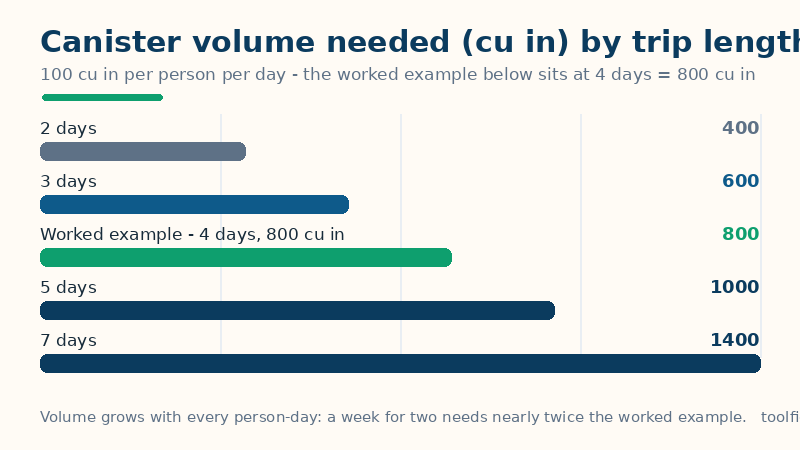
Two things people forget belong inside the volume. First, everything scented counts, not just food: trash, toiletries, sunscreen, lip balm, soap and medications all have to fit, because a bear does not distinguish dinner from deodorant. Second, the first day is special: food you carry in your hand and eat before the first night never has to be stored, so experienced backpackers pack the first day's food outside the canister and gain a day of capacity for free — one person's first day is one person-day saved, which is why the checkbox subtracts one person-day per person, not one day off the trip.
Worked example: 2 people, 4 days
Two people on a four-day trip need 800 cubic inches — 13.11 litres — of canister space, covered by one Wild Ideas Expedition canister (900 cu in, 14.75 litres), leaving 100 cubic inches (1.64 litres, about one person-day) spare. The working: person-days = 2 × 4 = 8. Volume = 8 × 100 = 800 cu in. Litres = 800 × 0.0163871 = 13.11 L. The ladder below the result shows why the Expedition wins: the BV500 holds 700 cu in, which is 100 short, so the next standard size up is the 900. Check the spare: 900 − 800 = 100 cu in, exactly one person-day at the planning rule. Tick the first-day box and the answer changes honestly: stored person-days fall to 8 − 2 = 6, volume to 600 cu in (9.83 litres), and a single BV500 (700 cu in) covers the trip with the same 100 cubic inches spare. The same arithmetic on other trips:
| Trip | Person-days | Volume needed | Recommended canister |
|---|---|---|---|
| 1 person, 2 days | 2 | 200 cu in (3.28 L) | Bare Boxer Contender, 275 cu in (75 spare) |
| 1 person, 3 days | 3 | 300 cu in (4.92 L) | BearVault BV425, 305 cu in (5 spare — very tight) |
| 2 people, 3 days | 6 | 600 cu in (9.83 L) | BearVault BV500, 700 cu in (100 spare) |
| 2 people, 4 days (worked example) | 8 | 800 cu in (13.11 L) | Wild Ideas Expedition, 900 cu in (100 spare) |
| 2 people, 4 days, first day eaten out | 6 stored | 600 cu in (9.83 L) | BearVault BV500, 700 cu in (100 spare) |
| 4 people, 5 days | 20 | 2,000 cu in (32.77 L) | 3 × BearVault BV500, 2,100 cu in (100 spare) |
Check the big group row by hand: 4 × 5 = 20 person-days, 20 × 100 = 2,000 cu in, and 2,000 ÷ 700 = 2.86, which rounds up to 3 BV500s holding 2,100 cu in — the spare is again 100, because every recommendation rounds up to the next whole canister. And check the tight row: the BV425 at 305 cu in covers 300 with only 5 cubic inches to spare, which is no room for a tube of sunscreen — that row is the page's way of saying the arithmetic passes but the packing will not, so size up.
How to read your result, and its limits
Three checks before trusting the figure. First, the rule is an average, and your menu is the variable: repack bulky meals into bags, squeeze the air out, and 100 cubic inches a day is realistic; pack pouches as sold and it is not. Second, this page sizes canisters, not bags: soft bear bags (Ursacks and similar) carry their own capacities and their own approval rules, and a canister figure does not transfer to them. Third, capacity is not approval: where a canister is required, it must be an approved model for that area — the right size of the wrong canister still fails the regulation, so check the local list as well as the volume.
Common mistakes
- Sizing the canister to the pack instead of the food. A canister that fits the pack beautifully and leaves a day's food outside it has failed at its one job — size from the food outward.
- Counting meals only. Trash, toiletries and sunscreen are scented too, and they take real space — the 100 cubic inch rule already assumes they are inside.
- Trusting a 5 cubic inch margin. A recommendation that only just covers the volume leaves no room for imperfect packing — size up when the spare is under half a person-day.
- Packing bulky pouches at the repacked rate. Freeze-dried meals in their original packaging can need nearer 150 cubic inches a day; either repack or plan for the bigger figure.
Related tools: Camping Food Calculator — How much food to pack from trip days, group size and daily calories — total weight, per-person weight and per-day weight, with a safety buffer for delays; Backpack Weight Calculator — Your pack weight from gear, food, water and fuel — base weight, total pack weight and load as a percentage of body weight, with the weight bands shown; Hiking Water Calculator — Your hiking water from hours, heat and effort — litres to carry, 1-litre bottles and the pack weight, with a delay hour and camp water included.
Frequently asked questions
How many days of food fit in a bear canister?
About one day per 100 cubic inches of capacity, for one person, with repacked food: a 275 cu in canister covers about 2–3 days, a 440 about 4, a 565 about 5–6, a 700 about 7, and a 900 about 9. Multiply by your group: 2 people on a 4-day trip need 800 cu in, which is one 900 cu in canister.
What has to go inside a bear canister?
Everything scented: all food, trash, toiletries, sunscreen, lip balm, soap and medications. Bears are attracted by scent, not by the idea of dinner, so anything that smells goes in — the 100 cubic inches a day rule already assumes scented items are included.
Does the first day's food count toward canister size?
Only if it has to be stored overnight. Food you carry and eat before the first night never enters the canister, so it saves one person-day per person — on the worked example, 2 people on 4 days drop from 800 cu in to 600 cu in, and a BV500 covers the trip instead of a 900 cu in canister.
Is a bigger canister always safer?
Bigger is safer for capacity but heavier and bulkier in the pack, and an oversized canister still has to be an approved model where one is required. Size from the food outward, keep a little spare room for imperfect packing, and check the local approved list — capacity alone does not satisfy a regulation.
