The chart: body weight first, purpose second
Published glove guides agree on two things and argue about the rest, so the table below keeps only what they agree on. First, body weight decides the band: each band covers its lower weight up to, but not including, the next band's lower weight, so a boxer at 68 kg is in the 68–81 kg band and a boxer at 67 kg is still in the 59–67 kg band. Second, purpose decides the column: sparring always runs heavier than bag work at the same body weight, because sparring gloves protect the partner as well as the wearer, while competition gloves run lightest of all and are set by the rules of the bout, not by comfort. The table is ToolFigure's own consolidation of the published guides, not any single brand's chart — brands move a boundary by a kilogram or two, so treat the edges as guidance and the middle of each band as solid.
| Body weight | Bag / Pad Work | Sparring | Competition |
|---|---|---|---|
| Under 45 kg | 6–8 oz | 8–10 oz | 8 oz |
| 45–58 kg | 8–10 oz | 12–14 oz | 8 oz |
| 59–67 kg | 10–12 oz | 14 oz | 8 oz |
| 68–81 kg | 12–14 oz | 14–16 oz | 10 oz |
| 82–90 kg | 14–16 oz | 16 oz | 10 oz |
| 91 kg and over | 16 oz | 16–18 oz | 10 oz |
Worked example: 80 kg
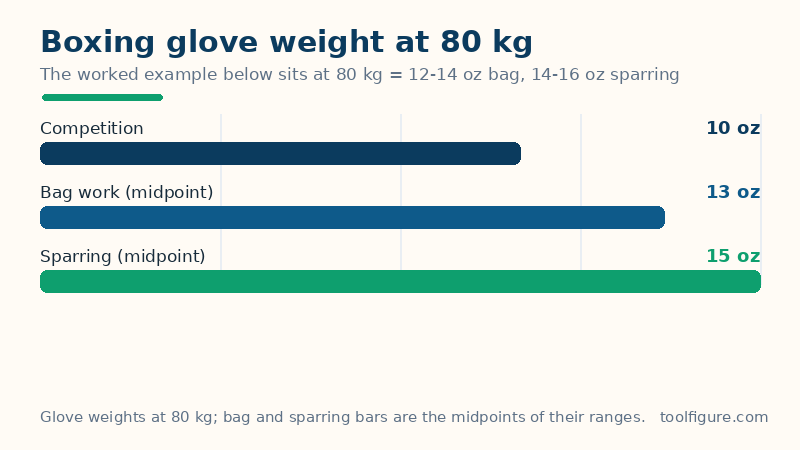
Take a boxer who weighs 80 kg (176.37 lb). That weight falls in the 68–81 kg band, so the calculator reads 12–14 oz for bag and pad work, 14–16 oz for sparring, and 10 oz for competition. The same answer comes out of the pounds input: 176 lb ÷ 2.20462 = 79.83 kg, which is in the same 68–81 kg band, so 176 lb also reads 12–14 oz for bag work. The calculator converts pounds to kilograms first and then uses the same bands, so the two units can never disagree. Other weights on the same table read:
| Body weight | Bag / Pad Work | Sparring | Competition |
|---|---|---|---|
| 50 kg | 8–10 oz | 12–14 oz | 8 oz |
| 65 kg | 10–12 oz | 14 oz | 8 oz |
| 75 kg | 12–14 oz | 14–16 oz | 10 oz |
| 85 kg | 14–16 oz | 16 oz | 10 oz |
| 100 kg | 16 oz | 16–18 oz | 10 oz |
The optional knuckle measurement only moves you inside the range, never to a different one: at 80 kg with a 22 cm knuckle circumference, the calculator adds that the hand is on the larger side, so lean to the upper end — 14 oz for bag work rather than 12 oz. A 15 cm measurement at the same weight would lean the other way, to 12 oz, and a 20 cm measurement sits mid-range and takes the range as given.
How to read your result, and its limits
Three checks before buying. First, one pair does not cover every job: most regular gym boxers end up with two pairs — a lighter bag pair and a heavier sparring pair — because the sparring column exists to protect the partner, and bagging in sparring gloves wears the extra padding down faster. Second, ounces are padding, not fit: the hand compartment, the cuff and the thumb attachment vary by brand at the same ounce weight, so the range on this page is a shortlist, not a purchase — try the shortlisted weight on, with the wraps you actually train in, and make a fist. Third, competition weights are rules, not recommendations: the 8 oz below 67 kg and 10 oz at 67 kg and over shown here are the commonly published fight-glove weights, but the bout's own rules and the sanctioning body have the final word, and a coach's advice outranks any chart. For the rest of the kit, the glove size converter fits ordinary gloves from a palm measurement, and the skateboard size calculator sizes a deck from shoe size and style.
Related tools: Cricket Bat Size Calculator — The right cricket bat size from your height, with bat length, typical age group and a next-size-up warning near a boundary.
Frequently asked questions
What size boxing gloves do I need?
Start from your body weight and what the gloves are for: 80 kg is 12–14 oz for bag work, 14–16 oz for sparring and 10 oz for competition. Enter your weight above and the calculator reads the same table.
What do boxing glove ounces mean?
Ounces measure the weight of the padding in the glove, not the size of the hand compartment. More ounces means more padding and protection and a slightly slower hand; fewer ounces means less padding and more speed.
Should I use the same gloves for bag work and sparring?
Ideally not: sparring gloves run heavier than bag gloves at the same body weight because they protect your partner too, and most regular gym boxers keep a lighter bag pair and a heavier sparring pair.
Do I size boxing gloves by hand size or body weight?
Body weight first, hand size second: the weight band gives the ounce range, and the knuckle circumference only tells you whether to lean to the lower or upper end of that range — under 16.5 cm leans low, over 21.5 cm leans high.
