One quantity, many dialects
Force — a push or a pull, F = m × a — is measured in dialects that grew up in different trades. Physicists and the whole SI system use the newton: one newton accelerates one kilogram at one metre per second squared. Engineers working in metric scale it up to the kilonewton for structural loads and down to the millinewton for small mechanisms. American structural engineers work in pound-force and its big brother the kip — a thousand pound-force — which is the unit on US beam and column drawings, where a load is quoted in kips the way a European drawing quotes it in kilonewtons. Older specifications, especially from continental Europe, quote kilogram-force: the weight of a kilogram under standard gravity. And old textbooks carry two survivors — the dyne from the centimetre-gram-second system and the poundal, one pound accelerated at one foot per second squared. They are all the same quantity wearing different costumes, and this page undresses it: any force restated in all ten units at once, worked through the newton with every factor defined.
The formula
answer = newtons ÷ (newtons in one "to" unit)
Three terms, all visible on the page. value is the number you enter. newtons in one "from" unit is the exact definition of the unit you are converting from — 4.4482216152605 for the pound-force, 9.80665 for the kilogram-force, 1,000 for the kilonewton, 0.138254954376 for the poundal. answer is the result in the unit you asked for. The pound-force factor is exact by definition: 0.45359237 kg × 9.80665 m/s² = 4.4482216152605 N, the kilogram-force is exactly 9.80665 N, and the kip is exactly 1,000 pound-force — 4,448.2216152605 N. There is no lookup table of approximations here; every conversion is the same two multiplications through the newton.
Worked example
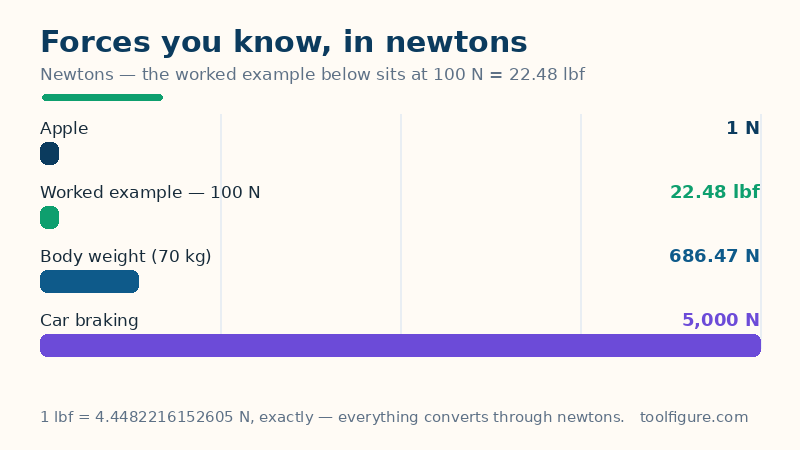
Convert 100 N to pound-force, the way the tool does it.
Step 1 — get to newtons. 100 N is already in newtons, so this step is 100 × 1 = 100 N.
Step 2 — divide by the target factor. One pound-force is 4.4482216152605 N, so 100 ÷ 4.4482216152605 = 22.48089…
Step 3 — read the display. The page prints four decimals below 10 and two above, so the headline reads 22.48 lbf, and the detail line shows the working: 100 N = 22.48 lbf — worked through newtons: 100 N ÷ the Pound-force factor.
Check it. Multiplying back, 22.48 × 4.4482216152605 = 99.996…, which is 100.00 to the display's two decimals — the gap is the rounding, not an error. The table underneath restates the same 100 N in all ten units, so the from/to choice only changes which row is the headline.
Conversions worth memorising
Every row below is the tool's own output, checked figure by figure:
| From | To | Result |
|---|---|---|
| 1 N | pound-force | 0.2248 lbf |
| 1 kN | pound-force | 224.81 lbf |
| 20 lbf | newtons | 88.96 N |
| 2.5 kN | pound-force | 562.02 lbf |
| 70 kgf | newtons | 686.47 N |
| 70 kgf | pound-force | 154.32 lbf |
| 2,500 lbf | kips | 2.5 kip |
| 150 lbf | kilogram-force | 68.04 kgf |
| 100,000 dyn | newtons | 1 N |
| 500 N | kilogram-force | 50.99 kgf |
| 1 pdl | newtons | 0.1383 N |
| 1 kip | newtons | 4,448.22 N |
Three rows deserve a second look. The 70 kgf pair is your own body weight on Earth: 70 kilograms of mass weighs 686.47 N, which is 154.32 lbf — the number American scales show, derived honestly from gravity rather than guessed. The kip row shows why US engineers love the unit: 2,500 lbf becomes a clean 2.5 kip, the way 2,500 N becomes a clean 2.5 kN. And the 20 lbf row round-trips exactly — 88.96 N back through the page gives 20 lbf — which is how you know the factor is exact rather than approximate.
Three traps worth knowing
lbf is not lb. The pound-force is a force; the pound is a mass. On Earth's surface a 1 lb mass happens to weigh 1 lbf, which is why the two get mixed up constantly — but put that mass in orbit and it still has its pound of mass while the force drops to zero. This page converts forces; if you are converting how much stuff there is, the weight converter is the page you want.
Kilogram-force is not SI, and it smuggles gravity in. One kilogram-force is defined as the force gravity exerts on a kilogram at standard gravity, 9.80665 m/s² — on the Moon the same "unit" would mean something six times smaller. It is fine for reading old specifications, but wrong for physics homework and wrong anywhere the gravity is not Earth's; use newtons there.
Tiny units hit the display floor. The page prints four decimals below 10 and two above, so one dyne — 0.00001 N — prints as 0 N. The factor is exact; the display is rounded. Convert a larger multiple instead (100,000 dynes, which reads 1 N) and the true value comes through.
How to read your result, and the limits
Results show four decimal places below 10 and two above — more precision than most load cells and spring scales justify, so round to the precision of the instrument for real use. Four limits belong with the page. Negative values are allowed: −100 N converts to −22.48 lbf — a force is a vector, and the sign is its direction, so the page converts it as given rather than refusing it. Empty input clears quietly; type and the table rebuilds, delete and the page waits. Anything past a trillion newtons gets a clear error instead of a meaningless digit string — planetary-scale forces deserve their own arithmetic. And this page converts units, not situations: it will restate a load in any dialect you like, but it will not tell you whether a beam holds — for that you need the span, the supports and an engineer.
Related tools: Unit Converter — Convert length, weight, temperature and volume — km to miles, kg to pounds, °C to °F, litres to gallons; Weight Converter — Kilograms to pounds, pounds to kg, ounces, stone and tonnes — every answer in all eight units, through the exact definitions; Torque Converter — N·m to ft·lb, in·lb, kgf·m and more — every answer in all nine units, through the exact definitions.
Frequently asked questions
How do I convert newtons to pounds-force?
Multiply by 0.224809 — that is 1 ÷ 4.4482216152605. So 100 N becomes 22.48 lbf, and 1 kN becomes 224.81 lbf. To go back, multiply pound-force by 4.4482: 20 lbf is 88.96 N. This page does both directions and restates every answer in all ten units at once.
What is the difference between lbf and lb?
A pound-force (lbf) is a unit of force; a pound (lb) is a unit of mass. On Earth's surface a 1 lb mass weighs 1 lbf, so the numbers match and the two get mixed up — but they are different quantities, and in zero gravity the mass remains while the force vanishes. Convert forces here; convert masses on the weight converter.
What is a kip?
A kip is 1,000 pound-force — 4,448.22 N — and it is the working unit of American structural engineering: beam loads, column loads and connection forces on US drawings are quoted in kips the way European drawings quote kilonewtons. 2,500 lbf is 2.5 kip.
Why does this page allow negative forces?
Because a force is a vector and the sign carries its direction — pushing versus pulling, up versus down. −100 N converts to −22.48 lbf honestly, the same arithmetic with the sign kept, rather than the page pretending opposite directions do not exist.
