Three steps: heater watts, warm-up, session
The whole calculation is two small multiplications added together, and the warm-up is the one people get wrong. Heater watts divided by 1,000 is heater kilowatts; heater kilowatts times the warm-up hours is the warm-up's energy; heater kilowatts times the session hours times the load is the session's energy; the two together are the session's energy; the session's energy times the sessions a week times 52 is the year's energy; the year's energy times the price is the year's money. The month is the year divided by 12, not the week times 4 — the two differ by about seventy-five cents on a sauna, and the year-divided-by-12 figure is the one this page uses, so it agrees with the yearly total exactly:
warm-up energy per session (kWh) = heater watts ÷ 1,000 × warm-up minutes ÷ 60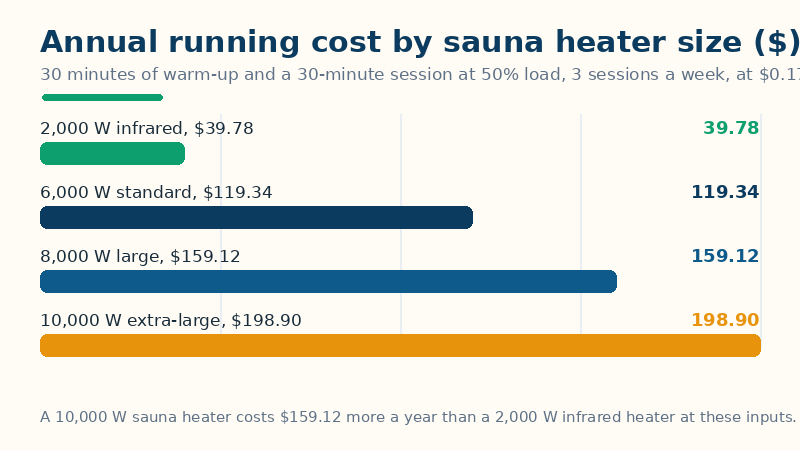
session energy per session (kWh) = heater watts ÷ 1,000 × session minutes ÷ 60 × average load ÷ 100annual cost ($) = (warm-up energy + session energy) × sessions a week × 52 × electricity priceThe heater watts on the rating plate are the sauna's maximum draw, and the heater does not draw them all day. Most home saunas run 2,000 to 10,000 W — infrared cabins at 1,500 to 2,500 W, standard traditional saunas at 6,000 to 9,000 W, large outdoor saunas at 9,000 to 12,000 W. What matters is the warm-up: a traditional heater draws full power until the room reaches temperature, which takes about 30 to 45 minutes, and then cycles at roughly half power to hold it — saunahelper's worked example, a 6 kW heater warming up for 30 minutes and running a 30-minute session at 50% load, uses 4.5 kWh a session.
Worked example: 6,000 W heater, 30 minutes of warm-up, a 30-minute session at 50% load, 3 sessions a week, $0.17/kWh
A 6,000 W heater warming up for 30 minutes uses 6 × 0.5 = 3.000 kWh of warm-up, and a 30-minute session at 50% load uses 6 × 0.5 × 0.50 = 1.500 kWh. Together that is 4.5 kWh a session, costing $0.77. A week is 4.5 × 3 = 13.5 kWh, costing $2.30. A month is 702 ÷ 12 = 58.5 kWh, costing $9.95. A year is 4.5 × 3 × 52 = 702.0 kWh, costing $119.34. The table above shows the same maths for the other heater sizes at 30 minutes of warm-up, a 30-minute session at 50% load and 3 sessions a week: a 2,000 W infrared heater uses 1.5 kWh a session, costing $0.26 a session, $3.32 a month and $39.78 a year, an 8,000 W large heater uses 6.0 kWh a session, costing $1.02 a session, $13.26 a month and $159.12 a year, and a 10,000 W extra-large heater uses 7.5 kWh a session, costing $1.28 a session, $16.58 a month and $198.90 a year. One hour at full power costs 102.0¢; at 100% load the session uses 6.000 kWh and costs $1.02 — $159.12 a year — and ten years of sauna at this pace costs $1,193.40. Five published cross-checks reproduce exactly: saunahelper's 6 kW sauna at 30 minutes of warm-up, a 30-minute session at 50% load, 3 sessions a week and 18.34 cents costs $0.83 a session, $10.73 a month and $128.75 a year — this page gives the same $0.83 a session, $10.73 a month and $128.75 a year. saunamonthly's 6 kW heater at an hour's warm-up, a 40-minute session at half power, 5 sessions a week and 18 cents uses 8.0 kWh a session and costs $1.44 a session — this page gives the same 8.0 kWh and $1.44, with $31.20 a month against their 'about $31' and $374.40 a year against their '$374'. Their 8 kW heater on the same pattern uses 10.7 kWh a session and costs $1.92 — this page gives the same 10.7 kWh and $1.92, with $41.60 a month against their 'about $42'. Their 2 kW infrared cabin at 30 minutes of warm-up and a 40-minute session at full power, 5 sessions a week and 18 cents uses 2.3 kWh a session and costs 42¢ — this page gives 2.3 kWh and $0.42 a session, with $9.10 a month against their 'about $9'. And hottubpatio's 6 kW heater at 30 minutes of warm-up, a 30-minute session at 60% load and 18 cents uses 4.8 kWh a session and costs $0.86 — this page gives the same 4.8 kWh and $0.86, with the 100% ceiling at 6.0 kWh and $1.08, exactly as they state it.
How to read your result, and its limits
Four cautions keep the number honest. First, the warm-up is most of the bill: at the worked example's inputs the warm-up uses 3.0 kWh a session and the session 1.5 kWh — two-thirds warm-up, one-third session — so a second session in an already-warm sauna costs about a third of the first. Second, the load percentage is an estimate, not a measurement: 50% is the usual starting figure for a traditional sauna once it is up to temperature, but insulation, room size, outdoor temperature and how often the door opens all move it — a plug-in power meter on the heater circuit for a week gives the real figure, and the 100% ceiling is the most the session can possibly cost. Third, this page prices electric saunas only: a wood-fired sauna burns wood, not kilowatt-hours, and its running cost is the price of the wood — the heater watts here are electric watts. For the hot tub beside the sauna, the hot tub cost calculator prices the heater and the jets separately. Fourth, the electricity price is the all-in rate: the total on the bill divided by the kilowatt-hours on the bill, including delivery charges. For the cost of running anything else in the house, the electricity cost calculator prices any appliance by watts and hours.
Common mistakes
- Pricing the heater watts as if they ran at full power the whole session. A 6,000 W heater does not use 3.0 kWh for a 30-minute session — at 50% load it uses 1.5 kWh, $0.26, not $0.51. Enter the load, not just the watts.
- Forgetting the warm-up. The session alone is 1.5 kWh, but the warm-up adds 3.0 kWh — the session is $0.77, not $0.26. Count the warm-up every time the sauna starts cold.
- Multiplying the weekly cost by 4 for the month. Four weeks is not a twelfth of a year: the week times 4 gives $9.20 a month at the worked example's inputs, while the year divided by 12 gives $9.95. Use the year-divided-by-12 figure, which is the one that adds up.
- Comparing a traditional sauna with an infrared cabin on watts alone. A 6,000 W traditional heater costs $119.34 a year at the worked example's frequency, but a 2,000 W infrared cabin on the same frequency costs $39.78 — the cabin also warms up in about half the time, so the gap is bigger than the watts suggest.
- Adding the standing charge to every session. The daily supply charge is payable whether the sauna runs or not. Only the per-kWh rate belongs in the per-session maths — the fixed charge is a separate line on the bill.
Related tools: Space Heater Cost Calculator — What does your space heater really cost to run? Price the heat by watts, hours and thermostat — per hour, day, month and year.
Frequently asked questions
How much does it cost to run a sauna per session?
At the worked example's inputs — a 6,000 W heater, 30 minutes of warm-up and a 30-minute session at 50% load — a sauna uses 4.5 kWh a session and costs $0.77 at $0.17 per kWh. Three sessions a week cost $9.95 a month and $119.34 a year. A 2,000 W infrared cabin costs $0.26 a session and a 10,000 W large heater $1.28 a session at the same times and rate.
How much electricity does a sauna use per hour?
A 6 kW heater at full power uses 6 kWh in one hour, costing $1.02 at $0.17 per kWh. But a sauna rarely draws full power for a whole hour: the warm-up runs at full power and the session cycles at about half, so the worked example's hour — 30 minutes of warm-up plus 30 minutes at 50% load — uses 4.5 kWh.
What costs more — the warm-up or the session?
The warm-up, at the worked example's inputs: 3.0 kWh of warm-up against 1.5 kWh for the session — two-thirds warm-up, one-third session. That is why short sessions cost almost as much as long ones, and why an infrared cabin, which warms up in about 15 minutes, costs far less per session than a traditional sauna.
How can I reduce my sauna running costs?
Shorten the warm-up by preheating only as long as your sauna needs — well-insulated cabins reach temperature faster — keep sessions at the temperature you actually enjoy rather than the maximum, and use the sauna on days you would heat it anyway: the second session in an already-warm sauna skips the warm-up entirely. An infrared cabin at 2,000 W costs $39.78 a year at the worked example's frequency against $119.34 for a 6,000 W traditional heater.