The method: one measurement, matched to a band
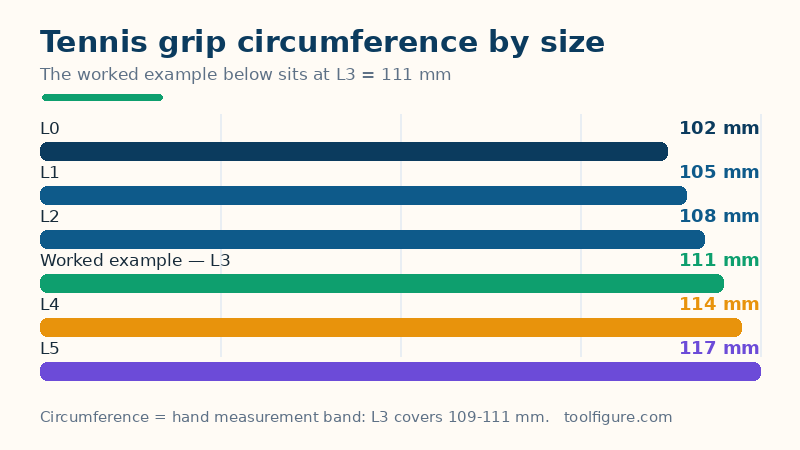
Measure your dominant hand flat, fingers together, from the bottom lateral crease of your palm to the tip of your ring finger. Convert that length to millimetres — inches × 25.4, or centimetres × 10 — round to the nearest whole millimetre, and match it to the band it falls in. The grip size is the circumference around the handle, and the published charts line the two up directly: the hand measurement that reads 4 3/8 in sits in the 109–111 mm band, and the grip it buys is 111 mm around. The L number and the European number are the same digit: L3 is EU 3, L0 is EU 0, and the US size steps by eighths of an inch from 4 in at L0 to 4 5/8 in at L5.
| Size | US | EU | Circumference | Hand measurement |
|---|---|---|---|---|
| L0 | 4 in | 0 | 102 mm | 100–102 mm |
| L1 | 4 1/8 in | 1 | 105 mm | 103–105 mm |
| L2 | 4 1/4 in | 2 | 108 mm | 106–108 mm |
| L3 | 4 3/8 in | 3 | 111 mm | 109–111 mm |
| L4 | 4 1/2 in | 4 | 114 mm | 112–114 mm |
| L5 | 4 5/8 in | 5 | 117 mm | 115–117 mm |
Worked example: 4 3/8 in
Take a hand measurement of 4 3/8 in (4.375 in). The arithmetic is 4.375 × 25.4 = 111.1 mm, rounded to 111 mm, which sits inside the 109–111 mm band — so the grip size is L3, 4 3/8 in, EU 3, 111 mm. The same hand measured in centimetres reads 11.1 cm: 11.1 × 10 = 111 mm, the same band, the same L3. The rest of the table checks the same way: 4 1/4 in is 107.9 mm, rounded to 108 mm, so L2; 4 1/2 in is 114.3 mm, rounded to 114 mm, so L4; 4 in is 101.6 mm, rounded to 102 mm, so L0; and 4 5/8 in is 117.5 mm, rounded to 117 mm, so L5. Rounding to the whole millimetre is what removes the gaps: a measurement of 102.6 mm rounds to 103 mm and reads L1, not a no-mans-land between L0 and L1.
How to read your result, and its limits
Three checks before buying. First, between sizes, take the smaller one: an overgrip wrapped over the base grip adds about 1/16 in, roughly half a size, so a grip that feels slightly small can be built up, while one that feels large cannot be shrunk — and a replacement grip adds a similar amount, so count what is already on the handle. Second, confirm with the finger test: hold a racquet in a normal forehand grip and slide the index finger of your other hand into the gap between your ring finger and your palm — it should fit snugly, not loosely and not jammed. If the ruler and the finger test disagree, trust the feel of the racquet in your hand over the tape. Third, brands vary around the table: the chart is the published standard, but two makers L3 handles can differ slightly, and a thick overgrip or a worn grip changes the effective size — so treat the letter as the starting point and the demo racquet as the verdict. For the rest of the kit, the glove size converter sizes hands from palm circumference, and the helmet size converter sizes head protection from a tape measure.
Related tools: Bike Frame Size Calculator — Your frame size for road, gravel, hybrid and mountain bikes from one inseam measurement, plus starting saddle height.
Frequently asked questions
What tennis grip size is 4 3/8 inches?
L3 — EU 3, 111 mm around the handle. A hand measurement of 4.375 in converts to 111.1 mm, rounded to 111 mm, inside the 109–111 mm band for L3.
How do I measure my tennis grip size?
Hold your dominant hand flat with fingers together and measure from the bottom lateral crease of your palm to the tip of your ring finger. That length in inches is your grip size: 4 1/4 in buys L2, 4 3/8 in buys L3, 4 1/2 in buys L4.
What if I fall between two grip sizes?
Take the smaller one. An overgrip wrapped over the base grip adds about 1/16 in, roughly half a size, so a slightly small grip can be built up — a grip that feels large cannot be shrunk.
Do the L size and the EU number mean the same thing?
Yes, they are the same digit: L0 is EU 0, L3 is EU 3, L5 is EU 5. The US size is the same grip in inches, stepping by eighths from 4 in at L0 to 4 5/8 in at L5.
