Three steps: watts, duty hours, cost
The whole calculation is one multiplication with a correction for the cycling. Watts times the duty hours a day, divided by 1,000, is the day's energy; the day's energy times 365 days is the year's energy; the year's energy times the price is the year's money. The correction that makes the answer honest is the duty hours — the compressor does not run all day:
energy per day (kWh) = watts × duty hours a day ÷ 1,000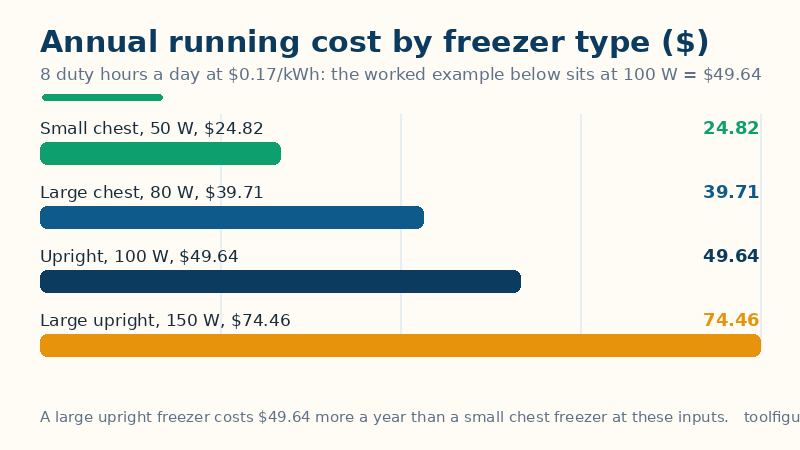
annual energy (kWh) = energy per day × 365annual cost ($) = annual energy × electricity priceA freezer's compressor runs roughly 8 to 9.6 hours out of every 24 — a third to 40% of the time — depending on the room, the setting and how often the door opens. One measured guide found a standalone freezer averaging about 130 W while its compressor runs, over about 8.5 duty hours a day. Typical running watts are about 50 W for a small chest, 80 W for a large chest, 100 W for an upright and 150 W for a large upright. A chest typically uses less energy than an upright of the same size, because cold air stays inside a chest when the lid opens while it spills out of an upright when the door opens. The energy label is the honest source for your own freezer: labels show annual kWh — a new ENERGY STAR chest model claims roughly 215 to 260 kWh a year — so divide the label's figure by 365 for the daily energy, or compare it with this page's annual figure.
Worked example: 100 W upright, 8 duty hours a day, $0.17/kWh
A 100 W upright freezer running 8 duty hours a day at $0.17 per kWh uses 100 × 8 ÷ 1,000 = 0.8 kWh a day. A year is 0.8 × 365 = 292.0 kWh, costing $49.64. A month is 292.0 ÷ 12 = 24.3 kWh, costing $4.14. The table above shows the same maths for the other freezer types at the same 8 duty hours a day: a small chest at 50 W costs $24.82 a year, a large chest at 80 W costs $39.71, and a large upright at 150 W costs $74.46. At 12 duty hours a day the 100 W upright costs $74.46 a year, and at 6 duty hours $37.23. Four published cross-checks reproduce exactly: WattCostCalc's 100 W freezer at 24 hours a day drawing full power 40% of the time — 9.6 duty hours — at 17.5 cents costs $0.17 a day and $61.32 a year, and this page gives the same $61.32, while its month is $5.04 because it multiplies the day by 30 and this page's month is $5.11 because it divides the year by 12; a 130 W freezer running 8.5 duty hours at 18.44 cents uses 1.105 kWh a day, 33.6 kWh a month and $6.20 a month — bill.ninja's figures — and $74.37 a year on this page; a 148 W chest freezer running 10 hours at 17.2 cents uses 45.0 kWh a month, $7.74 a month and $92.91 a year — joteo's figures; and a 200 W freezer at 40% runtime and 15 cents costs $105.12 a year — costtorun's figure — while its month is $8.64 by the day-times-30 rule and this page's month is $8.76 by the year-divided-by-12 rule.
How to read your result, and its limits
Four cautions keep the number honest. First, the year is 365 days and the month is the year divided by 12: 292.0 kWh a year is 24.3 kWh a month and $4.14, while the day times 30 would give 24.0 kWh and $4.08 — a six-cent difference that is only a convention, and the year-divided-by-12 figure is the one that adds up to the yearly total. Second, duty hours move with the room: a freezer in a hot garage runs more hours than one in a cool basement, and the published range is wide — the US Energy Information Administration measured 570 kWh a year for the average separate freezer in American homes, while a new ENERGY STAR chest model claims roughly 215 to 260 kWh a year — so if your freezer sits somewhere hot, raise the duty hours rather than the watts. Third, a half-empty freezer still costs nearly the same: the compressor cools the air whether the shelves are full or not, so keeping it full — even with sealed water bottles — steadies the temperature and the compressor cycles less. Fourth, the electricity price is the all-in rate: the total on the bill divided by the kilowatt-hours on the bill, including delivery charges. For the appliance that shares the cold, the refrigerator cost calculator prices the fridge the same way — watts times duty hours, not 24 hours on the clock; for the cost of running anything else in the house, the electricity cost calculator prices any appliance by watts and hours; and for the dishes, the dishwasher cost calculator prices the cycle by kWh.
Common mistakes
- Multiplying the nameplate watts by 24 hours. A 100 W freezer at 24 hours looks like 2.4 kWh a day and $148.92 a year — against the real 0.8 kWh a day and $49.64. The compressor runs about 8 hours a day, not 24.
- Comparing freezers on watts instead of annual kWh. A 150 W upright at 8 duty hours is 438 kWh a year and $74.46, while a 50 W chest is 146 kWh and $24.82 — the watts alone do not say which costs more to run; watts times duty hours does.
- Forgetting the garage in summer. Duty hours rise with the room temperature: a freezer that costs $49.64 a year in a cool kitchen costs more in a hot garage. Raise the duty hours to match the season instead of guessing a higher wattage.
- Adding the standing charge to every day. The daily supply charge is payable whether the freezer runs or not. Only the per-kWh rate belongs in the per-day maths — the fixed charge is a separate line on the bill.
Frequently asked questions
How much does it cost to run a freezer per month?
A 100 W upright freezer running 8 duty hours a day at $0.17 per kWh uses 24.3 kWh a month and costs $4.14 — $49.64 a year. A small chest at 50 W costs $2.07 a month and $24.82 a year at the same duty hours and rate.
Does a chest freezer cost less to run than an upright?
Usually, yes: cold air stays inside a chest when the lid opens, while it spills out of an upright when the door opens. At the same 8 duty hours a day and $0.17 per kWh, a small chest at 50 W costs $24.82 a year against $49.64 for a 100 W upright — though the watts and the duty hours both matter, not the shape alone.
How many watts does a freezer use?
About 50 to 200 W while the compressor runs — 50 W for a small chest, 100 W for a typical upright, 150 W for a large upright. The watts are the running draw, not the daily energy: the bill is decided by watts times the duty hours, about 8 hours a day, not by watts times 24.
Is it cheaper to switch a freezer off when it is empty?
No — an empty freezer switched off saves the running cost but the food has to go somewhere, and re-cooling a warm freezer uses more energy than keeping it cold. If a freezer is half empty most of the year, fill the space with sealed water bottles: the frozen mass steadies the temperature and the compressor cycles less.