The formula: age bands, then diameter from circumference
Ball size is an age band, with gender deciding only the top two sizes: ages 2–3 take size 1, age 4 takes size 3, ages 5–8 take size 4, ages 9–11 take size 5, and from age 12 girls and women stay on size 6 while boys take size 6 at 12–14 and move to size 7 at 15. The one piece of arithmetic on the page is the diameter, worked out from the circumference because ball sizes are specified by circumference:
Diameter = circumference ÷ π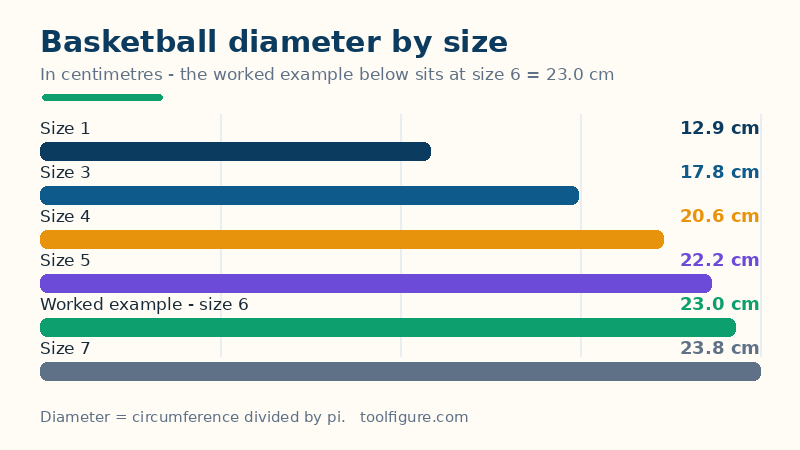
| Ball size | Circumference | Weight | Diameter |
|---|---|---|---|
| Size 1 (mini) | 16 in (40.6 cm) | 8 oz (227 g) | 12.9 cm |
| Size 3 (mini) | 22 in (55.9 cm) | 10 oz (283 g) | 17.8 cm |
| Size 4 | 25.5 in (64.8 cm) | 14 oz (397 g) | 20.6 cm |
| Size 5 | 27.5 in (69.9 cm) | 17 oz (482 g) | 22.2 cm |
| Size 6 | 28.5 in (72.4 cm) | 20 oz (567 g) | 23.0 cm |
| Size 7 | 29.5 in (74.9 cm) | 22 oz (624 g) | 23.8 cm |
Worked example: age 13, boy
A 13-year-old boy is in the 12–14 boys' band, so the ball is size 6: 28.5 in around (72.4 cm), 20 oz (20 × 28.3495 = 566.99 g, rounded to 567 g), and its diameter is the circumference divided by pi: 72.4 ÷ 3.1416 = 23.0 cm. A second check: a 10-year-old takes size 5 — 27.5 in (69.9 cm), 17 oz (482 g), diameter 69.9 ÷ π = 22.2 cm — and a 7-year-old takes size 4 — 25.5 in (64.8 cm), 14 oz (397 g), diameter 64.8 ÷ π = 20.6 cm. A 13-year-old girl takes the same size 6, and stays on it as an adult: size 6 is the official women's ball.
How to read your result, and its limits
Three checks before buying. First, the league's table beats this page: the 14/15 boundary for boys is the one place the published guides genuinely disagree — some move boys to size 7 at 14, this page at 15. Second, sizes 3 and 4 overlap at ages 5–8 by design: size 4 is the standard youth ball and size 3 the lighter mini alternative, so a smaller or weaker player in that band is better off on the size 3. Third, weight matters as much as size: a size 7 weighs more than twice a size 3 (22 oz against 10 oz), which is why a too-big ball wrecks a young player's shooting form.
Common mistakes
- Buying size 7 for a young teenager. A 13- or 14-year-old boy plays size 6 on this page's table — the full-size ball comes at 15, when the strength to shoot it properly arrives.
- Giving a girl the men's ball. Girls and women play size 6 at every level, including the professional game — size 7 is the men's ball only.
- Judging by height instead of age. Ball size follows the age band, not how tall the player is — a tall 10-year-old still plays size 5.
- Skipping the mini ball for a small child. A 4-year-old with a size 4 cannot control it; the size 3 mini ball exists for exactly that player.
Related tools: Soccer Ball Size Calculator — The right soccer ball size from the player's age: league sizes 3, 4 and 5, plus skills balls 1 and 2; Volleyball Size Calculator — The right volleyball size from age: indoor sizes 3, 4 and 5 plus the beach ball, with circumference, weight and diameter; Baseball Glove Size Calculator — The right baseball glove size from age group and position: the published chart, looked up openly, with the catcher's circumference exception stated.
Frequently asked questions
What size basketball does a 13-year-old boy need?
Size 6: 28.5 in around, 20 oz, about 23.0 cm across. Boys stay on size 6 through age 14 and move to the full-size 7 at 15.
What size basketball for a 10-year-old?
Size 5 for both boys and girls: 27.5 in around, 17 oz, about 22.2 cm across. It is the standard youth ball for ages 9–11.
What is the difference between a size 6 and a size 7 basketball?
Size 6 is 28.5 in and 20 oz (23.0 cm across); size 7 is 29.5 in and 22 oz (23.8 cm across). Size 6 is the official women's ball and the boys' 12–14 ball; size 7 is the men's ball from age 15 up.
Do girls use a different basketball size?
Yes, from age 12: girls and women play size 6 at every level, while boys move to size 7 at 15. Below age 12 the bands are shared — size 5 at 9–11, size 4 at 5–8.
