One quantity, many dialects
Power — the rate at which energy moves — is measured in dialects that grew up in different trades. Electricians and EV makers use watts and kilowatts. Car makers use horsepower, and European ones often use the slightly different metric horsepower (PS). Air-conditioner catalogues speak tons of refrigeration and BTU per hour. They are all the same quantity wearing different costumes, and this page undresses it: any rating restated in all eight units at once, worked through the watt with every factor defined.
How the conversion works, with every factor defined
Watts = value × the from-unit's factor · Converted value = watts ÷ the to-unit's factorKilowatt 1,000 · Megawatt 1,000,000 · Mechanical hp 745.6998715822702 (550 ft·lb/s, exact) · Metric hp (PS) 735.49875 (exact) · BTU/h 0.29307107017222224 · Ton of refrigeration 3,516.8525 · Foot-pound per second 1.35581794833140041 hp = 0.745699871582 kW · 1 kW = 1.34102209 hp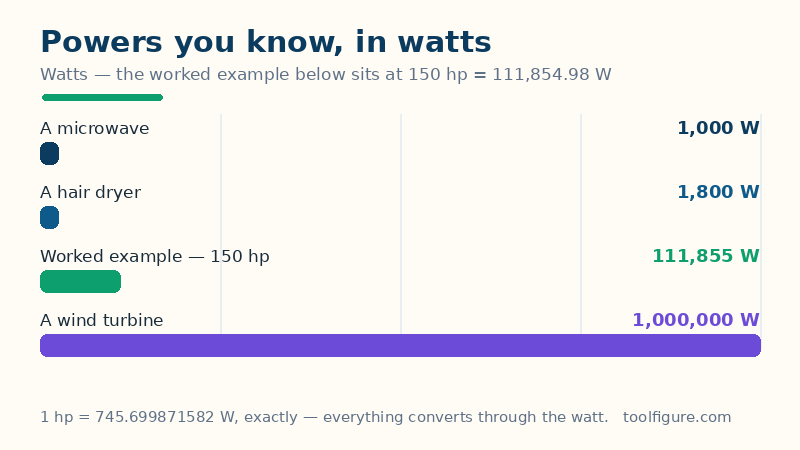
These factors are definitions, not measurements. Mechanical horsepower was fixed as 550 foot-pounds per second — which, with the exact modern definitions of the foot and the pound, is 745.6998715822702 watts. Metric horsepower is 75 kilogram-force metres per second: 735.49875 watts, exactly, about 1.4% smaller than the mechanical one. A ton of refrigeration is defined as 12,000 BTU per hour, the cooling power that melts a short ton of ice in a day: 3,516.8525 watts. Converting to a bigger unit always makes the number smaller — 150 of anything becoming a tenth of a megawatt is the correct shape — and the honest page names which horsepower it uses, because hp and PS differ and neither is "the" horsepower.
Worked example: 150 mechanical horsepower
The defaults above convert 150 mechanical horsepower — a family car's engine. Through the base unit: 150 × 745.699871582 = 111,854.98 W. Dividing by each unit's factor: 111.85 kW, 0.1119 MW, 152.08 PS (the same engine sounds stronger in metric), 381,665.04 BTU/h, 31.81 tons of refrigeration — and exactly 82,500 ft·lb/s, because 150 × 550 is the definition working in reverse, the one row on the page that needs no rounding. Three habits follow from the method. First, the quick mental version — horsepower times three-quarters is close to kilowatts — gives 112.5 for 150 hp, within 0.6% of the true 111.85; fine for comparing brochures, not for sizing a motor. Second, always convert before you compare engine figures: 150 hp and 152 PS are nearly the same engine, not two ratings a trim level apart. Third, keep power and energy apart: 111.85 kW is the rate; running it for an hour is 111.85 kWh of energy — a job for the energy converter this page links below.
The conversions people actually ask for
| Conversion | Answer | How it is worked |
|---|---|---|
| 150 hp to kW (worked example) | 111.85 kW | 150 × 0.745699871582 |
| 1 mechanical hp to watts | 745.7 W | The definition, 550 ft·lb/s |
| 1 mechanical hp to kW | 0.7457 kW | 745.699871582 ÷ 1,000 |
| 1 kW to mechanical hp | 1.341 hp | 1,000 ÷ 745.699871582 |
| 200 hp to kW | 149.14 kW | 200 × 0.745699871582 |
| 100 kW motor to hp | 134.1 hp | 100,000 ÷ 745.699871582 |
| 1 metric hp (PS) to watts | 735.5 W | The definition, 75 kgf·m/s |
| 1 metric hp (PS) to kW | 0.7355 kW | 735.49875 ÷ 1,000 |
| 100 PS car to mechanical hp | 98.63 hp | 100 × 735.49875 ÷ 745.699871582 |
| 1 ton of refrigeration to kW | 3.5169 kW | 3,516.8525 ÷ 1,000 |
| 12,000 BTU/h to tons | 1 ton | 12,000 × 0.29307107017 ÷ 3,516.8525 — the definition working in reverse |
| 1 MW turbine to hp | 1,341.02 hp | 1,000,000 ÷ 745.699871582 |
| Hair dryer: 1,800 W to hp | 2.4138 hp | 1,800 ÷ 745.699871582 |
| 150 hp to MW | 0.1119 MW | 111,854.98 ÷ 1,000,000 |
Three rows deserve a second look. The 100 PS row is why the honest page offers both horsepowers: a European car badged 100 PS is 98.63 mechanical hp — smaller than the badge number suggests, and the 1.4% gap compounds in advertising copy. The 12,000 BTU/h row is the definition checking itself: 12,000 BTU/h ÷ 3,516.85 W lands on exactly 1 ton of refrigeration, which is how you know the factors are consistent rather than two rounded strangers. And the hair-dryer row puts the units in your hand: an 1,800-watt dryer is about two and a half horsepower — the same "horsepower" as the first steam engines, which is where the word came from.
How to read your result, and the limits
Results show four decimal places below 10 and two above — more precision than any nameplate justifies, so round to the precision of the rating for real use. Four limits belong with the page. Horsepower has cousins: this page offers mechanical hp and metric PS only — electric hp (746 W) and boiler hp (33,475 BTU/h) exist and are not offered, stated rather than silently merged. VA is not W: in AC circuits volt-amperes equal watts only for purely resistive loads — do not convert a 5 kVA UPS to 5 kW without the power factor. kW is not kWh: kilowatts are a rate, kilowatt-hours an amount — converting between them needs a duration, and this page does not do it. And the ton row is a cooling power, not a mass: a 3-ton air conditioner weighs nothing like three tons.
Related tools: Unit Converter — Convert length, weight, temperature and volume — km to miles, kg to pounds, °C to °F, litres to gallons; Energy Converter — Joules to calories, kcal to kJ, kWh to joules and BTU — every answer in all ten units, through the exact definitions; Electricity Cost Calculator — What any appliance costs to run — per day, per month and per year — from watts, hours and your rate.
Frequently asked questions
How many kW is 1 hp?
0.7457 kW — one mechanical horsepower is defined as 745.699871582 watts. So a 150 hp car engine is 111.85 kW, and the quick mental version (hp × 0.75) lands within 0.6%. Metric horsepower (PS) is slightly smaller: 0.7355 kW.
What is the difference between hp and PS?
Mechanical horsepower (hp) is 745.699871582 W, defined as 550 foot-pounds per second. Metric horsepower (PS, Pferdestärke) is 735.49875 W, defined as 75 kilogram-force metres per second — about 1.4% smaller. A car badged 100 PS is 98.63 mechanical hp; this page offers both, stated openly.
How many watts is a ton of refrigeration?
3,516.85 W. A ton of refrigeration is a cooling-power rating defined as 12,000 BTU per hour — the power that melts a short ton of ice in a day — not a mass. A 3-ton air conditioner therefore moves about 10.55 kW of heat.
Can I convert kW to kWh with this converter?
No — and any page that offers it without asking for a time is hiding something. Kilowatts are a rate, kilowatt-hours an amount: multiply the kW by the hours it runs to get kWh, then use the energy converter this page links below for the unit juggling.