Three steps: total watts, hours a night, nights a season
The whole calculation is one multiplication repeated, and the total watts are the one people get wrong. Total watts divided by 1,000 is kilowatts; kilowatts times the hours a night is the night's energy; the night's energy times the nights is the season's energy; the season's energy times the price is the season's money. A 30-night month is the night's energy times 30, and it is shown only as a comparison — the season is the unit that matters, because the lights do not run all year:
energy per night (kWh) = total display watts ÷ 1,000 × hours a night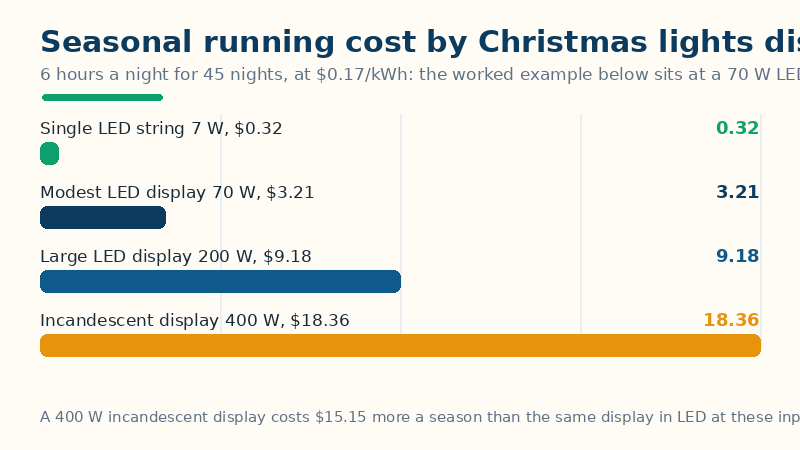
seasonal cost ($) = energy per night × nights a season × electricity priceThe watts are the whole display added up, not one string. A 100-bulb LED string draws about 5 to 10 watts and a 100-bulb incandescent string about 40 to 70 watts, so a modest display of ten strings is 70 watts in LED and 400 watts in incandescent — the same display, six times the bill. What matters is the bulb: traditional incandescent mini-lights use about 0.4 to 0.5 watts a bulb and LEDs about 0.07 watts a bulb, roughly 85 to 90% less, which is why the same display costs $3.21 a season in LED and $18.36 in incandescent at the worked example's inputs.
Worked example: 70 W LED display, 6 hours a night, 45 nights, $0.17/kWh
A 70 W LED display running for 6 hours a night uses 0.07 × 6 = 0.420 kWh a night, costing $0.07. A 30-night month is 0.420 × 30 = 12.6 kWh, costing $2.14. A 45-night season is 0.420 × 45 = 18.900 kWh, costing $3.21. The table above shows the same maths for the other display sizes at 6 hours a night, 45 nights and $0.17/kWh: a single 7 W LED string uses 0.042 kWh a night, costing $0.01 a night and $0.32 a season, a large 200 W LED display uses 1.200 kWh a night, costing $0.20 a night and $9.18 a season, and a 400 W incandescent display uses 2.400 kWh a night, costing $0.41 a night and $18.36 a season. One hour costs 1.2¢; ten seasons at this pace cost $32.13; and a timer cutting the night from 8 hours to 5 saves 37.5% — $1.61 a season at these watts and rate. Four published cross-checks reproduce exactly: wattcostcalc's 40 W display at 6 hours a day and $0.175 costs $0.007 an hour, $0.042 a day, $1.26 a month and $15.33 a year — this page gives the same $0.007 an hour and $0.04 a night, with $1.26 for a 30-night season; their $15.33 a year is the same 0.24 kWh a day × 365 days × $0.175. lifeandwork's 50 W display at 6 hours a night for 30 nights at $0.18 uses 9 kWh and costs $1.62 — this page gives the same 9.000 kWh and $1.62 — and their 48 W, ten-string example at 6 hours for 35 nights costs $1.81 — this page gives the same $1.81. electricchoice's modest display — ten strings of 100-bulb mini lights, 6 hours a night for 45 nights at 16.5¢ — costs $17.82 in incandescent and $3.12 in LED — this page gives the same $17.82 and $3.12. And alibaba's 40 W incandescent strand at 6 hours a night for 30 nights at $0.13 costs $0.94 a month — this page gives the same $0.94 for a 30-night season.
How to read your result, and its limits
Four cautions keep the number honest. First, the bulb type is the decision: at the worked example's inputs the same display costs $3.21 a season in LED and $18.36 in incandescent — a $15.15 difference every season — so switching bulbs saves more than any timer ever will. Second, count the whole display: strings, the tree, the roofline, the inflatables and the projector all draw watts, and an inflatable alone adds 100 to 200 watts — a display priced on the strings alone is priced on half the display. Third, the season is nights, not a calendar month: the lights run about 45 nights, not 365, so the $3.21 a season is the bill, and the $2.14 for a 30-night month is only a comparison figure — never multiply the season by 12. Fourth, this page prices electricity only: the lights themselves, the timer and the extension cords are separate lines, and the electricity price is the all-in rate, the total on the bill divided by the kilowatt-hours on the bill. For the saving from switching the bulbs in the house, the LED bulb savings calculator prices the same swap indoors; for the cost of running anything else, the electricity cost calculator prices any appliance by watts and hours.
Common mistakes
- Pricing one string and stopping there. A string is $0.32 a season, but ten strings are $3.21 — the display is the sum of its strings. Add them all up, including the inflatables.
- Pricing an incandescent display at LED watts. The same ten strings are 70 watts in LED and 400 watts in incandescent — $3.21 a season against $18.36. Check which bulbs you actually own before entering the watts.
- Multiplying the season by 12 for the year. The lights run about 45 nights, not 365 — the season is $3.21, not $38.52. The season is the unit; the year does not apply.
- Forgetting the timer. Cutting the night from 8 hours to 5 saves 37.5% — $1.61 a season at the worked example's watts and rate — and a timer does it every night without being remembered.
- Adding the standing charge to every night. The daily supply charge is payable whether the lights run or not. Only the per-kWh rate belongs in the per-night maths — the fixed charge is a separate line on the bill.
Related tools: Air Conditioner Cost Calculator — What does your air conditioner really cost to run? Price it by BTU and SEER — day, month and season.
Frequently asked questions
How much does it cost to run Christmas lights?
At the worked example's inputs — a 70 W LED display, 6 hours a night for 45 nights — Christmas lights use 18.9 kWh a season and cost $3.21 at $0.17 per kWh, about $0.07 a night. A single 7 W LED string costs $0.32 a season, a large 200 W LED display $9.18, and the same display in incandescent bulbs $18.36.
Do LED Christmas lights use much electricity?
Very little. A 70 W LED display uses 0.42 kWh a night and costs $0.07 at $0.17 per kWh — $3.21 for a 45-night season. LEDs use about 85 to 90% less electricity than incandescent bulbs: the same display in incandescent bulbs draws 400 W and costs $18.36 a season.
How many watts do Christmas lights use?
A 100-bulb LED string draws about 5 to 10 watts and a 100-bulb incandescent string about 40 to 70 watts. A modest display of ten strings is about 70 watts in LED and about 400 watts in incandescent — add up every string, inflatable and projector in your display for the total.
How can I reduce the cost of running Christmas lights?
Switch to LEDs first — it cuts the bill by about 85 to 90% — then put the display on a timer: cutting the night from 8 hours to 5 saves 37.5%, which is $1.61 a season at the worked example's watts and rate. Shortening the season by a week saves about a fifth of the bill.