Four lines that make a patio price: material, area, removal, shape
A patio price is an installed rate per square foot set by the material — material, compacted base and professional installation combined — times the patio area, plus old patio removal where chosen, then multiplied by a shape factor and a region factor:
installed rate per sq ft ($) = $5.50 gravel · $9.50 poured concrete · $15.00 stamped concrete · $16.50 concrete pavers · $25.00 flagstone / natural stone — material, compacted base and professional installation combined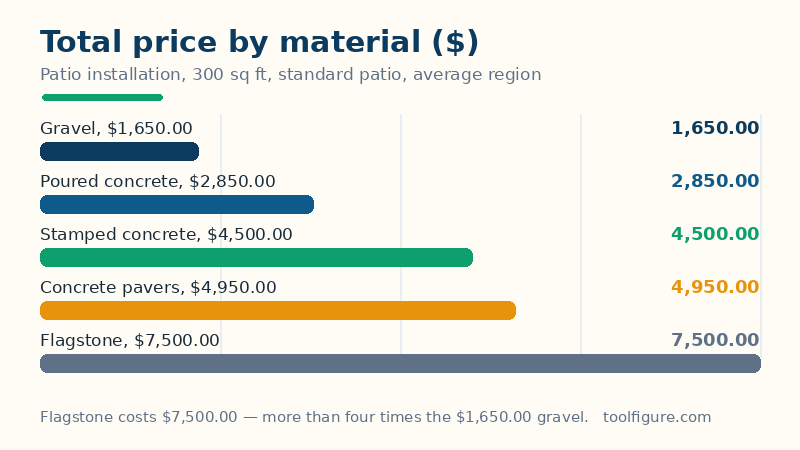
total ($) = ((rate + old patio removal $4.00 per sq ft) × patio area (sq ft)) × shape factor (×1.00 standard ground-level patio · ×1.25 raised / multi-level patio) × region factor (×0.90 low-cost · ×1.00 average · ×1.10 high-cost)price per sq ft ($) = total ÷ patio areaplanning range = total × 0.85 to total × 1.15The same formula is behind the table above, so every row can be rebuilt by hand. The worked example is 300 sq ft in concrete pavers, no removal, standard ground-level patio, average region: $16.50 × 300 is $4,950.00 — $16.50 a sq ft, with a planning range of $4,207.50 to $5,692.50.
Worked example, checked against the published calculators
Five published 2026 patio cost guides bracket the worked example rather than matching it to the dollar, because no two guides price the same combination — and the bracket is the honest check. HomeAdvisor puts a paver patio at $8 to $25 a sq ft installed, a 280 sq ft patio at $3,800 on average, with most homeowners spending $2,400 to $7,000 — this page's worked example, 300 sq ft in concrete pavers, is $4,950.00 and sits inside that band, while its 280 sq ft paver figure is $4,620.00, above their $3,800 average, because pavers at $16.50 a sq ft are the premium pick rather than the typical one: the same 280 sq ft in poured concrete is $2,660.00, below their average. Angi puts a concrete patio at $7 to $12 a sq ft in Indianapolis and $8 to $13 in Philadelphia, with sand-set concrete pavers at $14 to $17 in Indianapolis and $16 to $19 in Philadelphia — this page's $9.50 concrete and $16.50 pavers sit inside all four bands. Angi puts the average patio project at $4,296 in Indianapolis, with most homeowners spending $2,455 to $6,200, and $3,734 in Philadelphia, with most spending $1,917 to $5,642 — this page's $4,950.00 worked example sits inside both typical bands. Extervia puts the national average at about $3,800 with most homeowners paying $1,946 to $5,815, plain concrete at $6 to $11 a sq ft, stamped concrete at $12 to $18, pavers at $10 to $25, flagstone at $15 to $35 and gravel at $3 to $8 — this page's $9.50, $15.00, $16.50, $25.00 and $5.50 sit inside all five bands. Angi Philadelphia puts concrete demolition at $2 to $6 a sq ft — this page's $4.00 removal rate is the midpoint, which turns the worked example into $6,150.00. The table rows show the model's edges: a flagstone raised patio with removal in a high-cost region is $15,950.00, a stamped concrete patio is $4,800.00, and a gravel patio is $2,750.00.
How to read your result, and its limits
Four cautions keep the number honest. First, the material is the base: the same 300 sq ft is $1,650.00 in gravel and $7,500.00 in flagstone — the material alone moves the worked example by $5,850.00 — and the difference is real, not cosmetic: poured concrete lasts 30 to 50 years and cracks as a slab, pavers last 25 to 35 years and can be lifted and reset one at a time, and gravel is the cheapest surface and the least permanent. Second, the shape factor is this page's own model: no published guide gives a single raised-patio multiplier, so this page rounds the retaining edges and extra base work of a raised or multi-level patio to ×1.25 — the worked example as a raised patio is $6,187.50 against $4,950.00 at ground level. Third, half to two-thirds of a patio's cost is labour, not material: Extervia's warning is the reason two crews can quote the same 300 sq ft very differently, and the reason a bid that skimps on the base — the compacted aggregate the pavers sit on — is the bid that settles and heaves in two winters. Fourth, removal is a demolition job, not a line item: breaking up and hauling away an old patio at $4.00 a sq ft is the removal alone — grading, drainage and a permit are priced separately, and a yard that slopes toward the house needs the drainage before the patio, not after it. The region is only a proxy: the worked example is $4,455.00 in a low-cost region and $5,445.00 in a high-cost one, so only local crews settle the real number, and with removal the same job is $6,150.00 — $20.50 a sq ft — and as a raised patio $6,187.50, or $20.63 a sq ft. A deck is a different job, priced by the deck building cost calculator, and a driveway by the driveway paving cost calculator.
Common mistakes
- Comparing a material-only price with an installed price. Pavers run $3 to $10 a sq ft for the material alone — this page is the installed job, so a $4,950.00 paver patio is the finished price, not the pallets of pavers.
- Forgetting the removal. Old patio removal is $4.00 a sq ft — the worked example with removal is $6,150.00, not $4,950.00 — and a quote that omits it understates a replacement patio by $1,200.00 on a 300 sq ft job.
- Measuring the yard instead of the patio. A 15 × 20 ft patio is 300 sq ft — measure the patio itself, not the space around it — and a count taken from the yard overstates the area, and the price with it.
- Pricing a raised patio like a flat one. A raised or multi-level patio is ×1.25 — the worked example as a raised patio is $6,187.50, not $4,950.00 — and a quote that prices flat ground while the job is raised understates it by $1,237.50.
- Skipping the base to save money. The compacted aggregate base is what keeps pavers level — a bid that skimps on it is cheaper for a season and expensive for a decade, because resetting a settled patio costs more than building it right the first time.
Related tools: Fence Installation Cost Calculator — What does a fence cost? Length, material, height, terrain, gates and removal — total price, per linear foot and posts.
Frequently asked questions
How much does a patio cost?
HomeAdvisor puts a 280 sq ft paver patio at $3,800 on average, with most homeowners spending $2,400 to $7,000. Angi puts the average project at $4,296 in Indianapolis and $3,734 in Philadelphia. A 300 sq ft patio in concrete pavers is $4,950.00 on this page — $16.50 a sq ft — while the same patio in poured concrete is $2,850.00 and in gravel $1,650.00.
What is the cheapest patio material?
Gravel, at $5.50 a sq ft installed on this page — $2,750.00 for a 500 sq ft patio, against $4,750.00 for the same area in poured concrete. Gravel is the cheapest surface and the least permanent: it shifts underfoot, needs topping up, and is not the surface for a dining set, so it is a path and seating-area material rather than a whole-patio one.
How much does it cost to remove an old patio?
Angi Philadelphia puts concrete demolition at $2 to $6 a sq ft, and this page uses $4.00 — the midpoint. On the worked example's 300 sq ft that adds $1,200.00, turning $4,950.00 into $6,150.00. Grading, drainage and a permit are priced separately, so a removal quote is not a drainage quote.
Concrete or pavers — which is better for a patio?
Poured concrete is $9.50 a sq ft against $16.50 for concrete pavers — $2,850.00 against $4,950.00 on the worked example's 300 sq ft. Concrete lasts 30 to 50 years but cracks as a slab, so a crack is a patch or a replacement; pavers last 25 to 35 years and can be lifted and reset one at a time, so a settled paver is a single-paver fix. Pavers are the better pick where the ground moves or the patio will be extended later; concrete is the better pick for the lowest installed price.