From the sun's height to a single number
The UV index measures erythemally weighted ultraviolet radiation — the sunburning part of sunlight — on a scale where 1 unit equals 25 milliwatts per square metre. Official forecasts run a full radiative-transfer model on ozone, cloud and elevation forecasts. This page uses the published clear-sky shortcut, the Madronich (2007) analytic formula, which reproduces that model to about 10% under clear skies:
UVI = 12.5 × μ^2.42 × (Ω ÷ 300)^−1.23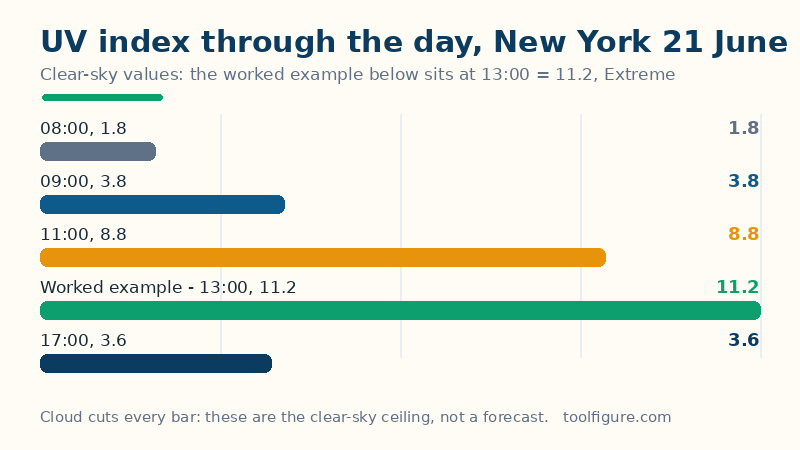
Here μ is the cosine of the solar zenith angle — the angle between the sun and straight overhead — and Ω is the total ozone column in Dobson units (DU), typically near 300. The zenith angle comes from the same solar geometry as this site's daylight and sunrise calculators: declination δ by Cooper's equation, the equation of time and your longitude and UTC offset fixing solar noon on your clock, the hour angle H = 15 × (your clock time − solar noon), and then μ = sin φ × sin δ + cos φ × cos δ × cos H, where φ is your latitude. The page then applies the US EPA's altitude adjustment, about 6% more UV per kilometre above sea level, because there is less air overhead to absorb it. Two consequences fall straight out of the formula: UV rises steeply as the sun climbs (μ^2.42, not μ itself), and thinner ozone raises it — dropping the ozone assumption from 300 to 250 DU lifts the index by about a quarter, while 400 DU cuts it by about a third.
Worked example: New York, 21 June 2026, 13:00
Day 172: δ = 23.45° × sin(360° × (284 + 172) ÷ 365) = +23.45°, and the equation of time is −1.45 minutes, so solar noon = 12:00 − (−1.45 ÷ 60) − (−74.006 − 15 × (−4)) ÷ 15 = 12:57 — the same noon the sunrise calculator gives for this city and date. At 13:00 the hour angle is H = 15 × (13.00 − 12.958) = 0.63°, barely past noon. Then μ = sin(40.7128°) × sin(23.45°) + cos(40.7128°) × cos(23.45°) × cos(0.63°) = 0.9549, so the zenith angle is 17.27° and the sun sits 72.73° above the horizon — nearly overhead, as a June noon in New York should be. With ozone 300 DU and altitude 0 km, UVI = 12.5 × 0.9549^2.42 × (300 ÷ 300)^−1.23 = 12.5 × 0.8944 = 11.2, band Extreme. The table on the calculator shows how fast that number moves through the same clear day: 1.8 (Low) at 08:00, 3.8 (Moderate) at 09:00, 8.8 (Very high) at 11:00, 11.2 at 13:00, back to 3.6 at 17:00 and 1.6 at 18:00 — the whole day's protection advice changes twice before lunch. Three cross-checks confirm the model behaves: the same city at solar noon on 21 December gives μ = 0.4358, zenith 64.16°, UVI 1.7 (Low) — winter sun, low and weak; Miami (25.7617°N) at its June solar noon gives μ = 0.9992, zenith 2.31°, UVI 12.5 (Extreme); and London (51.5074°N) at its June solar noon gives μ = 0.8825, zenith 28.06°, UVI 9.2 (Very high). Ozone and altitude move the worked example as the formula promises: 250 DU instead of 300 lifts it to 14.0, and 1.609 km of altitude (a mile up, Denver's height) lifts it to 12.3.
How to read your result, and its limits
Four cautions keep the number honest. First, this is a clear-sky estimate, not a forecast: the Madronich formula assumes a clean, cloud-free sky, and real cloud cuts UV sharply — broken cloud to roughly three-quarters of the clear-sky value in the EPA's own example, overcast far lower — so on a cloudy day treat the page's number as the ceiling, not the reading. Second, the bands are the standard ones (0–2 Low, 3–5 Moderate, 6–7 High, 8–10 Very high, 11+ Extreme) and the protection note follows the band, not your skin: fair skin burns far faster than the band alone suggests, and this page gives general information, not medical advice. Third, altitude and ozone are your inputs to get right: the defaults (300 DU, sea level) suit most lowland days, but a mountain trip or a known ozone low changes the answer by more than a whole band. Fourth, night is 0, exactly: when μ goes negative the sun is below the horizon, and the page says so instead of printing a small positive number from a formula that no longer applies. For the sunrise time that ends the night, use the sunrise and sunset calculator; for how hot that same sun feels, the heat index calculator covers the humid side.
Common mistakes
- Quoting a noon index for the whole day. UV follows the sun's height, not the clock: the worked example's day runs from 1.8 to 11.2 and back. Always enter the time you will actually be outside.
- Assuming cloud means safety. Thin cloud barely dents UV, and broken cloud can even spike it briefly as sunlight reflects off cloud edges. Only thick overcast reliably drops it, and the clear-sky formula cannot tell you which cloud you have.
- Forgetting altitude. A mile of elevation adds about 10% to the index — enough to push a Very high day into Extreme. Enter your real altitude on mountain days.
- Treating the index as a burn timer. The index is a rate, not a countdown: time to burn depends on skin type, sunscreen, clothing and reflection off water, sand or snow, none of which this page knows. Use the band's protection advice, not a minute count.
Related tools: Daylight Hours Calculator — How long the sun stays up where you are — day length, declination, solar noon and clock sunrise and sunset for any latitude and date.
Frequently asked questions
What is the UV index?
A scale from 0 to 11+ for the strength of the sun's sunburning ultraviolet radiation, where 1 unit equals 25 milliwatts per square metre of erythemally weighted UV. The bands are 0–2 Low, 3–5 Moderate, 6–7 High, 8–10 Very high and 11+ Extreme. The worked example, New York on 21 June 2026 at 13:00, is 11.2 — Extreme.
How is the UV index calculated here?
From the sun's position: declination, equation of time and your longitude and UTC offset give solar noon, the hour angle at your time gives the cosine of the solar zenith angle μ, and the Madronich clear-sky formula UVI = 12.5 × μ^2.42 × (ozone ÷ 300)^−1.23 turns μ and the ozone column into the index, with about 6% added per kilometre of altitude.
Is this UV index a forecast?
No — it is a clear-sky estimate. Official forecasts model ozone, cloud and elevation together; this page assumes a clean, cloud-free sky, so on a cloudy day its number is the ceiling the real value sits below, sometimes far below. Check your weather service's forecast UV index for the day's actual expected value.
Why is the UV index 0 at night?
Because the sun is below the horizon: the cosine of the zenith angle goes negative, and there is no direct ultraviolet reaching you. The page reports 0 rather than running a formula that no longer applies, and the index returns at sunrise.
