The formula: weight × a skill multiplier × a use adjustment
The calculation is one published rule with both of its multipliers stated, and the calculator shows the multipliers it used so the answer can be checked by hand. Step 1, convert to kilograms: weight in pounds times 0.45359237 gives kilograms — the unit the volume rule is built in. Step 2, apply the skill multiplier: beginners need the most volume for stability, so their multiplier is 2.0; intermediate paddlers take 1.5; advanced paddlers, who can balance a smaller board, take 1.1. Step 3, apply the use adjustment: all-around boards take 1.00, touring boards 1.10 (longer trips carry gear), yoga and fitness boards 1.15 (stability matters most), racing boards 0.90 (narrow and fast, less volume needed) and surf boards 0.85 (short and manoeuvrable). The result is rounded to the nearest litre, and it is a minimum volume — the smallest board that floats the paddler properly — not a target to hit exactly. The two multiplier tables are:
| Skill level | Volume multiplier | Why |
|---|---|---|
| Beginner | 2.0 × weight in kg | Maximum stability while learning to balance |
| Intermediate | 1.5 × weight in kg | Comfortable stability with better glide |
| Advanced | 1.1 × weight in kg | Experienced balance, smaller and faster board |
| Use | Adjustment | Length | Width: beginner / intermediate / advanced |
|---|---|---|---|
| All-around | × 1.00 | 10'–11' (305–335 cm) | 33 / 32 / 31 in |
| Touring | × 1.10 | 11'–12'6" (335–381 cm) | 32 / 31 / 30 in |
| Yoga & fitness | × 1.15 | 10'–11' (305–335 cm) | 34 / 33 / 32 in |
| Racing | × 0.90 | 12'6"–14' (381–427 cm) | 28 / 27 / 26 in |
| Surf | × 0.85 | 9'–10' (274–305 cm) | 31 / 30 / 29 in |
Width follows the same logic as volume: beginners go wider, advanced paddlers narrower, and yoga boards widest of all because the board is a platform, not a hull. Thickness follows the inflatable rule: a 6-inch inflatable board is rigid enough to feel like a hard board, which is why every all-around, touring, yoga and racing row above carries 6 inches; surf boards run thinner, at 4–5 inches, because they are smaller and shaped for waves rather than stiffness.
Worked example: 80 kg, intermediate, all-around
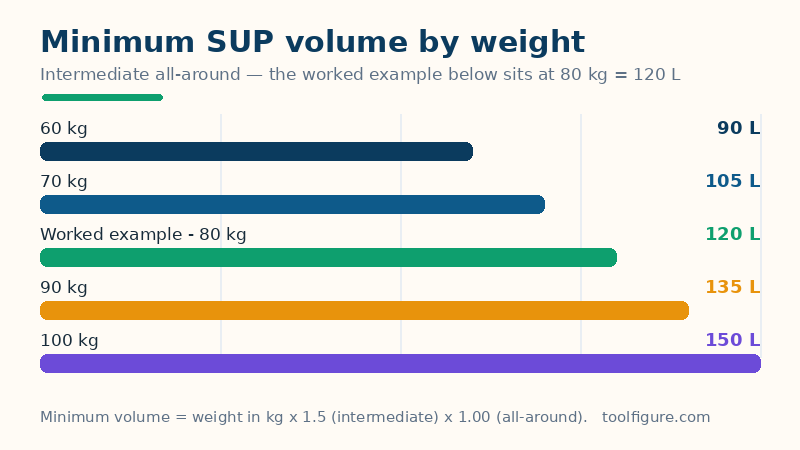
Take a paddler who weighs 80 kg (176.4 lb), paddles at intermediate level and wants an all-around board. Step 1 is already in kilograms. Step 2: 80 × 1.5 = 120. Step 3: all-around adjusts by 1.00, so the answer stays 120 L minimum volume, with a length of 10'–11' (305–335 cm), a width of 32 in (81 cm) and a thickness of 6 in (15 cm) — the classic 10'6" all-around board, which typically carries well over 120 L, clears this floor comfortably. The same rider at other skills and uses reads:
| Same 80 kg rider | Minimum volume |
|---|---|
| Beginner, all-around (80 × 2.0 × 1.00) | 160 L |
| Intermediate, all-around (80 × 1.5 × 1.00) | 120 L |
| Advanced, all-around (80 × 1.1 × 1.00) | 88 L |
| Intermediate, touring (80 × 1.5 × 1.10) | 132 L |
| Intermediate, yoga & fitness (80 × 1.5 × 1.15) | 138 L |
| Intermediate, racing (80 × 1.5 × 0.90) | 108 L |
| Intermediate, surf (80 × 1.5 × 0.85) | 102 L |
Beginner all-around paddlers at other weights read 50 kg → 100 L, 60 kg → 120 L, 70 kg → 140 L, 80 kg → 160 L, 90 kg → 180 L and 100 kg → 200 L — the volume ladder is a straight line in weight, which is why the chart on this page is drawn from it. The pounds input agrees: 176 lb converts to 79.8 kg, and 79.8 × 1.5 × 1.00 = 119.7, which rounds to the same 120 L, so the two units can never disagree by more than rounding.
How to read your result, and its limits
Three checks before buying. First, check the board's own label: this page consolidates the published volume rule, but manufacturers tune volume by model — rocker, outline and construction all shift the right size, and the board's own volume figure outranks this page. Second, height sets your paddle, not your board: a taller paddler needs a longer paddle, which is why some guides mention height at all, but the board itself does not know how tall you are — it knows your weight pushing it into the water, which is why weight decides the volume. Third, load counts as weight: gear, a cooler, a child or a dog all add to the weight the board must float, so a paddler who regularly carries a load should size up in width or volume rather than trusting the body-weight figure alone. For the rest of the kit, the kayak paddle length calculator sizes a paddle from height and boat width, the surfboard volume calculator sizes a surfboard from weight and skill on the same volume logic, and the wetsuit size calculator sizes a suit from height and weight.
Frequently asked questions
What size paddleboard do I need for my weight?
As a starting point, size by weight and skill: an 80 kg intermediate paddler needs at least 120 L on an all-around board, 10'–11' long and 32 in wide, while the same paddler as a beginner needs at least 160 L. Enter your own weight, use and skill above and the calculator shows your minimum volume with its length and width.
Does height matter for paddleboard size?
Only secondarily: weight decides the volume, because the board must float the rider, and height is not a sizing factor for the board itself. Height sets paddle length instead — a taller paddler needs a longer paddle, which is a separate purchase decision.
Should I choose an inflatable or a hard paddleboard?
For sizing, the difference is thickness: a 6-inch inflatable board is rigid enough to feel like a hard board, which is why the all-around, touring, yoga and racing rows on this page all carry 6 inches. Surf boards run thinner, at 4–5 inches, because they are smaller and shaped for waves.
What if I am between sizes, or I carry gear?
Take the larger volume and the wider board: the figure on this page is a minimum, so a board above it is fine, while a board below it will sit low and feel slow and unstable. Gear, a cooler, a child or a dog all count as weight the board must float, so size up when you regularly carry a load.
