One thickness, two families of units
Dynamic viscosity is a fluid's resistance to flowing — how thick it feels when it is poured, pumped or stirred. Water flows freely, honey does not, and the number that says how much is the dynamic viscosity, usually written μ. The trouble is that the number arrives in different units depending on who wrote it. A lubricant datasheet quotes centipoise, a physics textbook quotes pascal-seconds, an older American engineering table quotes poise or even reyn — and the same oil can wear any of those labels. This page restates any dynamic viscosity in all nine units at once, worked through the pascal-second with every factor defined, so a figure in any dialect can be read in any other. It does not convert kinematic viscosity in the same table, because that is a different quantity that needs the fluid's density — it gets its own line at the bottom of the result instead.
The formula
answer = pascal-seconds ÷ (pascal-seconds in one "to" unit)
Two terms, both visible on the page. value is the number you enter. pascal-seconds in one "from" unit is the definition of the unit you are converting from: 1 for the pascal-second itself, 0.001 for the millipascal-second, 0.1 for the poise, 0.001 for the centipoise, 1/3600 for the kilogram per metre-hour, 9.80665 for the kilogram-force-second per square metre, 1.4881639435695537 for the pound per foot-second, 47.88025898033584 for the pound-force-second per square foot, and 6,894.757293168361 for the reyn. answer is the result in the unit you asked for. Two names that look like extra units are not: the poiseuille is simply the pascal-second under another name, and a figure quoted in kilograms per metre-second is already in pascal-seconds — one kilogram per metre-second is exactly one pascal-second, so read it directly and do not convert it at all.
Worked example
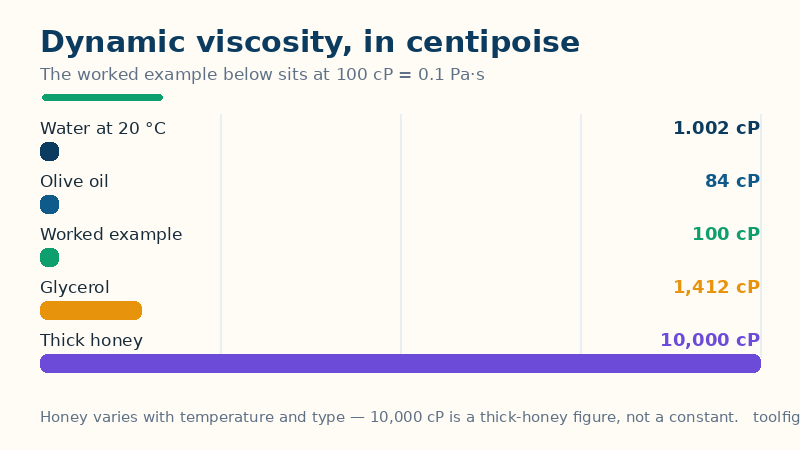
Convert 100 centipoise to pascal-seconds — a light oil, or a thick syrup thinned by warming — the way the tool does it.
Step 1 — get to pascal-seconds. One centipoise is 0.001 Pa·s, so 100 × 0.001 = 0.1 Pa·s.
Step 2 — divide by the target factor. The target is the pascal-second itself, whose factor is 1, so 0.1 ÷ 1 = 0.1.
Step 3 — read the display. The page prints six decimals below 0.001, four below 10 and two above, so the headline reads 0.1 Pa·s, and the detail line shows the working: 100 cP = 0.1 Pa·s — worked through pascal-seconds: 0.1 Pa·s ÷ the Pascal-second factor.
Check it. Multiplying back, 0.1 × 1,000 = 100 exactly — the centipoise factor closes with nothing lost. The table underneath restates the same 0.1 Pa·s in all nine units (100 mPa·s, 1 P, 100 cP, 360 kg/(m·h), 0.0102 kgf·s/m², 0.0672 lb/(ft·s), 0.0021 lbf·s/ft², 0.000015 reyn), so the from/to choice only changes which row is the headline. And the density line finishes the job for this fluid: at the default 1,000 kg/m³, that 0.1 Pa·s is 100 mm²/s (100 cSt) kinematic viscosity — the number a flow calculation actually wants, worked out in the open from μ ÷ ρ.
Conversions worth memorising
Every row below is the tool's own output, checked figure by figure:
| From | To | Result |
|---|---|---|
| 1 Pa·s | centipoise | 1,000 cP |
| 1 P | centipoise | 100 cP |
| 1,000 cP | pascal-second | 1 Pa·s |
| 0.5 Pa·s | centipoise | 500 cP |
| 200 cP | pascal-second | 0.2 Pa·s |
| 1 lbf·s/ft² | pascal-second | 47.88 Pa·s |
| 1 lb/(ft·s) | pascal-second | 1.4882 Pa·s |
| 1 reyn | pascal-second | 6,894.76 Pa·s |
| 1 kgf·s/m² | pascal-second | 9.8067 Pa·s |
| 10 Pa·s | poise | 100 P |
| 3,600 kg/(m·h) | pascal-second | 1 Pa·s |
| 1,412 cP (glycerol) | pascal-second | 1.412 Pa·s |
Three rows deserve a second look. The 1,000 cP row is the identity every lubricant engineer carries: a thousand centipoise is one pascal-second, and a millipascal-second is one centipoise — the two smallest metric units are the same number, which is why datasheets switch between them without changing a digit. The reyn row shows why the reyn is nearly extinct: one reyn is almost seven thousand pascal-seconds, a unit so large that ordinary oils measure in millionths of it, and the page's own display floor proves it — a single centipoise reads as 0 reyn at the page's finest step, because 0.000000145 reyn rounds to zero at six decimals. And the glycerol row is the reality check on temperature: glycerol is 1,412 cP at 20 °C, but warm it and the figure collapses — every viscosity on this page belongs to a temperature, and a datasheet figure without one is a figure without a meaning.
Three traps worth knowing
Centipoise and centistokes are equal only for water-like fluids. Dynamic viscosity (cP) and kinematic viscosity (cSt) are different quantities, related by density: kinematic = dynamic ÷ density. For water at 20 °C the density is close to 1,000 kg/m³, so 1.002 cP and about 1.004 cSt nearly coincide — and that coincidence has fooled generations of readers into treating the two as interchangeable. For an oil at 850 kg/m³ they are not: 100 cP at that density is about 118 cSt, not 100. This page keeps them apart on purpose: the table converts dynamic units only, and the kinematic figure appears only once you supply a density.
A viscosity without a temperature is unfinished. Water is about 1.002 cP at 20 °C, 1.79 cP at 0 °C and 0.28 cP at 100 °C — the same fluid, a sixfold range, purely from temperature. Honey, motor oil and glycerol all move the same way, only further. Before comparing two figures, check that both were measured at the same temperature; a "thicker" oil measured hot can be thinner in service than a "thinner" oil measured cold.
Tiny figures hit the display floor in the big units. The page prints six decimals below 0.001, so water's 1.002 cP reads as 0.001 Pa·s at four decimals — the 0.001002 underneath is rounded away in the headline, and the centipoise row is the readable one. The same floor swallows the reyn row entirely for ordinary fluids. Read the row on the fluid's own scale: the factor is exact, and the readable row is the one near the fluid's own size.
How to read your result, and the limits
Results show six decimals below 0.001, four below 10 and two above — more precision than any viscometer justifies, so round to the instrument for real use. Four limits belong with the page. Negative values are refused: a negative viscosity gets a clear error, because this page converts sizes, and a minus sign here would mean nothing physical. Empty input clears quietly; type and the table rebuilds, delete and the page waits. Anything past a trillion in any unit gets a clear error instead of a meaningless digit string. And this page converts units, not fluids: it will restate any viscosity in any unit, but it will not tell you how a fluid's viscosity changes with temperature or shear rate, or whether a fluid is Newtonian at all — ketchup, paint and blood change viscosity as they are stirred, and no unit conversion can capture that. For those, you need the fluid's own curve, and this page will at least help you read its units correctly.
Related tools: Density Converter — kg/m³ to lb/ft³, g/cm³ to lb/in³, lb/gal and more — every answer in all nine units, through the exact definitions; Pressure Converter — Convert PSI, bar, kPa, atmospheres and the mercury and water columns — every answer in all ten units, gauge-vs-absolute explained; Force Converter — Newtons to pound-force, kgf, kips and more — every answer in all ten units, through the exact definitions.
Frequently asked questions
How many centipoise are in a pascal-second?
Exactly 1,000. So 1 Pa·s is 1,000 cP, 0.1 Pa·s is 100 cP, and 1,412 cP — glycerol at 20 °C — is 1.412 Pa·s. To go back, divide centipoise by 1,000. A millipascal-second is the same number as a centipoise: 1 mPa·s = 1 cP exactly.
What is the difference between dynamic and kinematic viscosity?
Dynamic viscosity (μ, in Pa·s or cP) is the fluid's own resistance to shear flow. Kinematic viscosity (ν, in m²/s or cSt) is that resistance divided by the fluid's density: ν = μ ÷ ρ. They coincide numerically only when the density is 1,000 kg/m³, as it nearly is for water — for an oil at 850 kg/m³, 100 cP is about 118 cSt. This page converts dynamic units in its table and computes the kinematic figure only from a density you enter.
What is the viscosity of water?
About 1.002 centipoise at 20 °C, which is 0.001002 Pa·s — the page prints 0.001 at its four-decimal step. It changes fast with temperature: about 1.79 cP at 0 °C and 0.28 cP at 100 °C. That is why water is the calibration reference for viscometers, and why every viscosity figure needs its temperature beside it.
What is a reyn?
The reyn is the imperial unit of dynamic viscosity: one pound-force-second per square inch, equal to 6,894.76 Pa·s. It is named for Osborne Reynolds and appears in older American lubrication engineering. It is so large that ordinary oils measure in millionths of it — a single centipoise reads as 0 reyn on this page — which is why the pascal-second and centipoise have replaced it almost everywhere.
