Three steps: gaming watts, gaming hours, idle hours
The whole calculation is one multiplication repeated twice, and the gaming watts are the one people get wrong. Gaming watts divided by 1,000 is kilowatts; kilowatts times the gaming hours is the gaming energy; idle watts divided by 1,000 times the idle hours is the idle energy; the two energies added together times the price is the day's money; the day times 365 is the year's energy and money. The month is the year divided by 12, not the day times 30 — the two differ by about fifteen cents on a gaming PC, and the year-divided-by-12 figure is the one this page uses, so it agrees with the yearly total exactly:
energy per day (kWh) = gaming watts ÷ 1,000 × gaming hours + idle watts ÷ 1,000 × idle hours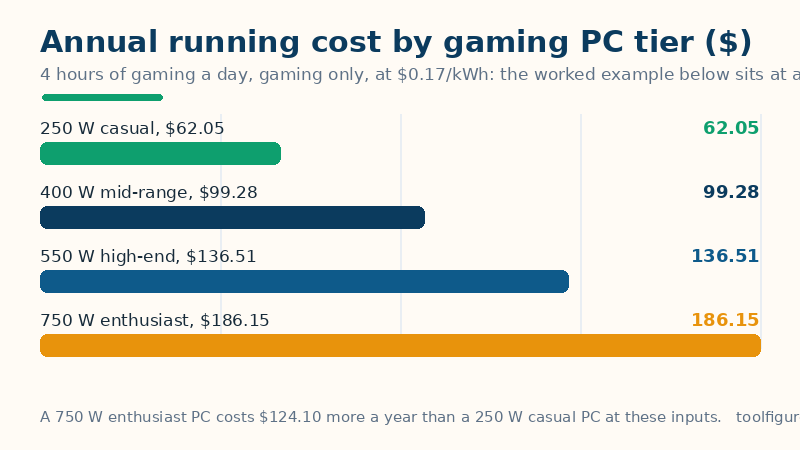
annual cost ($) = energy per day × 365 × electricity priceThe power supply's rated wattage is not what the PC consumes: lab tests at Lawrence Berkeley National Laboratory measured desktop gaming PCs averaging 34 to 410 watts at the wall while a game was running, and most gaming desktops draw somewhere between 200 and 600 watts under load and far less idle — the draw varies with the CPU, the GPU, the game and the settings, and the top graphics cards alone are rated at 450 to 575 watts. What matters is the wall draw: a plug-in power meter on the PC for a week gives the real figure, and 400 W is the usual starting estimate for a mid-range build.
Worked example: 400 W gaming, 4 hours a day, 80 W idle, 4 idle hours a day, $0.17/kWh
A 400 W gaming PC run for 4 hours a day uses 0.40 × 4 = 1.600 kWh gaming, costing $0.27, and 0.08 × 4 = 0.320 kWh idle, costing $0.05. A day is 1.600 + 0.320 = 1.920 kWh, costing $0.33. A month is 700.8 ÷ 12 = 58.4 kWh, costing $9.93. A year is 1.920 × 365 = 700.8 kWh, costing $119.14. The table above shows the same maths for the other PC tiers at 4 hours of gaming a day and $0.17/kWh, gaming only: a 250 W casual PC uses 1.000 kWh a day, costing $0.17 a day, $5.17 a month and $62.05 a year, a 550 W high-end PC uses 2.200 kWh a day, costing $0.37 a day, $11.38 a month and $136.51 a year, and a 750 W enthusiast PC uses 3.000 kWh a day, costing $0.51 a day, $15.51 a month and $186.15 a year; the worked example's 400 W mid-range PC, gaming only, uses 1.600 kWh a day, costing $0.27 a day, $8.27 a month and $99.28 a year. One gaming hour costs 6.8¢; gaming alone costs $99.28 a year and idle alone $19.86; ten years at this pace costs $1,191.36. Five published cross-checks reproduce exactly: wattcostcalc's 400 W gaming PC at 4 hours a day and $0.175 costs $0.07 an hour, $0.28 a day, $8.40 a month and $102.20 a year — this page gives the same $0.07 an hour, $0.28 a day and $102.20 a year, with $8.52 a month on the year-divided-by-12 figure against their $8.40 on a 30-day month. calculatorsheaven's 400 W PC at 4 hours a day and $0.18 costs $8.76 a month and $105.12 a year — this page gives the same $8.76 and $105.12. The Lawrence Berkeley National Laboratory figures quoted by wattcost-energy-costs — a 410 W PC at 4 hours a day and 18.16¢ — cost $0.07 an hour, $0.30 a day, $8.93 a month and $107 a year — this page gives the same $0.07 an hour and $0.30 a day, with $9.06 a month on the year-divided-by-12 figure and $108.71 a year on a 365-day year; their $107 a year is twelve 30-day months. appliancerunningcost's budget tier — a 300 W PC at 4 hours a day and $0.18 — costs $6.48 a month on a 30-day month, and their flagship 775 W tier $16.74 — this page gives $6.57 and $16.97 on the year-divided-by-12 figure, the same daily maths. And calculatorcollection's worked example — a 400 W PC at 4 hours a day and $0.15 — costs $7.20 a month on a 30-day month — this page gives $7.30 on the year-divided-by-12 figure, the same $0.24 a day.
How to read your result, and its limits
Four cautions keep the number honest. First, the PSU rating is not the draw: at the worked example's inputs a 400 W average costs $99.28 a year gaming only, but a PC with a 750 W power supply does not draw 750 W while gaming — priced as if it did, the same hours would cost $186.15 a year, nearly double the real bill. Enter the wall draw, and measure it with a plug-in power meter if you want the number exact. Second, idle adds up: at the worked example's inputs 4 idle hours a day at 80 W costs $19.86 a year, and leaving the same PC idle 24 hours a day would cost $119.14 a year — as much as the whole worked example — so sleep mode is the cheapest upgrade. Third, the month is not thirty days: the day times 30 gives $9.79 a month at the worked example's inputs, while the year divided by 12 gives $9.93 — use the year-divided-by-12 figure, which is the one that adds up. Fourth, this page prices electricity only: the PC itself, the games and the monitor are separate lines — the monitor is a separate draw of its own, typically 25 to 50 W, and the electricity price is the all-in rate, the total on the bill divided by the kilowatt-hours on the bill. For the cost of running the TV next to the PC, the TV cost calculator prices it by watts and hours; for the cost of running anything else, the electricity cost calculator prices any appliance by watts and hours.
Common mistakes
- Entering the power supply rating as the gaming watts. A PC with a 750 W PSU does not draw 750 W while gaming — lab tests put the average at 34 to 410 W at the wall, and a mid-range build averages about 400 W. Enter the wall draw, not the PSU label.
- Pricing the gaming hours and forgetting the idle hours. Gaming is $99.28 a year at the worked example's inputs, but the idle hours add $19.86 — a sixth of the bill. Count both.
- Multiplying the daily cost by 30 for the month. Thirty days is not a twelfth of a year: the day times 30 gives $9.79 a month at the worked example's inputs, while the year divided by 12 gives $9.93. Use the year-divided-by-12 figure, which is the one that adds up.
- Forgetting the monitor. A 27-inch monitor draws about 25 to 50 W, which adds roughly $6 to $12 a year at 4 hours a day and $0.17 per kWh. The monitor is a separate appliance — price it with the TV cost calculator if it is not in the watts above.
- Adding the standing charge to every gaming hour. The daily supply charge is payable whether the PC runs or not. Only the per-kWh rate belongs in the per-hour maths — the fixed charge is a separate line on the bill.
Related tools: EV Charging Cost Calculator — What one EV charge really costs — energy added, energy from the wall, cost, charging time, range added and cost per mile.
Frequently asked questions
How much does it cost to run a gaming PC per month?
At the worked example's inputs — a 400 W average, 4 hours of gaming and 4 idle hours at 80 W a day — a gaming PC uses 58.4 kWh a month and costs $9.93 at $0.17 per kWh, or $119.14 a year. Gaming only, a 250 W casual PC costs $5.17 a month, a 400 W mid-range PC $8.27 and a 750 W enthusiast PC $15.51 a month at the same hours and rate.
How many watts does a gaming PC use?
Lab tests at Lawrence Berkeley National Laboratory measured desktop gaming PCs averaging 34 to 410 watts at the wall while a game was running, and most gaming desktops draw 200 to 600 watts under load and far less idle. A mid-range build averages about 400 W, a high-end build about 550 W and an enthusiast 4K build about 750 W — the power supply rating is higher than any of these, because it is a maximum, not a draw.
Does a gaming PC use a lot of electricity?
No. At the worked example's inputs — 400 W, 4 hours of gaming and 4 idle hours a day — a gaming PC uses 700.8 kWh a year and costs $119.14, about $9.93 a month. Even a 750 W enthusiast PC at 4 hours a day costs $186.15 a year gaming only — far less than a water heater, a dryer or an air conditioner.
How can I reduce my gaming PC's electricity cost?
Let it sleep instead of idling — 4 idle hours a day at 80 W costs $19.86 a year, and 24 idle hours a day would cost $119.14 — cap the frame rate so the GPU stops rendering frames you cannot see, and game on an off-peak tariff if your supplier offers one. The watts dominate the bill, so the biggest saving is a lower average draw, not fewer hours: a 250 W casual PC costs $62.05 a year against $99.28 for a 400 W mid-range PC at the same hours.