Why lumens and candelas refuse to convert directly
A lumen counts all the light a source gives out, in every direction at once. A candela counts how much of that light goes in one particular direction — one lumen per steradian, where a steradian is the three-dimensional cousin of a radian. A bare bulb and a spotlight can both be rated 800 lumens and light a room completely differently, because the spotlight squeezes its 800 lumens into a narrow cone while the bulb spreads them everywhere. That is why no fixed factor converts lumens to candelas: the conversion needs a third number, the beam angle, and this page asks for it openly instead of quietly assuming one. Its companion, the illuminance converter, handles the other half of the story — light falling on a surface, in lux and foot-candles — while this page handles light leaving a source in a direction.
The formula
candelas = lumens ÷ Ω
lumens = candelas × Ω
lux at distance d = candelas ÷ d²
Four terms, all visible on the page. θ is the beam's full apex angle in degrees — the angle between the two opposite edges of the cone, as a spotlight datasheet quotes it. Ω is the solid angle that cone covers, in steradians: a narrow beam covers a small Ω, so the same lumens divide into more candelas. lumens and candelas are the two quantities being converted. d is the distance from the source to the surface in metres, and the last line is the inverse-square law: double the distance and the lux falls to a quarter, not a half.
Worked example
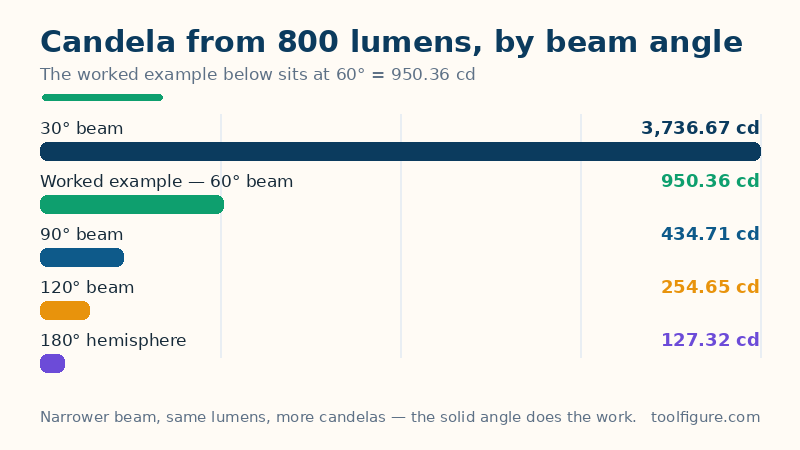
Convert 800 lumens in a 60° beam to candelas — an ordinary LED spotlight — the way the tool does it.
Step 1 — the solid angle. Half the apex angle is 30°, cos(30°) = 0.866, so Ω = 2π × (1 − 0.866) = 2π × 0.134 = 0.8418 steradians. The page prints the solid angle in its table so this step can be checked, not trusted.
Step 2 — divide. 800 ÷ 0.8418 = 950.36, so the headline reads 950.36 cd, and the detail line shows the working: 800 lm = 950.36 cd — worked through the solid angle: 800 ÷ 0.8418 sr.
Step 3 — the lux at your distance. At the default 2 m, lux = 950.36 ÷ 2² = 950.36 ÷ 4 = 237.59 lx. At 1 m the same intensity gives 950.36 lx (dividing by 1² changes nothing — the candela figure and the 1-metre lux figure are the same number by definition, not by coincidence), and at 3 m it gives 105.6 lx. Move the lamp and the lux follows the square of the distance; the candela figure does not move at all, because it describes the source, not the surface.
Check it. Multiplying back, 950.36 × 0.8418 = 800, near enough that the difference is display rounding — the page prints four decimals below 10, two above, and six below 0.001, and the table's candela, lumen, solid-angle and lux rows are all computed from the same inputs, so they agree with each other by construction.
Conversions worth memorising
Every row below is the tool's own output, checked figure by figure (the beam angle is stated on every row, because without it the row would be meaningless):
| From | Beam angle | Result |
|---|---|---|
| 800 lm | 60° | 950.36 cd |
| 1,000 lm | 60° | 1,187.95 cd |
| 800 lm | 30° | 3,736.67 cd |
| 800 lm | 120° | 254.65 cd |
| 1,000 lm | 180° | 159.15 cd |
| 500 cd | 60° | 420.89 lm |
| 100 lm | 60° | 118.79 cd |
| 2,000 lm | 90° | 1,086.78 cd |
| 50 cd | 36° | 15.38 lm |
Three rows deserve a second look. The 30° row is the whole point of the page: the same 800 lumens that make 950.36 cd in a 60° beam make 3,736.67 cd in a 30° beam — nearly four times the intensity, from the same bulb, because the light is squeezed into a quarter of the solid angle. The 180° row is a hemisphere — a source shining into half the world — where 1,000 lumens are only 159.15 cd in any one direction. And the limiting case behind all of them: a source shining equally in all directions fills the whole sphere, Ω = 4π = 12.5664 sr, so 1,000 lumens spread over the sphere are only 79.58 cd in any one direction — the same formula, with the sphere's solid angle in place of a beam's.
Three traps worth knowing
Comparing a lumen figure with a candela figure is comparing a total with a concentration. "This torch is 1,000 lumens and that one is 1,000 candelas — which is brighter?" has no answer until both beam angles are known. A 1,000-lumen torch in a 60° beam is 1,187.95 cd; a 1,000-candela torch in the same beam is 841.79 lumens. The page forces the angle into the open precisely so this comparison stops being a trick question.
Not every "beam angle" on a datasheet means the same angle. This page uses the full apex angle — edge to opposite edge of the cone. Some datasheets quote the FWHM angle, the angle where the brightness has fallen to half its peak, which is narrower than the full cone the formula assumes. Enter an FWHM angle here and the candela figure comes out high, because the formula treats the narrower angle as the whole beam. If the datasheet says FWHM, treat the result as an upper estimate, not a measurement.
The formula assumes a uniform beam, and real beams are not uniform. A real spotlight is brightest at its centre and fades toward the edges; the formula spreads the lumens evenly across the cone, so its candela figure is the beam's average intensity, not its peak. A datasheet's peak candela — measured at the centre — will read higher than this page's figure for the same lamp, and both can be honest: one is the average, the other the brightest point.
How to read your result, and the limits
Results show six decimals below 0.001, four below 10 and two above — more precision than any light meter justifies, so round to the meter for real use. Four limits belong with the page. Negative values are refused: −800 lm gets a clear error, because this page converts sizes, and a minus sign here would mean nothing. A beam angle of 0° or past 180° gets a clear error instead of a division by zero or a cone wider than a hemisphere. Empty input clears quietly; type and the table rebuilds, delete and the page waits — and an empty distance simply drops the lux line while the conversion itself still computes. And this page converts photometric quantities, not lighting designs: it will restate any source in lumens, candelas and lux at your distance, but it will not tell you whether a room is well lit — for that you need the illuminance converter's area maths, the room's reflectance, and the even-spread assumption stated on both pages.
Related tools: Illuminance Converter — Lux to foot-candles, phot and more — every answer in all six units, plus the lumens your room needs; Energy Converter — Joules to calories, kcal to kJ, kWh to joules and BTU — every answer in all ten units, through the exact definitions; Power Converter — Horsepower to kW, kW to hp, watts and tons of refrigeration — every answer in all eight units, through the exact definitions.
Frequently asked questions
How do I convert lumens to candela?
You need the beam angle as well as the lumens: candelas = lumens ÷ the solid angle, where the solid angle Ω = 2π × (1 − cos(beam angle ÷ 2)). For example, 800 lumens in a 60° beam gives Ω = 0.8418 sr and 800 ÷ 0.8418 = 950.36 cd. Enter the lumens and the beam angle on this page and it does both steps, with the solid angle shown in the table.
Why can't I convert lumens to candela directly?
Because they measure different things: lumens are the total light in all directions, candelas are the light in one direction per steradian. The same 1,000 lumens are 1,187.95 cd in a 60° beam but only 79.58 cd if spread equally over a whole sphere (Ω = 4π). Without a beam angle the conversion is undefined, which is why this page asks for one instead of assuming it.
What beam angle should I enter?
The full apex angle of the beam — edge to opposite edge — as a spotlight datasheet usually quotes it. A typical household spotlight is around 36° to 60°; a floodlight is 90° to 120°. If your datasheet quotes an FWHM angle instead (where brightness falls to half its peak), the result here will read high, because the formula treats that narrower angle as the whole beam.
How do lumens, candelas and lux relate?
Lumens are the total light leaving the source, candelas are that light concentrated in one direction (lumens ÷ solid angle), and lux is what arrives on a surface (candelas ÷ distance²). This page covers the source side; the illuminance converter covers the surface side in lux and foot-candles, including the lumens a room of a given area needs.
