Why 30 degrees, and why the ridgeline is 83%
Two numbers decide a hammock hang, and both are conventions with physics behind them. The 30-degree hang angle is the angle between the suspension and the horizontal that experienced hammock campers aim for, because it is where comfort and strap load shake hands: the sag is deep enough to lie diagonally across the hammock — the flat lay, not the banana — and the tension on each strap is about your full body weight, not a multiple of it. The 83% ridgeline is the structural ridgeline length that produces that sag for a gathered-end hammock: 83% of the hammock's end-to-end length, so an 11-foot hammock takes a 9.13-foot ridgeline. Once the ridgeline is fixed at that length, the sag stays the same whatever the tree spacing — the suspension absorbs the difference instead of your back doing it.
Ridgeline (feet) = 0.83 × hammock length — Sag depth (feet) = (tree distance ÷ 2) × tan(hang angle) — Anchor height (feet) = sit height + sag depth — Suspension per side (feet) = √((tree distance ÷ 2)² + sag depth²) − ridgeline ÷ 2 — Tension per strap (lb) = body weight ÷ (2 × sin(hang angle)) — Sideways pull per tree (lb) = tension × cos(hang angle)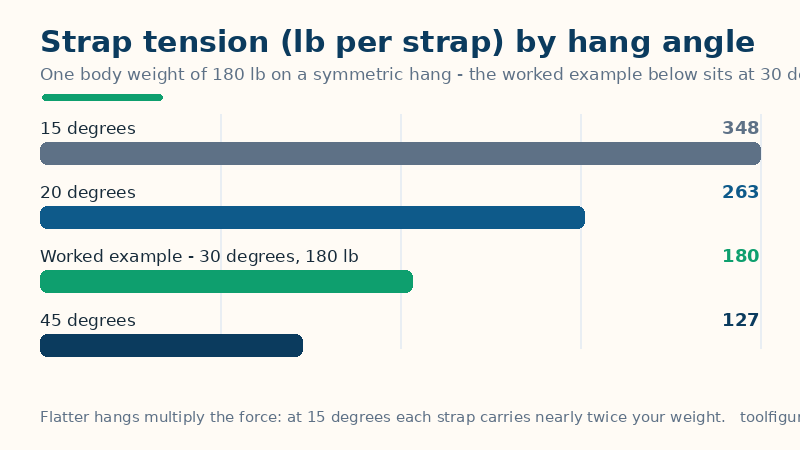
Every variable in that box is an input on this page. The tension formula is the one that surprises people: at 30 degrees, sin(30°) is 0.5, so tension = weight ÷ (2 × 0.5) = weight, one body weight per strap. At 15 degrees, sin(15°) is 0.259, so tension = weight ÷ 0.517 = 1.93 body weights per strap — nearly double. The suspension formula is one triangle per side: the anchor, the ridgeline end and the ground below it, with the sag as the vertical drop, and the ridgeline half-length taken off because the suspension only covers the span the hammock itself does not.
Worked example: 15-foot span, 11-foot hammock, 18-inch sit height, 30 degrees, 180 lb
A common 11-foot hammock between trees 15 feet apart, sat at chair height (18 inches, 1.50 ft), hung at 30 degrees, for a 180 lb sleeper, needs straps at 5 ft 10 in, with 180 lb of tension on each strap. The working: ridgeline = 0.83 × 11 = 9.13 ft. Sag depth = (15 ÷ 2) × tan(30°) = 7.50 × 0.5774 = 4.33 ft. Anchor height = 1.50 + 4.33 = 5.83 ft (5 ft 10 in). Suspension per side = √(7.50² + 4.33²) − 4.56 = √75.00 − 4.56 = 8.66 − 4.56 = 4.10 ft. Tension per strap = 180 ÷ (2 × 0.5) = 180 lb. Sideways pull on each tree = 180 × cos(30°) = 180 × 0.8660 = 156 lb. The same arithmetic at other angles, on the same span and hammock:
| Hang angle | Sag depth | Anchor height | Suspension per side | Tension per strap | Sideways pull |
|---|---|---|---|---|---|
| 15° | 2.01 ft | 3.51 ft (3 ft 6 in) | 3.20 ft | 348 lb | 336 lb |
| 20° | 2.73 ft | 4.23 ft (4 ft 3 in) | 3.42 ft | 263 lb | 247 lb |
| 30° (worked example) | 4.33 ft | 5.83 ft (5 ft 10 in) | 4.10 ft | 180 lb | 156 lb |
| 45° | 7.50 ft | 9.00 ft (9 ft 0 in) | 6.04 ft | 127 lb | 90 lb |
Check the 15-degree row by hand: sag = 7.50 × tan(15°) = 7.50 × 0.2679 = 2.01 ft; anchor = 1.50 + 2.01 = 3.51 ft; tension = 180 ÷ (2 × 0.2588) = 180 ÷ 0.5176 = 347.7 lb, shown as 348 lb. And notice what does not change with tree distance: at 30 degrees the tension is 180 lb per strap on a 12-foot span, a 15-foot span and an 18-foot span alike, because tension depends only on weight and angle. What distance changes is the anchor height and the suspension length — a 12-foot span at 30 degrees needs straps at 4.96 ft (5 ft 0 in) with 2.36 ft of suspension per side, while an 18-foot span needs straps at 6.70 ft (6 ft 8 in) with 5.83 ft per side. A shorter hammock moves the suspension the other way: a 10-foot hammock with a 150 lb sleeper on the same 15-foot span takes an 8.30 ft ridgeline, 4.51 ft of suspension per side, and 150 lb per strap.
How to read your result, and its limits
Three limits decide whether a passing geometry is enough. First, the anchors are assumed level and symmetric: real trees are not, so the higher side's strap goes up by the difference and the sag is measured from the lower side — the calculator gives the symmetric answer, and the field adjustment is yours. Second, the loads are static: getting in, shifting in your sleep and wind all spike the real peak above the static figure, which is why straps and hardware should be rated well above it rather than at it. Third, 83% is a starting point, not a universal fit: some hammocks and some sleepers prefer a slightly longer or shorter ridgeline, and personal preference moves the sag either way — the calculator shows what the standard gives, and your back is the final judge. Trees matter too: the sideways pull is the force trying to bend the trunk, so the anchor tree must be alive, sturdy and thick enough to take it, and dead or thin trees are not anchors whatever the numbers say.
Common mistakes
- Hanging it flat and tight. The most common failed hang is a hammock pulled drum-tight at 10 or 15 degrees: it feels tidy, it sleeps terribly, and each strap carries nearly twice your weight.
- Measuring the fabric, not the hammock. The length that sets the ridgeline is end to end, including the gathered ends — the fabric alone understates it and the ridgeline comes out short.
- Eyeballing the strap height. The worked example's 5 ft 10 in is higher than most first hangs land; measure it, or mark your straps, instead of trusting your eye.
- Forgetting the sideways pull. The tension figure is per strap, but the tree feels the sideways component — 156 lb per tree in the worked example — so a thin or dead tree is the wrong anchor even when the hang angle is right.
Related tools: Hammock Size Calculator — Your hammock size from height — the minimum length, the 10, 11 or 12 ft size to buy, the width and the hanging distance; Tent Size Calculator — Your tent size from sleepers and comfort — the floor area you need and the rating that covers it — with the packs-inside allowance; Bear Hang Calculator — Does your bear bag hang pass? The three PCT clearances checked, plus the branch height and rope length your hang needs.
Frequently asked questions
Why is 30 degrees the recommended hammock hang angle?
Because it balances comfort and load: the sag is deep enough for a flat diagonal lay, and the tension on each strap is about your full body weight. Flatter hangs multiply the force — at 15 degrees each strap carries nearly twice your weight — while looser hangs push the straps out of reach.
How long should my hammock ridgeline be?
About 83% of the hammock's end-to-end length: an 11-foot hammock takes a 9.13-foot ridgeline. A structural ridgeline cut to that length locks the sag in place, so the lay feels the same whatever the tree spacing — the suspension absorbs the difference.
How high should I put the straps on the tree?
Sit height plus sag depth: for the worked example, 18 inches of sit height plus 4.33 feet of sag puts the straps at 5 feet 10 inches. The calculator works it out from your span, hammock, sit height and angle — measure it rather than eyeballing it.
Why do flat, tight hammock hangs break straps?
Because tension = body weight ÷ (2 × sin(angle)), and the sine shrinks as the angle flattens: at 30 degrees each strap carries your body weight, at 20 degrees about 1.5 times it, and at 15 degrees nearly twice it. A drum-tight hang is not stronger — it is the hang most likely to fail.
