One formula, priced by terrain and pack
Exercise science prices activity in METs — Metabolic Equivalents of Task — where 1 MET is the energy of sitting still and every activity is a multiple of it. Hiking sits on a wide span of that scale: about 4 METs on a flat groomed path, about 5.5 on rolling ground, about 6.5 on sustained climbs and 8 or more on steep mountain terrain, with the pack adding further cost because carrying load raises oxygen consumption. The formula is then a single multiplication: calories = MET × body weight in kilograms × hours. Nothing else enters it — which is both its strength and its honest limit: it prices the terrain and the pack, not the weather, the altitude or the walker, and those move any real burn by roughly 15–20% either way.
MET used = terrain MET + pack adjustment — Calories per hour = MET used × body weight (kg) — Total calories burned = calories per hour × hours on the trail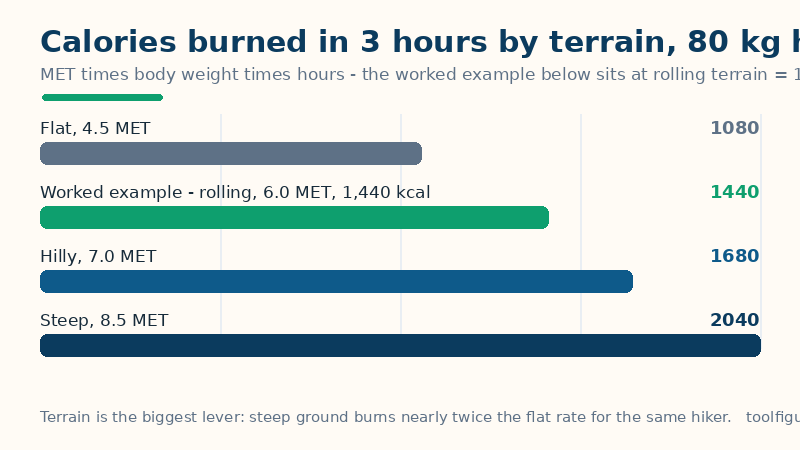
The pack adjustment follows the load pattern used across hiking calculators: a daypack adds about 0.5 MET, an overnight pack about 1.0 and a heavy pack about 1.5. That is a coarse scale by design — a pack's true cost depends on its weight, not its label — but it is far closer than ignoring the pack, which is what a flat "hiking burns 500 calories an hour" figure does for everyone from the unloaded stroller to the winter mountaineer.
Worked example: 80 kg hiker, rolling terrain, daypack, 3 hours
An 80 kg hiker on rolling terrain (5.5 MET) carrying a daypack (+0.5 MET) for 3 hours burns 1,440 kcal — 480 kcal an hour. The working: MET used = 5.5 + 0.5 = 6.0 MET. Burn rate = 6.0 × 80 = 480 kcal per hour. Total = 480 × 3 = 1,440 kcal. Turned back into food at the balanced-menu density of 125 calories an ounce, that burn is 1,440 ÷ 125 = 11.52 oz of food — the bridge to the camping food calculator, which turns a trip's daily calories into a packed weight. The same formula on other hikers:
| Hiker and hike | MET used | Burn rate | Total |
|---|---|---|---|
| 70 kg, flat, no pack, 2 hours | 4.0 | 280 kcal/hr | 560 kcal |
| 80 kg, rolling, daypack, 3 hours (worked example) | 6.0 | 480 kcal/hr | 1,440 kcal |
| 80 kg, steep, overnight pack, 2 hours | 9.0 | 720 kcal/hr | 1,440 kcal |
| 90 kg, hilly, heavy pack, 4 hours | 8.0 | 720 kcal/hr | 2,880 kcal |
| 60 kg, flat, no pack, 5 hours | 4.0 | 240 kcal/hr | 1,200 kcal |
Check the steep row by hand: 8.0 + 1.0 = 9.0 MET, 9.0 × 80 = 720 kcal an hour, 720 × 2 = 1,440 kcal — the same total as the worked example by coincidence, reached at a far higher rate for a far shorter time. Check the heavy row: 6.5 + 1.5 = 8.0 MET, 8.0 × 90 = 720 kcal an hour, 720 × 4 = 2,880 kcal. And check the flat five-hour row: 4.0 × 60 = 240 kcal an hour, 240 × 5 = 1,200 kcal. The pattern to notice is that weight scales everything linearly: the same hike at 90 kg costs exactly 1.5 times the same hike at 60 kg, because the formula multiplies by body weight throughout.
How to read your result, and its limits
Three checks before trusting the figure. First, terrain is the biggest lever, not duration: doubling the hours doubles the burn, but moving from flat to steep more than doubles the rate — picking the terrain honestly matters more than timing the hike to the minute. Second, the pack adjustment is a band, not a weighing: a 5 kg daypack and a 12 kg daypack both read as "daypack" here, so a genuinely heavy load deserves the next band up. Third, this is activity burn on top of rest, priced as total burn: the MET formula counts the whole hourly cost including the resting rate, so do not add a basal figure on top of it — and do not eat back the full figure on a multi-day trip without the camping food calculator's buffer, because appetite, altitude and cold all push real needs above any single hike's arithmetic.
Common mistakes
- Using one rate for all hiking. Flat ground at 4 METs and steep ground at 8 METs are different activities wearing the same name — the terrain choice is the calculation.
- Ignoring the pack. A heavy pack adds 1.5 METs, which on a 90 kg hiker is 135 extra calories an hour — over a full day, more than a whole meal.
- Adding basal calories on top. The MET total already includes the resting rate, so adding a daily basal figure double-counts every hour on the trail.
- Treating the estimate as a measurement. Fitness, heat, altitude and surface move the true burn by roughly 15–20% — plan food with a buffer, not to the calorie.
Related tools: Hiking Time Calculator — Your trail time from distance and ascent by Naismith's Rule — walking time, breaks and arrival time, in metric or imperial units; Pace Calculator — Running pace, speed and predicted finish times for 5K, 10K, half marathon and marathon; Calorie Calculator — Daily calorie needs (TDEE) from your BMR and activity level, with weight-loss and weight-gain targets.
Frequently asked questions
How many calories do you burn hiking?
It depends on terrain, pack and body weight, through calories = MET × weight in kg × hours. An 80 kg hiker on rolling terrain with a daypack (6.0 MET) burns 480 kcal an hour — 1,440 kcal over 3 hours — while the same hiker on steep ground with an overnight pack (9.0 MET) burns 720 kcal an hour.
What MET value is hiking?
About 4 METs on a flat groomed path, 5.5 on rolling ground, 6.5 on sustained climbs and 8 or more on steep mountain terrain, from the published hiking range in the Compendium of Physical Activities. Add about 0.5 MET for a daypack, 1.0 for an overnight pack and 1.5 for a heavy pack.
Does carrying a backpack burn more calories hiking?
Yes — carrying load raises oxygen consumption, so this calculator adds 0.5 MET for a daypack, 1.0 for an overnight pack and 1.5 for a heavy pack. On a 90 kg hiker that heavy-pack adjustment alone is 135 extra calories an hour.
How accurate is a hiking calorie calculator?
It is an estimate with roughly 15–20% individual variation: fitness, heat, altitude and trail surface all move the true burn. The MET formula prices terrain and pack honestly, but it cannot price the weather or the walker — plan food with a buffer rather than to the calorie.