Length first: the height-by-type table
The guides agree on the shape of the answer even where their exact bands differ: taller paddlers need longer boats for legroom, and the type of paddling stretches or shrinks the length at the same height. The table below follows the height-by-type grid the kayak guides publish, with the gaps between their bands closed so every height lands in exactly one row — a paddler at 168 cm sits in the second row, and a paddler at 169 cm in the third, rather than falling between two published rows.
Kayak length = the published range for your height band and kayak type — longer for touring, shorter for whitewater, at every height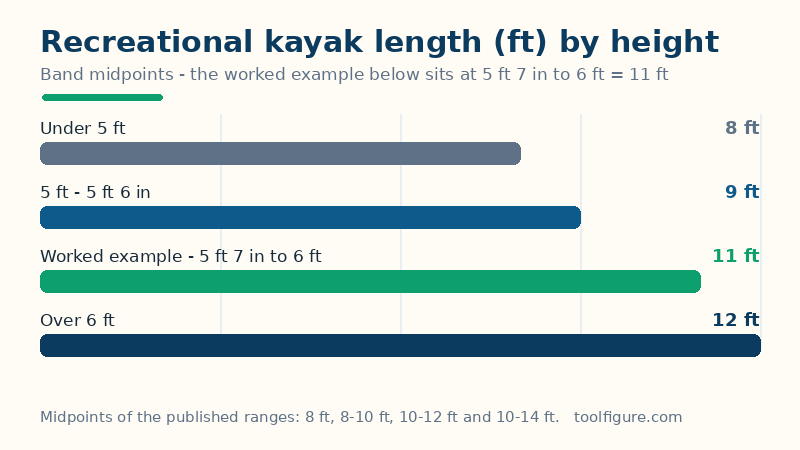
| Height | Recreational | Touring / sea | Fishing | Whitewater |
|---|---|---|---|---|
| Under 5 ft (under 152 cm) | 8 ft | 12–14 ft | 8–10 ft | 4–8 ft |
| 5 ft – 5 ft 6 in (152–168 cm) | 8–10 ft | 12–16 ft | 10–12 ft | 4–8 ft |
| 5 ft 7 in – 6 ft (169–183 cm) | 10–12 ft | 14–18 ft | 10–14 ft | 5–9 ft |
| Over 6 ft (184 cm +) | 10–14 ft | 14–20 ft | 12–14 ft | 6–9 ft |
Read the table by row, not by column: the touring column runs longest because a long hull tracks straighter and holds speed over distance, while the whitewater column stays short because a short boat turns in rapids. The feet convert at 1 ft = 0.3048 m exactly, so 10 ft is 3.05 m, 12 ft is 3.66 m, 14 ft is 4.27 m and 20 ft is 6.10 m — the recreational range for the worked example below, 10–12 ft, is 3.05–3.66 m.
Worked example: 178 cm, 80 kg, recreational
A paddler 178 cm tall (70.1 in, about 5 ft 10 in) weighing 80 kg (176 lb) looking for a recreational kayak takes 10–12 ft (3.05–3.66 m), medium volume, minimum rated capacity 134 kg (295 lb). The working: 178 cm falls in the 5 ft 7 in – 6 ft band, whose recreational range is 10–12 ft; the volume class is medium, because low needs both under 168 cm and under 64 kg while high needs over 178 cm or over 82 kg, and this paddler is neither; and the capacity is (80 + 20) ÷ 0.75 = 133.33, rounded up to 134 kg, which is 295 lb. Two more spot checks from the same rules: a 165 cm, 65 kg touring paddler takes 12–16 ft (3.66–4.88 m), medium volume, minimum 114 kg (251 lb) — (65 + 20) ÷ 0.75 = 113.33, rounded up; and a 190 cm, 95 kg fishing paddler takes 12–14 ft (3.66–4.27 m), high volume, minimum 154 kg (340 lb) — (95 + 20) ÷ 0.75 = 153.33, rounded up.
Volume and capacity: the two numbers length hides
Volume is the guides' better fit indicator for sit-inside kayaks, because it describes the hull's internal space where length alone does not: low is under 168 cm (5 ft 6 in) and under 64 kg (140 lb), for day trips with minimal gear; medium is 168–178 cm and 64–82 kg (140–180 lb), for overnight trips with moderate gear; high is over 178 cm or over 82 kg, for multi-day trips with full gear. Capacity follows the 75% performance rule the guides state: for the best handling, stay within 75% of the kayak's usable weight capacity, so the minimum rated capacity is (your weight + gear) ÷ 0.75. The tool adds 20 kg of gear by default — food, water, a dry bag and a paddle add up fast — and the capacity rows below show how the rule scales: 60 kg needs 107 kg (236 lb), 80 kg needs 134 kg (295 lb), 100 kg needs 160 kg (353 lb) and 120 kg needs 187 kg (412 lb). A boat loaded past its usable capacity sits low, handles sluggishly and risks swamping; a boat loaded far under it is harder to control in wind.
How to read your result, and its limits
Three checks before buying. First, sit in the boat: every guide says so, because cockpit size and legroom decide comfort in a way no length table can — a tall paddler in a short boat runs out of legroom, and a small paddler in a big cockpit cannot brace. Second, width is the stability trade: beginners on calm water are pointed at 71–81 cm (28–32 in) wide recreational boats, and the rule is simple — wider is steadier, narrower is faster and tracks straighter, and the right point on that trade depends on your balance and your water. Third, capacity is rated, not usable: the number on the boat includes the boat's own weight in some makers' figures and not in others, so treat the tool's minimum as a floor and check whether the maker's figure is total or payload before trusting a boat that only just clears it.
Common mistakes
- Buying length and ignoring capacity. A 12 ft boat rated for 100 kg does not carry a 110 kg paddler with gear just because the length looks right — the boat sits low and handles badly.
- Counting body weight only. Gear, water, a fishing kit or camping kit easily add 20 kg; the tool adds it for you, and a trip load over 20 kg needs the capacity raised by the difference divided by 0.75.
- Choosing touring length for a first boat. A 16 ft boat is faster in a straight line and harder to carry, store, transport and turn — most beginners are better served by the 10–12 ft recreational range.
- Skipping the test paddle. Length, volume and capacity narrow the choice to a shortlist; only sitting in the boat settles cockpit fit, legroom and stability.
Related tools: Kayak Paddle Length Calculator — The right kayak paddle length from your height, boat width and paddling style: the published height-by-width chart as a calculator; Paddleboard Size Calculator — The right stand-up paddleboard from your weight, use and skill: minimum volume, length range and width from one published rule, shown openly; Canoe Paddle Length Calculator — Your canoe paddle length from one seated measurement: torso length to straight-shaft and bent-shaft sizes.
Frequently asked questions
What size kayak do I need for my height?
Use the height-by-type table on this page: a 178 cm paddler takes 10–12 ft recreational, 14–18 ft touring, 10–14 ft fishing or 5–9 ft whitewater. Height sets the length band; the type stretches or shrinks it, and volume and capacity finish the answer.
How much weight capacity does my kayak need?
At least (your weight + gear) ÷ 0.75, so you stay within the 75% performance rule — 134 kg (295 lb) for an 80 kg paddler with 20 kg of gear. A boat loaded past its usable capacity sits low, handles sluggishly and risks swamping.
Does a longer kayak go faster?
Yes, in a straight line: a longer hull cuts through the water more efficiently and tracks straighter, which is why touring boats run longest. The trade is manoeuvrability, weight, transport and storage — a long boat turns worse and is harder to carry.
What is kayak volume — low, medium or high?
Volume is the hull's internal space, and a better fit indicator than length alone for sit-inside kayaks: low is under 168 cm and under 64 kg, medium is 168–178 cm and 64–82 kg, high is over 178 cm or over 82 kg. It tracks how much boat and gear room your body needs, not just how long the boat is.
