The formula: a height band, then inches × 2.54
Tennis racket length is a height lookup, not a calculation with a formula to solve: find your height band, read off the racket length in inches, and convert to centimetres only if you need it, with centimetres = inches × 2.54. The table below is this calculator's table, built from the height ladders the major guides agree on — brands differ by about an inch at the boundaries, so the fit check underneath matters more than any single boundary. The adult standard is 27 in; longer frames exist, but only as a deliberate choice (see below).
Racket length (cm) = racket length (in) × 2.54 — e.g. 27 × 2.54 = 68.58 cm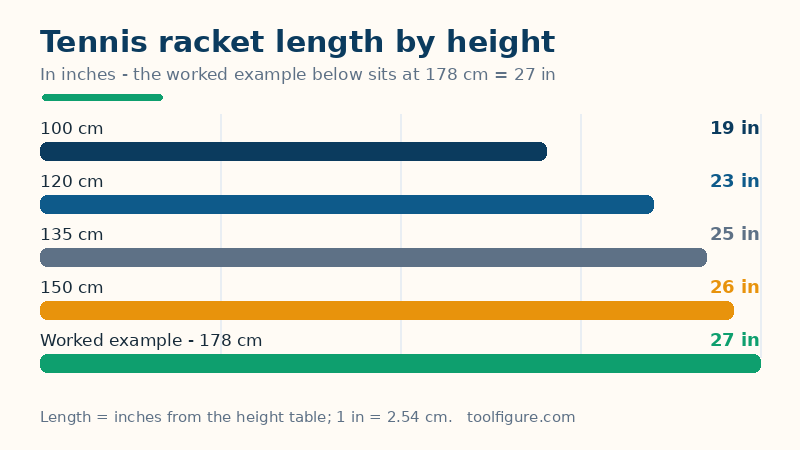
| Player height | Racket length | Exact conversion | Typical player |
|---|---|---|---|
| Under 102 cm | 19 in | 48.26 cm | Smallest juniors |
| 102–113 cm | 21 in | 53.34 cm | Young juniors |
| 114–126 cm | 23 in | 58.42 cm | Juniors |
| 127–140 cm | 25 in | 63.50 cm | Older juniors |
| 141–155 cm | 26 in | 66.04 cm | Pre-teens, bridge to adult |
| 156 cm and over | 27 in | 68.58 cm | Adults (standard) |
Spot checks against the table: 120 cm takes 23 in (58.42 cm), 135 cm takes 25 in (63.50 cm), and 150 cm takes 26 in (66.04 cm). Two boundaries are worth knowing exactly: 141 cm is the first height that takes 26 in, and 156 cm is the first that takes the 27 in adult standard. A player between two bands — a tall 10-year-old, say — should try both lengths, because strength and technique move a player up a size sooner than height alone would.
Worked example: 178 cm adult
Height 178 cm falls in the 156 cm and over band, so the recommendation is the 27 in adult standard, which is 27 × 2.54 = 68.58 cm. The grip starting point for the same height is 4 1/2 in (L4) — the 5 ft 9 in to 5 ft 11 in band of the height-to-grip table — and that starting point is exactly that: a starting point. Grip size is properly fitted by the hand, not by height, so before ordering, measure from the middle crease of the palm to the tip of the ring finger and run it through our tennis grip size converter, which returns the L size, the US size, the European number and the handle circumference. If the hand measurement and the height starting point disagree, trust the hand. The same calculator at 130 cm returns 25 in (63.50 cm) with a 4 in grip starting point — a junior frame, not a cut-down adult one.
How to read your result, and its limits
Three checks before buying. First, do the junior fit check: stand the racket on the floor beside the player — the palm should rest comfortably on the butt cap without reaching down or stretching up. If the table says 25 in but the child has to stretch, try 23 in. Second, do the grip finger-gap check: hold the racket in a continental grip and slip the index finger of the other hand between palm and ring finger — it should just fit. A grip that is too small lets the racket twist on off-centre hits; too large, and the wrist cannot snap through a serve. When in doubt, go one size smaller and build up with an overgrip — you can add thickness, but you cannot shave a grip down. Third, length is not the whole racket: head size (95–118 sq in for adults), weight (about 10.5–12.5 oz unstrung) and balance change how a frame plays far more than an inch of length. Taller adults over 183 cm (6 ft) may consider extended frames of 27.5–29 in for extra reach, but they trade manoeuvrability at the net for it, and the 27 in standard is the safe default.
Common mistakes
- Sizing by age instead of height. A tall 10-year-old and a short 10-year-old need different rackets; the table runs on height, and age is only a rough guide.
- Buying the adult 27 in frame "to grow into". A racket that is too long is heavy at the tip for a child, slows the swing and teaches poor technique; children move up a size when their height band changes.
- Treating the grip starting point as a fitting. Height predicts grip only roughly — two players at 178 cm can need different grips. The hand measurement decides.
- Confusing grip numbers across systems. L3, 4 3/8 in and the European 3 are the same grip; our tennis grip size converter translates between them.
Related tools: Badminton Racket Size Calculator — The right badminton racket from age and level: length, weight class (U) and grip size (G) in grams and millimetres.
Frequently asked questions
What size tennis racket do I need at 5 ft 10 in?
5 ft 10 in is 178 cm, which falls in the 156 cm and over band, so the recommendation is the 27 in adult standard (68.58 cm), with a grip starting point of 4 1/2 in (L4) — confirm the grip with a hand measurement before ordering.
What size tennis racket for a 10-year-old?
It depends on height, not age alone: a 10-year-old at 135 cm takes 25 in (63.50 cm), while a taller 10-year-old at 150 cm takes 26 in (66.04 cm). Do the floor fit check — palm resting on the butt cap — before buying.
What is the standard adult tennis racket length?
27 in (68.58 cm). Extended frames of 27.5–29 in exist for taller players seeking extra reach, but 27 in is the standard adult length and the safe default.
How do I measure tennis grip size?
Measure from the middle crease of your palm to the tip of your ring finger; that measurement in inches is your grip size. Our tennis grip size converter turns it into the L size, US size and European number.
