Two sizes, not one
A backpack size question is really two questions, and answering only one of them is how people end up with a pack that holds everything and still hurts. The frame size — XS, S, M or L — decides where the hip belt sits and whether the load rides on your hips instead of your shoulders. It comes from your torso length, measured along your spine from the bony bump at the base of your neck (the C7 vertebra) to the top of your hip bones. Height is a poor substitute: two people of the same height often have different torso lengths, and the guides that do this properly say so plainly. The volume in litres decides how much gear the pack holds, and it comes from how many nights you are out, how you pack and the season — not from your body at all.
Frame size = torso-length band (XS under 41 cm, S 41–46 cm, M 46–51 cm, L 51 cm and over) · Volume = trip base × packing multiplier × season multiplier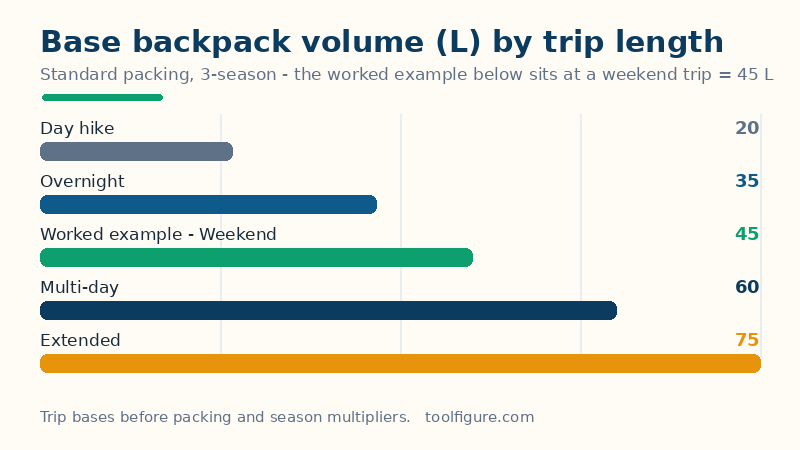
The multipliers are stated openly so the result can be checked by hand: packing is ultralight × 0.85, standard × 1.00, comfort × 1.15; season is summer × 0.90, 3-season × 1.00, winter × 1.25. Winter costs the most litres because a bulky sleeping bag and extra layers take space even before food goes in, and comfort packing costs more than ultralight for the same reason — bigger tent, more food, more layers. The shopping range is the volume ± 10%, rounded: makers measure litres differently (main compartment only, or every pocket included), so a single exact number would be false precision.
Worked example: 48 cm torso, weekend trip, standard packing, 3-season
A hiker with a 48 cm torso going out for a weekend (2–3 nights) with standard packing in 3-season conditions needs a M frame pack of 45 litres, shopping range 41–50 L (2,746 cubic inches). The working: 48 cm falls in the M band, 46–51 cm (18–20 in); the weekend base is 45 L, and both multipliers are 1.00, so 45 × 1.00 × 1.00 = 45 L; the range is 45 × 0.9 = 40.5, rounded to 41 L, up to 45 × 1.1 = 49.5, rounded to 50 L; and 45 × 61.024 = 2,746.08 cubic inches, rounded to 2,746 in³. Two torso cross-checks in inches: 18 in is 45.7 cm, which falls in the S band (41–46 cm), and 20 in is 50.8 cm, which falls in the M band (46–51 cm) — the same person measured in inches must land in the same frame, and here they do.
Volume at other trip lengths
The table below runs the same arithmetic at other combinations, so the effect of each multiplier is visible rather than asserted. Every row can be reproduced from the base table on the calculator: multiply the base by the packing multiplier, then by the season multiplier, then round to the nearest litre.
| Trip and packing | Volume | Shopping range | Cubic inches |
|---|---|---|---|
| Day hike, ultralight, summer (20 × 0.85 × 0.90) | 15 L | 14–17 L | 915 in³ |
| Overnight, comfort, winter (35 × 1.15 × 1.25) | 50 L | 45–55 L | 3,051 in³ |
| Multi-day, comfort, winter (60 × 1.15 × 1.25) | 86 L | 77–95 L | 5,248 in³ |
| Extended, ultralight, 3-season (75 × 0.85 × 1.00) | 64 L | 58–70 L | 3,906 in³ |
The pattern worth noticing is that season and packing together can move a trip by a whole pack size: an overnight trip is 35 L at standard 3-season packing but 50 L packed for comfort in winter, and a multi-day trip jumps from 60 L to 86 L on the same change. That is why the guides quote ranges per trip length rather than one number — 30–50 L for a weekend, 50–80 L for 3–5 nights, 70 L and over for extended or winter trips — and why this tool asks about packing and season instead of pretending trip length alone decides it.
How to read your result, and its limits
Three checks before buying. First, frame over litres: a 45 L pack in the wrong frame will hurt with 15 kg in it, while a 50 L pack in the right frame will carry comfortably — try the pack loaded, with the hip belt sitting on your hip bones, before judging it by its label. Second, a measurement exactly on a boundary takes the larger frame: the bands meet at 41, 46 and 51 cm, and the tool assigns the boundary to the larger size, because a slightly long frame adjusts down more gracefully than a short one riding on your shoulders. Third, the litre figure is a planning number, not a laboratory measurement: there is no single enforced standard for how a maker counts pockets and extensions, so two packs both labelled 45 L can hold visibly different kit — the ± 10% shopping range exists for exactly that reason, and the honest test is packing your own gear list into the pack, not comparing labels.
Common mistakes
- Sizing by height. Height and torso length track each other loosely, not exactly — measure the torso, or the frame size is a guess dressed up as a measurement.
- Buying litres for the longest trip you might ever take. A 75 L pack bought for one extended trip is a floppy, half-empty pack on every weekend walk; size for the trip you actually take most, and rent or borrow for the exception.
- Treating the litre number as exact. Makers measure differently, so a pack labelled 45 L from one brand can hold less than a 40 L from another — shop the range, and test with your own gear.
- Ignoring the season. Winter gear is bulky even when it is light: a summer-sized pack cannot swallow a winter sleeping bag no matter how carefully it is rolled.
Related tools: Trekking Pole Size Calculator — Your trekking pole length from height: flat, uphill and downhill settings in one page; Kayak Size Calculator — Your kayak size from height and weight: length range, volume class and minimum capacity; Wetsuit Size Calculator — The right wetsuit size from your height and weight, plus the suit thickness for your water temperature: one consolidated chart, honestly stated.
Frequently asked questions
What size backpack do I need for a weekend trip?
A weekend trip (2–3 nights) with standard packing in 3-season conditions calls for a 45 L pack, shopping range 41–50 L — plus the frame size from your torso length, which matters as much as the litres. Comfort packing or winter conditions push the same trip to 50 L or more.
How do I measure my torso length for a backpack?
Stand straight and measure along your spine from the bony bump at the base of your neck (the C7 vertebra) to the top of your hip bones (the iliac crest). That length, not your height, sets the frame size: under 41 cm is XS, 41–46 cm is S, 46–51 cm is M, and 51 cm and over is L.
How many litres is a day hike backpack?
A day hike needs about 20 L at standard packing, falling to 15 L packed ultralight in summer. The guides agree on the shape of the scale: roughly 10–30 L for a day, 30–50 L for 1–3 nights, 50–80 L for 3–5 nights, and 70 L and over for extended or winter trips.
Is frame size or litre capacity more important?
Frame size, by a clear margin: it decides whether the load rides on your hips or hangs off your shoulders, and no litre count fixes a wrong frame. Get the frame from your torso length first, then pick a volume inside the shopping range for your trip.
