Litres boiled set the fuel, the stove sets the rate
Every fuel plan is the same multiplication: litres boiled, times fuel per litre, times people, times days — then adjusted for weather. The litres come first and are the only figure you control directly: two litres per person per day is the usual planning figure for freeze-dried meals plus hot drinks, and it is the figure this page defaults to, because it is the figure the published guides budget. Real cooking with long simmering needs more, and melting snow needs far more — a snow-melting trip should budget roughly double the calm-weather fuel, which is why this page's cold-or-windy allowance multiplies by 1.5 rather than pretending weather is free. The burn rates are the makers' published ratings, not rules of thumb: an upright canister stove of the MSR PocketRocket 2 class boils about 16 litres from a 227 g canister, which works out to 14.2 grams per litre, rounded to 14 here; an integrated system of the Jetboil Flash class boils about 10 litres from a 100 g canister, which is 10 grams per litre, because its heat-exchanger cup keeps heat an open burner throws away; white gas is measured the other way, in fluid ounces, because MSR rates the WhisperLite at about 1.5 litres boiled per 1 fluid ounce, so each litre costs about 0.67 fluid ounces.
Litres boiled = people × days × litres per person per day — Canister fuel = litres × burn rate (14 g/L upright, 10 g/L integrated) × conditions (1.0 calm, 1.5 cold or windy) — White gas = litres × 0.67 fl oz/L × conditions — Canisters = fuel rounded up to whole 100 g or 230 g canisters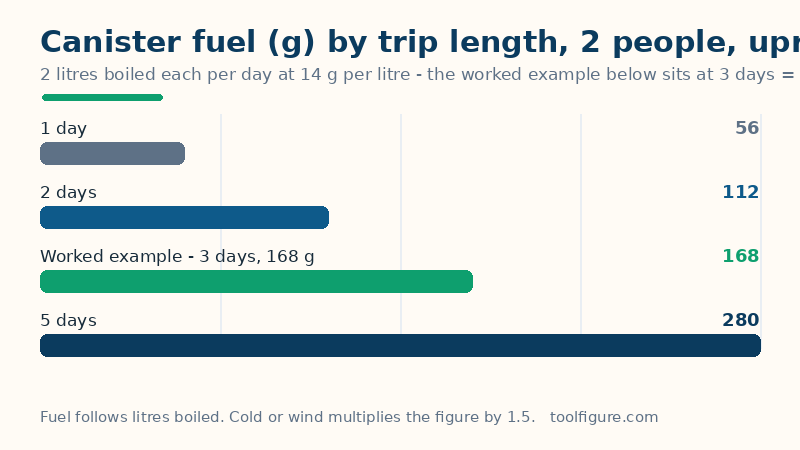
Rounding up to whole canisters is part of the calculation, not a courtesy: fuel is bought in canisters, and a trip needing 168 grams cannot be packed in a single 100 gram canister, whatever the arithmetic says. That is why the answer gives both canister sizes — two 100 gram canisters or one 230 gram canister for the worked example — so the packing choice stays yours while the quantity does not change.
Worked example: 2 people, 3 days, 2 litres each, upright stove, calm
Two people on a three-day trip, boiling two litres each per day on an upright canister stove in calm weather, should carry 168 grams of canister fuel — one 230 gram canister, or two 100 gram canisters. The working: litres boiled = 2 × 3 × 2 = 12 litres. At 14 grams per litre that is 12 × 14 = 168 grams (168 ÷ 28.3495 = 5.9 ounces). Calm conditions multiply by 1.0, so the answer stays 168 grams. Rounded up to whole canisters: 168 ÷ 100 = 1.68, so 2 × 100 gram canisters; 168 ÷ 230 = 0.73, so 1 × 230 gram canister. The same trip on other stoves and in other weather:
| Trip | Stove and conditions | Litres boiled | Fuel to carry |
|---|---|---|---|
| 1 person, 2 days, 2 litres each | Upright, calm | 4 litres | 56 g — 1 × 100 g canister |
| 2 people, 3 days, 2 litres each (worked example) | Upright, calm | 12 litres | 168 g — 1 × 230 g (or 2 × 100 g) |
| 2 people, 3 days, 2 litres each | Integrated, calm | 12 litres | 120 g — 1 × 230 g (or 2 × 100 g) |
| 2 people, 3 days, 2 litres each | Upright, cold or windy | 12 litres | 252 g — 2 × 230 g (or 3 × 100 g) |
| 2 people, 3 days, 2 litres each | White gas, calm | 12 litres | 8.0 fl oz (237.8 ml) |
| 2 people, 5 days, 2 litres each | Upright, calm | 20 litres | 280 g — 2 × 230 g (or 3 × 100 g) |
| 4 people, 3 days, 2 litres each | Upright, calm | 24 litres | 336 g — 2 × 230 g (or 4 × 100 g) |
Check the cold-or-windy row by hand: 168 grams × 1.5 = 252 grams, and 252 ÷ 230 = 1.10, so two 230 gram canisters, not one — weather is the difference between one canister and two on this trip. And check the white gas row: 12 × 0.67 = 8.04 fluid ounces, shown as 8.0, which is 8.04 × 29.5735 = 237.8 millilitres, or about 1.3 fluid ounces per person per day from boil math alone.
How to read your result, and its limits
Three checks before trusting the figure. First, the litre figure is the whole plan: if your group actually boils three litres each per day — real cooking, not freeze-dried meals — the fuel scales with it, and no stove choice rescues a litre figure that was guessed low. Second, white gas answers are floors, not packing lists: priming burns fuel at every lighting, and published rules of thumb land near 1.5 to 2.5 fluid ounces per person per day once priming and simmering are counted, against about 1.3 from boil math alone — carry a margin on any liquid-fuel trip. Third, wind is the largest single error: an unshielded stove in wind can double fuel use, which is why the cold-or-windy allowance exists and why a windscreen — used at a safe distance from the canister — is worth more than a larger canister. Fuel calculations are always estimates: your stove, your meals, your weather and your cooking habits all move the real figure, so test the stove at home and weigh a part-used canister rather than shaking it.
Common mistakes
- Packing the canister you have, not the fuel the trip needs. A part-used canister of unknown remainder is a guess, not a plan — weigh it and write the grams on the cap.
- Counting body weight instead of litres boiled. Fuel follows water boiled, not group size alone: two people boiling little use less than one person boiling much.
- Forgetting weather. Cold and wind roughly double a canister day plan in the worst case; the 1.5 allowance here is the planning middle, not the worst case.
- Planning white gas to the last fluid ounce. Priming is real fuel, spent at every lighting, and it is not in the boil math — the white gas answer needs a margin.
Related tools: Cooler Size Calculator — Your cooler size from group, days, drinks and food — the litres and quarts it must hold, the standard size to buy, and the ice inside it; Dry Bag Size Calculator — Your dry bag size from what must stay dry — the litres of gear, the size to buy after the roll-top allowance, and the spare room inside it; Backpack Size Calculator — Your backpack size in two parts: frame size from torso length, and litres from trip length, packing style and season.
Frequently asked questions
How much stove fuel do I need per person per day?
On boil math, about 28 grams of canister fuel a day for an upright stove at 2 litres boiled (2 × 14 g), or about 1.3 fluid ounces of white gas a day (2 × 0.67 fl oz). Real cooking, cold or wind, and white gas priming all push the real figure higher — the calculator applies a 1.5 allowance for cold or windy conditions.
How many canisters do I need for a 3-day trip for 2 people?
At 2 litres boiled each per day on an upright canister stove in calm weather: 12 litres × 14 g = 168 g, so one 230 g canister or two 100 g canisters. In cold or windy weather the same trip needs 252 g, which is two 230 g canisters.
Is an integrated stove really more fuel-efficient?
Yes, on the makers' ratings: about 10 grams per litre against about 14 for an upright stove, because the heat-exchanger cup keeps heat an open burner throws away. On the worked example that saves 48 grams — 120 g against 168 g — which is rarely a whole canister saved, but is a real margin on a longer trip.
Does melting snow change the fuel calculation?
Yes, a lot: melting snow means boiling far more water than the drinking figure, in cold conditions, so budget roughly double the calm-weather fuel for a snow-melting trip, and treat the cold-or-windy allowance as a minimum rather than a worst case.
