Three systems, three different questions
The reason no conversion table is exact is that the three systems do not measure the same thing. The YDS (Yosemite Decimal System) grades the hardest single move on a route — the crux — and adds a letter from 5.10 upward to split each number into four steps. The French sport scale grades the overall difficulty of redpointing the whole route, so a long, sustained route and a short, cruxy one can share a French grade while sitting a step apart in YDS. The UIAA scale, built on Roman numerals with plus and minus modifiers, grew out of the Alpine tradition and compresses differently again, especially at the top end. A conversion is therefore a consensus mapping between three opinions, and any two published tables can differ by a step — which is why this page prints its whole ladder instead of hiding the choice behind one answer.
Conversion = look the grade up on one consistent ladder — YDS 5.5 to 5.15a, French 4a to 9b, UIAA IV to XIII- — and read across the row. No arithmetic converts a grade: the ladder IS the conversion.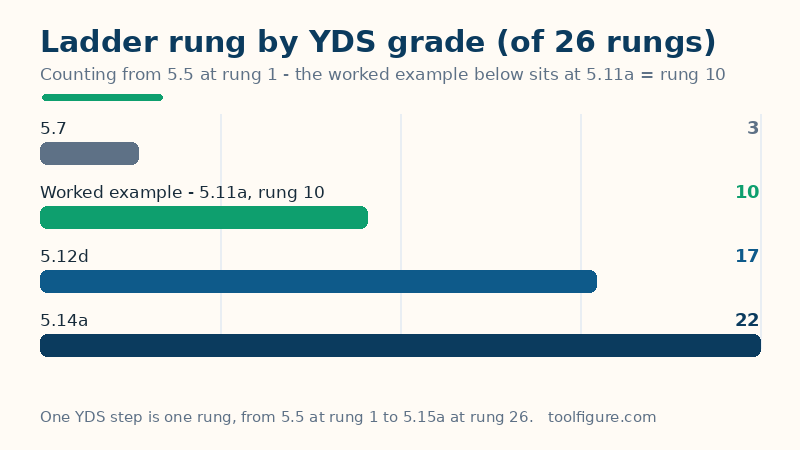
That box is deliberately not a formula, because there is none: grades are labels on a ladder, and converting one means finding the same rung in another labelling. The ladder on this page runs 26 rungs, from 5.5 at the bottom to 5.15a at the top, and every row below is that ladder — the tool, the worked example and the prose table all read from the same rows, so they cannot disagree with each other even where published tables disagree with this one.
Worked example: YDS 5.11a
Pick YDS 5.11a and the tool reads across its row: French 6c, UIAA VII+. It is rung 10 of 26 on the ladder — one step easier is 5.10d = 6b+ = VII, one step harder is 5.11b = 6c+ = VIII-. The same rows across the range:
| YDS | French | UIAA | Rung |
|---|---|---|---|
| 5.7 | 4c | V | 3 of 26 |
| 5.9 | 5b | VI- | 5 of 26 |
| 5.10c | 6b | VII- | 8 of 26 |
| 5.11a (worked example) | 6c | VII+ | 10 of 26 |
| 5.12a | 7b | IX- | 14 of 26 |
| 5.13a | 8a | X | 18 of 26 |
| 5.14a | 8c | XI+ | 22 of 26 |
Check the rung numbers by counting the ladder from the bottom: 5.5 is rung 1, 5.6 is 2, 5.7 is 3, 5.8 is 4, 5.9 is 5, 5.10a is 6, 5.10b is 7, 5.10c is 8, 5.10d is 9, 5.11a is 10 — the worked example's rung — and the count continues one rung per YDS step to 5.15a at rung 26. If a guidebook you trust puts 5.11a a step either way, that is the known one-step disagreement between tables, not an error on this page: the ladder is consistent, and the disagreement is stated wherever the ladder is shown.
How to read your result, and its limits
Three limits decide how far to trust a converted grade. First, the conversion is approximate by construction: above 5.12 especially, published tables place the same YDS grade a step apart in French or UIAA, so a converted grade is a starting point for choosing a route, never a guarantee of how it will feel. Second, grades describe specific routes, not difficulty in the abstract: two routes sharing a grade can feel different because of length, style, rock type and protection, and a sport grade says nothing about how serious a trad lead of the same number is. Third, this ladder covers route grades only: bouldering uses the V-scale and Font scales, British trad uses the E-grade pair, and ice and mixed climbing use WI and M grades — none of those convert on this ladder, and forcing them onto it would be a false conversion. Within those limits, the ladder is exact: pick a YDS grade and the French and UIAA figures on its row are the ones this page means, every time.
Common mistakes
- Treating a conversion as a measurement. A converted grade is a consensus mapping, not a unit conversion like metres to feet — there is no exact factor, and a one-step disagreement between tables is normal.
- Reading a French grade as a YDS number. French 6a is not "6" of anything American: it is the French label for the rung this page calls 5.10a. Read across the row, never across the digits.
- Forgetting the letter steps above 5.10. From 5.10 upward each YDS number splits into a, b, c and d — 5.11a and 5.11d are two full steps apart, not the same grade with decoration.
- Converting a boulder grade on a route ladder. A V-grade and a Font grade describe short boulder problems, not routes, and they do not sit on the YDS–French–UIAA route ladder at all.
Related tools: Climbing Harness Size Calculator — Your climbing harness size from waist and leg measurements — S, M, L or XL — with the fit checks that settle it; Climbing Shoe Size Calculator — Your climbing shoe size from foot length and fit: comfort, snug, performance or downsized; Climbing Rope Length Calculator — How long a climbing rope your route needs, from the longest pitch — minimum length by the double-the-pitch rule, and the standard rope to buy.
Frequently asked questions
What is YDS 5.11a in French and UIAA grades?
On this page's ladder, YDS 5.11a = French 6c = UIAA VII+, rung 10 of 26 — one step easier is 5.10d = 6b+ = VII, one step harder is 5.11b = 6c+ = VIII-. Treat it as an approximate equivalent: published tables disagree by one step in places, especially above 5.12.
Why do climbing grade conversion charts disagree with each other?
Because the systems measure different things: YDS grades the hardest single move, the French scale grades the overall redpoint difficulty, and the UIAA scale comes from a different tradition. A conversion is a consensus mapping between opinions, not a unit conversion, so a one-step difference between tables is normal rather than an error.
What is the difference between French and YDS climbing grades?
YDS is the American system (5.5 to 5.15a, with a–d letter steps from 5.10 up) that grades the hardest move; the French sport scale (4a to 9b, with + steps) grades the overall difficulty of the whole route. The same route can therefore sit a step apart in the two systems depending on whether it is cruxy or sustained.
Does this converter cover bouldering grades?
No — bouldering uses the V-scale and Fontainebleau scales, British trad uses E-grades, and ice and mixed climbing use WI and M grades, none of which sit on the YDS–French–UIAA route ladder. Converting a boulder grade on a route ladder would be a false conversion, so this page covers route grades only.
