What radiation dose is — and why it comes in three families
Radiation dose is not one quantity with many units; it is three quantities that share a page because reports keep mixing them up. Absorbed dose is the energy radiation deposits per unit mass of anything it hits, and its units are the gray (Gy) and the older rad. Equivalent dose is absorbed dose weighted by how damaging that radiation type is to living tissue, and its units are the sievert (Sv) and the older rem. Exposure is the charge radiation liberates per unit mass of air, and its units are the coulomb per kilogram (C/kg) and the older roentgen (R). A radiotherapy sheet quotes absorbed dose in gray, a dosimeter report quotes equivalent dose in sievert, and an old American survey meter quotes exposure in roentgen — and converting a gray figure straight into sievert, as if the units were interchangeable, is the single most common dose error on the internet. This page converts exactly within each family and refuses a cross-family conversion with a clear error, while the weighting figure below connects absorbed dose to equivalent dose through the one number that legitimately joins them: the radiation weighting factor.
The formula
family base = value × (family base in one "from" unit)
answer = family base ÷ (family base in one "to" unit)
equivalent dose H = wR × absorbed dose D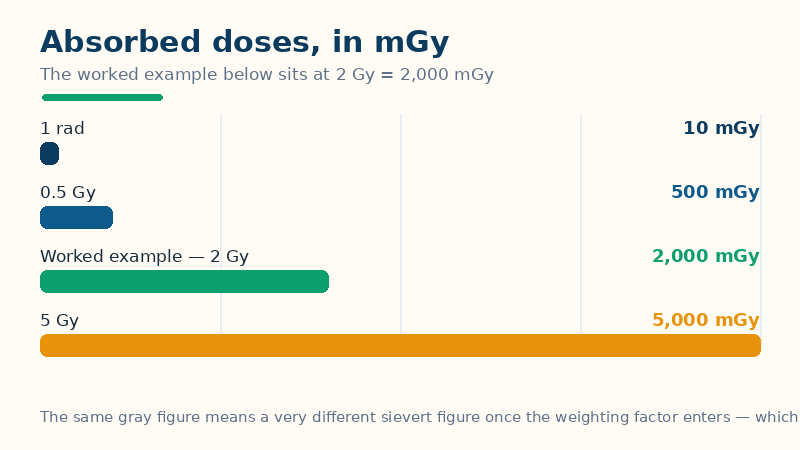
Three terms, all visible on the page. value is the number you enter. family base in one "from" unit is the definition of the unit you are converting from, inside its own family: for absorbed dose, 1 for the gray itself, 0.001 for the milligray, 0.000001 for the microgray, 1,000 for the kilogray, 0.01 for the rad and 0.00001 for the millirad; for equivalent dose, 1 for the sievert itself, 0.001 for the millisievert, 0.000001 for the microsievert, 0.01 for the rem and 0.00001 for the millirem; for exposure, 1 for the coulomb per kilogram itself, 0.001 for the millicoulomb per kilogram, 0.000258 for the roentgen and 0.000000258 for the milliroentgen. answer is the result in the unit you asked for, in the same family. equivalent dose H is the absorbed dose you enter times the weighting factor you enter, in sievert, so a gray figure becomes the sievert figure a dosimeter would report for that radiation type — 1 for photons and gamma rays, 20 for alpha particles.
Worked example
Convert 2 Gy to rad — the unit jump every radiotherapy sheet forces on a reader of old American tables — the way the tool does it.
Step 1 — get to the family base. One gray is 1 Gy, so 2 × 1 = 2 Gy.
Step 2 — read the display. The headline reads 200 rad, and the detail line shows the working: 2 Gy = 200 rad — worked through Gray: 2 Gy ÷ the Rad factor. The full table for this example reads: 2 Gy, 2,000 mGy, 2,000,000 µGy, 0.002 kGy, 200 rad and 200,000 mrad. The extra line, at the default absorbed dose of 2 Gy and weighting factor of 1, reads: Equivalent dose at wR = 1: 2 Sv (200 rem) — absorbed dose × weighting factor.
Check it. Multiplying back, 200 rad × 0.01 = 2 Gy exactly, and the weighting line checks the same way: 2 Gy × 1 = 2 Sv, and 2 Sv ÷ 0.01 = 200 rem.
Conversion table
The conversions dose sheets, dosimeter reports and old survey tables reach for most, each one the same two steps as the example, inside its own family:
| From | To |
|---|---|
| 1 Gy | 100 rad |
| 0.5 Gy | 50 rad |
| 1 rad | 10 mGy |
| 5 mGy | 0.5 rad |
| 150 rem | 1.5 Sv |
| 0.75 Sv | 75 rem |
| 1 mSv | 100 mrem |
| 3 R | 7.74e-04 C/kg |
| 1 C/kg | 3,875.97 R |
| 2 Gy at wR = 20 (alpha) | 40 Sv (4,000 rem) |
Three everyday cross-checks for the scale, each one the same two steps: the same 2 Gy that is 200 rad becomes 40 Sv at the alpha weighting factor of 20 — twenty times the photon figure, which is why the radiation type matters more than the gray figure alone; an exposure of 1 R is about 8.69 mGy of absorbed dose in air, a figure that belongs to air only and must never be quoted as a tissue dose; and average natural background is about 2.4 mSv a year of equivalent dose worldwide, so a single millisievert on a dosimeter report is less than half a year's background, while a single sievert is hundreds of times it.
Reading the result, and its limits
Four distinctions keep this page honest. First, gray and sievert are numerically equal only for photons: for X-rays and gamma rays the weighting factor is 1, so 1 Gy of absorbed dose is 1 Sv of equivalent dose — for alpha particles it is 20, so the same gray figure is twenty sievert, and this page never hides that step inside a conversion. Second, this page does not convert activity: becquerels and curies say how many atoms decay per second, not how much energy tissue absorbs, and they belong on the companion radioactivity converter, never in a dose table. Third, exposure is not dose: roentgen figures describe ionisation in air, and turning them into tissue dose needs the material, the energy and the geometry — the 8.69 mGy-per-roentgen figure above is an in-air approximation, not a body dose. Fourth, dose numbers are not medical advice: this page converts units, it does not judge whether a dose is safe, and any dose that matters clinically belongs to the physicist or physician who prescribed it.
Related tools: Radioactivity Converter — Becquerels to curies, millicuries and more — every answer in all eight units; Density Converter — kg/m³ to lb/ft³, g/cm³ to lb/in³, lb/gal and more — every answer in all nine units, through the exact definitions; Energy Converter — Joules to calories, kcal to kJ, kWh to joules and BTU — every answer in all ten units, through the exact definitions.
Frequently asked questions
How do I convert Gy to rad?
Multiply by 100. The worked example's 2 Gy is 2 × 100 = 200 rad. To go the other way, divide by 100 — 1 rad is 0.01 Gy, so 1 rad is 10 mGy.
Why can't I convert Gy directly to Sv?
Because they measure different quantities: gray is absorbed dose (energy per unit mass) and sievert is equivalent dose (absorbed dose weighted by radiation type). For photons the weighting factor is 1, so the numbers match, but for alpha particles it is 20 — so this page connects them only through the weighting figure, never silently.
What is the difference between rem and rad?
Rad is the old unit of absorbed dose (1 rad = 0.01 Gy) and rem is the old unit of equivalent dose (1 rem = 0.01 Sv). They share the factor 100 to their SI units, but they belong to different families and must never be converted into each other without a weighting factor.
How do I convert roentgen to C/kg?
Multiply by 0.000258. The table's 3 R is 3 × 0.000258 = 7.74e-04 C/kg. To go the other way, divide by 0.000258 — 1 C/kg is 3,875.97 R.
