The formula: age bands, then the official size table
Rugby ball size is an age band, not a height measurement. For rugby union matches the bands used here are: under 6 takes the mini ball, ages 6–9 take size 3, ages 10–14 take size 4, and ages 15 and over take the official size 5. Girls under 15 are the one stated exception in the RFU age-grade chart — they stay on size 4 through under-15, then move to size 5 with everyone else. Touch and tag rugby adds one more size: the 4.5, a transition ball between sizes 4 and 5 that is used for touch only and is not legal for union match play.
Size 5 (official, World Rugby Law 2): length 280–300 mm, girth 580–620 mm, end-to-end 740–770 mm, weight 410–460 g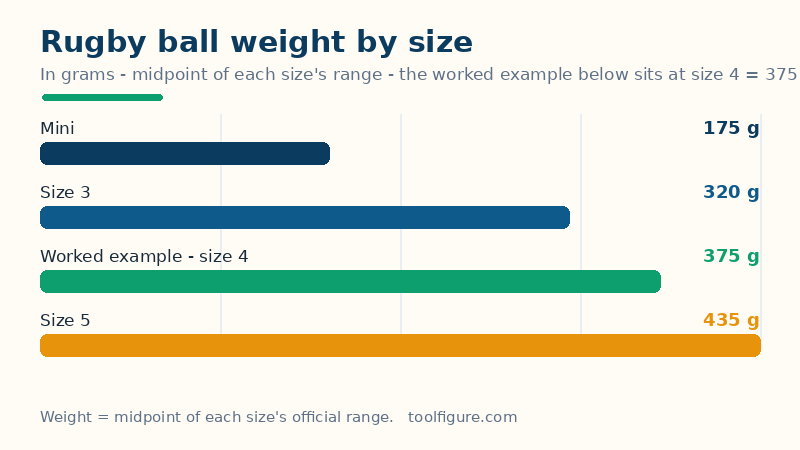
| Ball size | Ages | Length | Girth | End-to-end | Weight |
|---|---|---|---|---|---|
| Mini (size 1) | Under 6 | 160 mm | — | 400 mm | 150–200 g |
| Size 3 | 6–9 | 255 mm | 540 mm | 680 mm | 300–340 g |
| Size 4 | 10–14 | 275 mm | 555 mm | 720 mm | 360–390 g |
| Size 4.5 (touch) | 10+ (touch only) | between 4 and 5 | between 4 and 5 | between 4 and 5 | about 400 g |
| Size 5 (official) | 15+ | 280–300 mm | 580–620 mm | 740–770 mm | 410–460 g |
Sizes vary slightly between brands, so treat the table as the standard and the brand's own listing as the final word. The size 5 row is a range rather than a single figure because World Rugby's law states it as one: any ball inside 280–300 mm long and 410–460 g is a legal size 5.
Worked example: age 10, rugby union
Age 10 falls in the 10–14 band, so the ball is size 4: 275 mm long, 555 mm around its girth, 720 mm end-to-end, and 360–390 g — a midpoint weight of 375 g, which is 60 g lighter than the size 5 midpoint of 435 g. That 60 g step is the whole point of the youth sizes: a 10-year-old can grip, pass and kick a 375 g ball properly, while a 435 g senior ball is too heavy to handle cleanly. The same player moves to size 5 at 15, and a touch player of the same age would instead use the size 4.5 transition ball.
How to read your result, and its limits
Three checks before buying. First, check the competition's own rules: age-grade cut-offs differ by a year between unions, and a school or club tournament may specify its own ball. Second, weight matters as much as size: the step from size 4 (360–390 g) to size 5 (410–460 g) is small on paper but obvious in a child's hands. Third, match balls and training balls differ: a cheaper training ball in the right size is fine for practice, but match play should use a ball that meets the size 5 law above. This calculator covers rugby union and touch; rugby league uses the same numbered sizes but its own match-ball specification, so league players should check their league's rules.
Common mistakes
- Buying the official size 5 for a young child. A full-weight senior ball is too heavy for small hands to pass and kick properly — sizes 3 and 4 exist for exactly that reason.
- Using a size 4.5 touch ball in a union match. The 4.5 is a transition and touch ball; it is not a legal union match ball at any level.
- Judging by height instead of age. Ball size follows the age band, not how tall the player is — a tall 10-year-old still plays size 4.
- Assuming one size fits every format. A size 4 match ball, a size 4.5 touch ball and a mini ball are different tools; pick by the game being played, not just the age.
Related tools: Soccer Ball Size Calculator — The right soccer ball size from the player's age: league sizes 3, 4 and 5, plus skills balls 1 and 2; Basketball Size Calculator — The right basketball size from age and gender: sizes 1 to 7 with circumference, weight and diameter; Volleyball Size Calculator — The right volleyball size from age: indoor sizes 3, 4 and 5 plus the beach ball, with circumference, weight and diameter.
Frequently asked questions
What size rugby ball for a 10-year-old?
Size 4: 275 mm long, 555 mm girth, 720 mm end-to-end, 360–390 g (midpoint 375 g). A 10-year-old playing touch uses the size 4.5 transition ball instead.
What size rugby ball do adults use?
Size 5, the official size for ages 15 and over: 280–300 mm long, 580–620 mm girth, 740–770 mm end-to-end, 410–460 g — the ball used from under-15 rugby up to international matches.
What is a size 4.5 rugby ball?
A transition ball between sizes 4 and 5, used for touch and tag rugby and for players bridging to the senior ball. It is not legal for rugby union match play.
What size rugby ball for a 7-year-old?
Size 3: 255 mm long, 540 mm girth, 680 mm end-to-end, 300–340 g. Size 4 starts at age 10.
