Hours and heat set the rate, the delay hour sets the margin
Water needs on a hike are not fixed: they vary with temperature, effort, load and sun exposure, and the honest way to plan them is per hour, the way you drink on the trail. This page uses the published Trail Hiking Australia planning scale, which gives an hourly rate from temperature and effort together: half a litre an hour is the familiar rule for moderate hiking in moderate temperatures, and it is the middle of this scale, not its top — the scale runs from 0.30 litres an hour for easy walking in the cool up to 1.10 litres an hour for strenuous walking in very hot weather, because heat and effort together decide the rate. The estimate is then worked out as rate × hike time, plus rate × one extra hour for delays, plus camp water for cooking and washing. The delay hour is deliberate: a hike that runs an hour long is the hike that runs out of water, and the extra hour costs one rate-sized amount, not a guess.
Hourly rate from temperature × effort (0.30–1.10 L/hr) — Water to carry = rate × hike hours + rate × 1 delay hour + camp water — Bottles = water rounded up to whole 1-litre bottles — Pack weight = litres × 1 kg (× 2.20462 lb)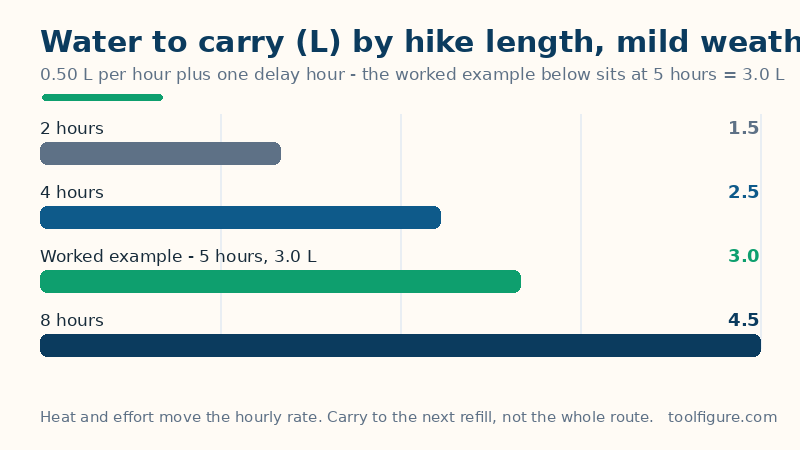
The scale is a set of planning assumptions, not a personal requirement: it does not establish how much any one person needs, and its highest figure is not a maximum. Direct sun, limited shade and humidity can increase heat strain and make the estimate less representative, and on long or hot hikes the real figure can exceed the scale — hikers can lose one to two litres an hour in summer heat. Weigh yourself before and after a long hike to learn your own rate; a rate learned from similar conditions and effort beats any generic estimate.
Worked example: 5 hours, mild weather, moderate effort
A five-hour hike in mild weather (15 to below 25 °C) at moderate effort, with no camp water, needs 3.0 litres of water — three 1-litre bottles, weighing 3.0 kg (6.6 lb). The working: the mild-and-moderate rate is 0.50 litres an hour. Hike water = 0.50 × 5 = 2.5 litres. Delay allowance = 0.50 × 1 = 0.5 litres. Camp water = 0. Total = 2.5 + 0.5 + 0 = 3.0 litres. Bottles = 3.0 rounded up to whole 1-litre bottles = 3. Weight = 3.0 × 1 = 3.0 kg, and 3.0 × 2.20462 = 6.6 lb. The same arithmetic in other conditions:
| Hike | Rate | Water to carry | Bottles and weight |
|---|---|---|---|
| 3 hours, cool, easy, no camp water | 0.30 L/hr | 1.2 L | 2 bottles, 1.2 kg (2.6 lb) |
| 5 hours, mild, moderate, no camp water (worked example) | 0.50 L/hr | 3.0 L | 3 bottles, 3.0 kg (6.6 lb) |
| 3 hours, warm, moderate, no camp water | 0.65 L/hr | 2.6 L | 3 bottles, 2.6 kg (5.7 lb) |
| 4 hours, warm, strenuous, no camp water | 0.80 L/hr | 4.0 L | 4 bottles, 4.0 kg (8.8 lb) |
| 3 hours, hot, strenuous, no camp water | 0.95 L/hr | 3.8 L | 4 bottles, 3.8 kg (8.4 lb) |
| 4 hours, very hot, moderate, no camp water | 0.90 L/hr | 4.5 L | 5 bottles, 4.5 kg (9.9 lb) |
Check the warm-and-moderate row by hand: 0.65 × 3 = 1.95 litres for the hike, plus 0.65 for the delay hour, is 2.60 litres, shown as 2.6 — and 2.6 litres needs 3 whole bottles, because bottles do not come in fractions. Adding 1 litre of camp water to the worked example gives 4.0 litres and 4 bottles: camp water is added after the delay allowance, not multiplied by it.
How to read your result, and its limits
Three checks before trusting the figure. First, calculate one carry period at a time: from your start, or your last reliable refill, to your next reliable refill or the end of the hike — carrying a whole multi-day route's water at once is neither possible nor the plan, and the weight column shows why. Second, treat the scale as a floor in heat: full sun adds water, shade saves some, and above 35 °C the 1.10 litre rate is a planning figure, not a ceiling — if you know you sweat heavily, use your own higher rate. Third, water alone is not enough past two hours in heat: drinking water without salt on a long hot hike risks hyponatraemia, so add electrolytes on any hike over two hours in heat, and drink on a schedule — about half a cup every 15–20 minutes — rather than waiting for thirst, which is a late signal.
Common mistakes
- Planning by miles instead of hours and heat. Five flat miles and five steep miles in summer heat are different hikes with different water needs — hours and temperature decide the litres, not distance alone.
- Carrying exactly the hike figure, with no delay allowance. A wrong turn or a slower group adds an hour, and an hour without water is the failure this page's delay hour exists to prevent.
- Carrying the whole route's water. Water weighs 1 kg a litre; plan refill points for hikes over four hours and carry to the next source, treating water there.
- Drinking only when thirsty. Thirst is a late signal on the trail — drink on a schedule, about half a cup every 15–20 minutes while moving.
Related tools: Water Intake Calculator — Daily water intake from your weight, exercise and climate — in litres, cups and glasses; Pace Calculator — Running pace, speed and predicted finish times for 5K, 10K, half marathon and marathon; Backpack Size Calculator — Your backpack size in two parts: frame size from torso length, and litres from trip length, packing style and season.
Frequently asked questions
How much water should I bring hiking?
About half a litre (17 oz) an hour of moderate hiking in mild temperatures is the standard starting point. This calculator refines it by temperature and effort: 0.50 litres an hour for moderate effort in mild weather, rising to 1.10 litres an hour for strenuous effort in very hot weather — plus one delay hour and any camp water. A 5-hour mild moderate hike needs 3.0 litres.
How much water does a day hike require?
A typical 5-hour moderate hike in mild weather needs about 3 litres, including the delay hour. The same 5 hours strenuous in very hot weather needs far more — 1.10 × 6 = 6.6 litres before camp water — which is why temperature and effort, not just hours, decide the answer.
Should I carry all my water from the trailhead?
Only to the next reliable refill. Water weighs 1 kg a litre, so 3 litres already adds 6.6 lb to the pack; on hikes over four hours, plan refill points and treat water at the source rather than carrying the whole route's supply.
Do I need electrolytes, or is water enough?
Water is enough for short, cool hikes, but on hikes over two hours in heat, add electrolytes: sweat takes salt out with the water, and drinking water alone on a long hot hike risks hyponatraemia. Drink on a schedule — about half a cup every 15–20 minutes — rather than waiting for thirst.