One hour angle, seven altitudes
Every event on this page is the same calculation run at a different solar altitude. First the sun's declination δ for your date, by Cooper's equation (N is the day of the year):
δ = 23.45° × sin(360° × (284 + N) ÷ 365)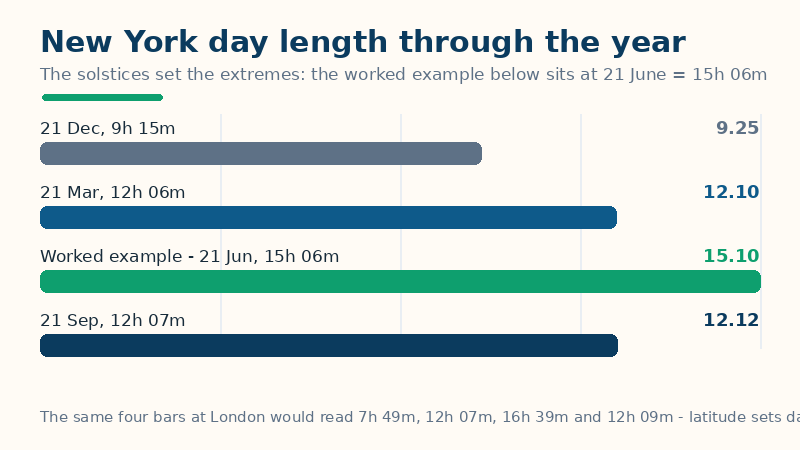
Then the equation of time, the NOAA approximation for the gap between apparent solar time and clock time, and solar noon on your clock:
solar noon = 12:00 − (equation of time ÷ 60) − (longitude − 15 × UTC offset) ÷ 15Then, for any altitude h, the hour angle ω — how far, in degrees, the sun sits from solar noon when it reaches that altitude — from spherical trigonometry:
cos ω = (sin h − sin φ × sin δ) ÷ (cos φ × cos δ)where φ is your latitude. The morning event is solar noon minus ω ÷ 15 hours, the evening event solar noon plus ω ÷ 15, because the Earth turns 15° an hour. The altitudes are the standard ones: sunrise and sunset at −0.833° (the sun's upper limb on the horizon, corrected for refraction and the sun's own disc), civil twilight at −6° (street lights on, reading outdoors still possible), nautical twilight at −12° (the horizon at sea disappears, bright stars out), astronomical twilight at −18° (the sky fully dark for astronomy), and the photographer's windows — golden hour while the sun sits between −4° and +6°, blue hour while it sits between −6° and −4°.
Worked example: New York, 21 June 2026
Day 172 of the year: δ = 23.45° × sin(360° × (284 + 172) ÷ 365) = +23.45°, the solstice value, and the equation of time is −1.45 minutes. With longitude −74.006° and UTC offset −4 (Eastern Daylight Time), solar noon = 12:00 − (−1.45 ÷ 60) − (−74.006 − 15 × (−4)) ÷ 15 = 12:00 + 0.02 + 0.93 = 12:57. For sunrise, cos ω = (sin(−0.833°) − sin(40.7128°) × sin(23.45°)) ÷ (cos(40.7128°) × cos(23.45°)) = −0.3942, so ω = 113.21° and day length = 2 × 113.21° ÷ 15 = 15.10 hours = 15h 06m. Sunrise = 12:57 − 7h 33m = 05:25, sunset = 12:57 + 7h 33m = 20:30 — matching the published New York times for 21 June to the minute, and matching this site's own daylight calculator, which uses the same geometry. The rest of the day follows from the same noon with different altitudes: astronomical twilight 03:18 → 22:37 (ω = 144.85°), nautical 04:09 → 21:46 (132.24°), civil 04:51 → 21:04 (121.57°), morning golden hour 05:04 → 06:06 (the −4° point at 05:04 to the +6° point at 06:06), evening golden hour 19:49 → 20:51, morning blue hour 04:51 → 05:04 and evening blue hour 20:51 → 21:04. Note how the windows join up without gaps: blue hour ends exactly where golden hour begins in the morning, and golden hour ends exactly where blue hour begins in the evening, because both are defined off the same −4° boundary. The day length is only 3 seconds longer than the previous day's — the solstice is the year's turning point, so change stalls there — while around the equinox it moves fast: on 21 March the same city gains 2.8 minutes on the previous day. The table on the calculator shows New York through the year: 12h 06m on 21 March (07:01 → 19:07), 15h 06m on 21 June, 12h 07m on 21 September (06:45 → 18:52) and 9h 15m on 21 December (07:17 → 16:32, offset −5).
How to read your result, and its limits
Four cautions keep the numbers honest. First, clock times are approximate to a few minutes: Cooper's declination and the NOAA equation of time are approximations, and real sunrise is moved by local hills, buildings and weather — never use these times for navigation, prayer-time rulings or legal deadlines. Second, the UTC offset is yours to get right: the calculator cannot know whether your date falls in daylight saving, so entering New York as −5 in June shifts every time an hour early; the worked example uses −4 for June and −5 for December deliberately. Third, a dash is an answer, not a failure: when the sun never drops to −6° at your latitude and date — a Reykjavik June night, where the sun dips only to about 2° below the horizon — there is no civil twilight, and the page prints a dash rather than a fictitious time; inside the polar circles the same logic gives midnight sun or polar night for the whole day. Fourth, golden and blue hour are conventions, not laws of nature: photographers argue over the exact boundaries (some use −6° to +6° for golden hour), so treat the −4° to +6° and −6° to −4° windows here as the widely used standard, and judge the light on the day. For the length of daylight alone, use the daylight hours calculator; for the moon on the same night, the moon phase calculator names the phase.
Common mistakes
- Entering today's UTC offset for a date in the other half of the year. Daylight saving moves the offset by an hour, and every event on the page moves with it. Always enter the offset in force on your date.
- Confusing civil twilight with sunrise. Civil twilight begins when the sun is 6° below the horizon — about half an hour before sunrise in New York in June (04:51 vs 05:25) — and it is already light enough to read by. The sun itself is not up until −0.833°.
- Expecting golden hour to last an hour. It rarely does: in New York in June it runs 62 minutes in the morning and 62 in the evening, but near the equator it can be under 45 minutes and in high summer at high latitudes it stretches far longer. The name is a description, not a duration.
- Reading a polar "sunrise" off a tool that always prints one. Above the Arctic Circle in summer there is no sunrise to print; a tool that shows one anyway is extrapolating the formula past its range. This page reports midnight sun or polar night instead.
Related tools: Time Zone Converter — Convert a date and time between 20+ cities with real offsets — and see when the answer lands on another day.
Frequently asked questions
What time is sunrise and sunset today?
Enter your latitude, longitude, the UTC offset in force on your date and the date itself, and the calculator gives clock sunrise and sunset, solar noon, day length, golden hour, blue hour and all three twilight phases. The worked example, New York on 21 June 2026, gives sunrise 05:25 and sunset 20:30, with morning golden hour 05:04 → 06:06.
How are sunrise and sunset calculated?
From the sun's declination for your date (Cooper's equation), the equation of time and your longitude and UTC offset, which together fix solar noon on your clock. The hour angle for the −0.833° sunrise altitude then gives sunrise as solar noon minus that angle and sunset as solar noon plus it; twilight and golden hour use the same formula at −18°, −12°, −6°, −4° and +6°.
What is the golden hour, and what is the blue hour?
Golden hour is the window while the sun sits between 4° below and 6° above the horizon, when its light travels through more atmosphere and turns warm and soft — in the worked example, 05:04 → 06:06 in the morning and 19:49 → 20:51 in the evening. Blue hour is the darker window just outside it, sun between 6° and 4° below the horizon, when the sky goes deep blue — 04:51 → 05:04 and 20:51 → 21:04 in the example.
Why does the calculator sometimes show a dash instead of a time?
Because the sun never reaches that altitude on that date at that latitude — for example, civil twilight never arrives on a bright Reykjavik summer night, and above the Arctic Circle in summer there is no sunrise at all. A dash is the honest answer; a tool that prints a time anyway is extrapolating past the formula's range.