Nine lines, one total
The whole calculation is one addition and one division, and the agency fee is the one people get wrong. The nine lines — agency fees, surrogate compensation, benefits and allowances, IVF and medical costs, legal fees, escrow and administration, insurance, travel and accommodation, and other costs — are added together once for the total, and the total divided by the journey length gives the monthly cash flow:
total ($) = agency + compensation + benefits + IVF & medical + legal + escrow + insurance + travel + other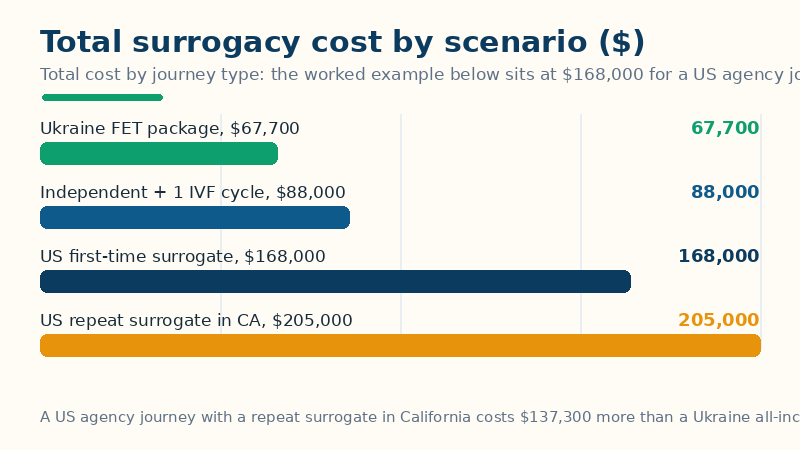
monthly cost ($) = total ÷ journey monthsshare of a line (%) = line ÷ total × 100The table above shows the same maths for four journeys. A Ukraine FET Standard all-inclusive package is a published $67,700 — $3,761.11 a month over 18 months. An independent journey with one IVF cycle is $88,000 — $4,888.89 a month. The worked example's US agency journey with a first-time surrogate is $168,000 — $9,333.33 a month. And a US agency journey with a repeat surrogate in California is $205,000 — $11,388.89 a month.
Worked example: a US agency journey with a first-time surrogate
A US agency charges $45,000, the surrogate's base compensation is $55,000, her benefits and allowances are $8,000, one IVF cycle including medications is $25,000, the legal fees are $12,000, escrow and administration $2,000, insurance $12,000, travel $4,000 and other costs $5,000. The total is $45,000 + $55,000 + $8,000 + $25,000 + $12,000 + $2,000 + $12,000 + $4,000 + $5,000 = $168,000: surrogate compensation is the largest line at 32.7% of the total, agency fees next at 26.8%, IVF and medical 14.9%, legal fees and insurance 7.1% each, benefits and allowances 4.8%, other costs 3.0%, travel 2.4% and escrow 1.2%, adding to exactly 100.0%. Over an 18-month journey that is $168,000 ÷ 18 = $9,333.33 a month — and the money is due in milestones along the way, not at the end, so the monthly figure is the cash flow to plan for, not a bill that arrives once. Four published cross-checks reproduce exactly: Patriot Conceptions publishes a US planning range of $123,100–$214,600 with a midpoint of $168,850 — this page's $168,000 worked example sits $850 below that midpoint — and every line range they publish contains this page's default (agency $45,000–$60,000, base compensation $55,000–$85,000, legal $9,000–$18,000, escrow $0–$3,000, insurance $8,000–$22,000); SurrogateFirst's compensation ladder is $55,000 for a first-time surrogate outside California, $70,000 for a repeat surrogate outside California or a first-time surrogate in California, and $85,000 for a repeat surrogate in California — this page's worked example uses the $55,000 first rung and the table's California row uses the $85,000 top rung — and their IVF cycle at $15,000–$25,000 including medications is this page's $25,000 default and the independent row's $15,000, while their US total of $100,000–$200,000 contains the $168,000 worked example and the $88,000 independent row, with the $205,000 California row sitting just above it because every one of its lines is near the top of its range; ivfconceptions' country table puts the USA at $100,000–$150,000, Ukraine at $50,000–$70,000 and Mexico at $60,000–$80,000 — this page's Ukraine package price of $67,700 sits inside their Ukraine range, while their USA top of $150,000 sits below SurrogateFirst's $200,000, because the two sources count different things: agency fees, insurance and benefits at the top of their ranges push a US journey past $150,000; and Delivering Dreams' published Ukraine tiers are FET Standard from $67,700, Own Oocytes Standard from $74,500 and Donor Egg Standard from $76,700, with a Ghana program for single fathers from $83,000.
How to read your result, and its limits
Four cautions keep the number honest. First, this is an estimate, not a quote: the final price depends on the clinic, the state, the embryo status, the surrogate's experience and the matching timeline, and an agency's own fee sheet is the number that matters — use this page to pressure-test that sheet, line by line. Second, one IVF cycle is the optimistic case: a failed cycle means another $15,000–$25,000, and the medical line is the one most likely to double — budget for two cycles if the clinic's success rate suggests it. Third, compensation is not the surrogate's take-home pay in the way a salary is: the benefits and allowances sit on top of the base fee, and lost wages, maternity clothing, childcare during appointments and the signing bonus are real money that arrives in the same journey. Fourth, insurance may not cover a surrogate pregnancy at all: most ordinary health plans exclude it, which is why the worked example carries a separate $12,000 policy — check the surrogate's policy and the intended parents' policy before signing anything, and confirm the legal position in the state where the surrogate will carry the pregnancy, because surrogacy law differs by state and by country. For the pregnancy itself, the due date calculator lays out the milestone weeks from the last period or conception date; for the first year after the birth, the baby cost calculator prices the first year the same way — one-off costs plus a year of yearly costs; and for the long horizon, the college savings calculator prices the 529 plan the same way — a monthly contribution, a rate and a number of years.
Common mistakes
- Budgeting the agency fee as the total. The agency is 26.8% of the worked example's $168,000 — the other eight lines add $123,000. A budget built from the agency fee alone is short by nearly three quarters of the journey.
- Assuming one IVF cycle is enough. One cycle is $15,000–$25,000 including medications, and a second cycle costs the same again — the medical line is the one most likely to double, and the only line with a published success rate to check against.
- Forgetting the monthly cash flow. $168,000 over 18 months is $9,333.33 a month, due in milestones along the way — matching, screening, transfer, pregnancy and birth — not as one bill at the end. A plan that saves the total but not the timing runs short in the middle.
- Comparing a US total with a Ukraine package price. A $67,700 all-inclusive package and a $168,000 line-by-line US total bundle the same costs differently — the package includes the clinic, the compensation and the legal work in one price, while the US total itemises them. Compare the totals, not the lines.
- Treating compensation as the surrogate's whole payment. The $55,000 base fee sits beside $8,000 of benefits and allowances at the worked example's inputs, and lost wages, maternity clothing, childcare and the signing bonus are real money in the same journey.
Frequently asked questions
How much does surrogacy cost in the US?
At the worked example's inputs a US agency journey with a first-time surrogate costs $168,000 — $9,333.33 a month over 18 months. Published US totals typically run $100,000–$200,000. A repeat surrogate in California costs $205,000 at the table's inputs, and an independent journey with one IVF cycle costs $88,000. Patriot Conceptions' published planning range is $123,100–$214,600.
What is the biggest cost in surrogacy?
Surrogate compensation is the largest single line at the worked example's inputs — $55,000, or 32.7% of the $168,000 total. Agency fees are next at $45,000 (26.8%), and together the two are 59.5% of the journey. IVF and medical costs are third at $25,000 (14.9%). Compensation rises with experience and location: $70,000 for a repeat surrogate outside California or a first-time surrogate in California, $85,000 for a repeat surrogate in California.
How much does surrogacy cost in Ukraine?
Delivering Dreams' published all-inclusive Ukraine programs start at $67,700 for a frozen embryo transfer (FET) Standard program, $74,500 for Own Oocytes Standard and $76,700 for Donor Egg Standard, with higher tiers up to $97,000–$103,700. A separate Ghana program for single fathers starts at $83,000. Under Ukrainian law surrogacy is available to married heterosexual couples.
Does insurance cover surrogacy?
Usually not under an ordinary health plan — most exclude a surrogate pregnancy, which is why the worked example carries a separate $12,000 policy, in the published $8,000–$22,000 range for one. Check the surrogate's policy and the intended parents' policy before signing, and confirm what the policy covers at each stage: screening, the transfer, the pregnancy and the birth can each be treated differently.