Why a glove size is just an inch measurement
Most clothing sizes hide their measurement behind an arbitrary number. Glove sizes do not: the size number is your palm circumference in inches. Measure around the widest part of your palm, just below the knuckles and excluding the thumb, and the number of inches on the tape is your size — a 9-inch palm takes a size 9, and the centimetre figure is the same measurement converted, 9 × 2.54 = 22.86 cm, shown as 22.9 cm in the table. The letter is only a banding of those numbers: sizes 9 and 9½ are both L, sizes 8 and 8½ are both M, so a letter alone never identifies a single row, and any converter that answers a letter with one number is guessing. Measure your dominant hand, because the two hands differ slightly and the larger hand decides the fit.
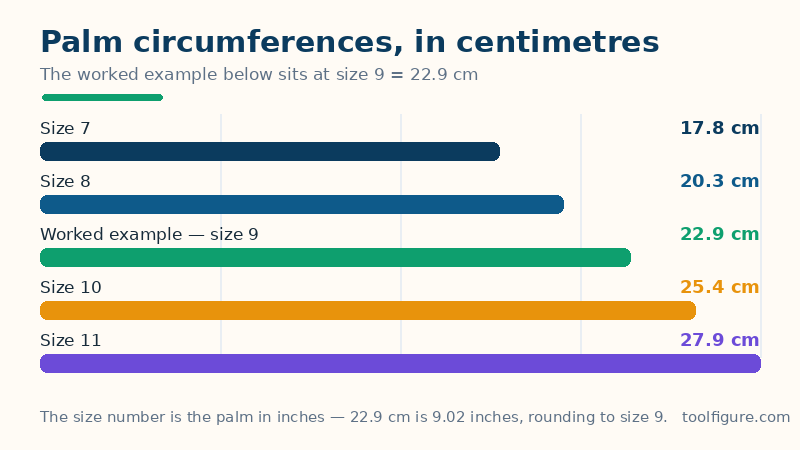
Worked example: a 22.9 cm palm
Take a palm measuring 22.9 cm. Divide by 2.54: 22.9 ÷ 2.54 = 9.02 inches, which rounds to the nearest half size, size 9, letter L — and the table row agrees exactly, 9 → 22.9 cm → L. Two more rows prove the rule holds across the table rather than on one lucky row: a 20.3 cm palm is 20.3 ÷ 2.54 = 7.99 inches, size 8, M, and an 8.5-inch palm is 8.5 × 2.54 = 21.59 cm, shown as 21.6 cm, size 8.5, M. A letter answer shows its range honestly: XL is sizes 10–10.5, palms 25.4–26.7 cm, and only a tape measurement picks the exact row inside it. A palm between rows — 23.5 cm, say — is answered by naming the nearest rows (9 at 22.9 cm and 9.5 at 24.1 cm) instead of inventing a size between them.
Glove size table
| Glove size | Palm (cm) | Palm (in) | Letter |
|---|---|---|---|
| 6 | 15.2 | 6.0 | XS |
| 6.5 | 16.5 | 6.5 | XS |
| 7 | 17.8 | 7.0 | S |
| 7.5 | 19.1 | 7.5 | S |
| 8 | 20.3 | 8.0 | M |
| 8.5 | 21.6 | 8.5 | M |
| 9 | 22.9 | 9.0 | L |
| 9.5 | 24.1 | 9.5 | L |
| 10 | 25.4 | 10.0 | XL |
| 10.5 | 26.7 | 10.5 | XL |
| 11 | 27.9 | 11.0 | XXL |
| 11.5 | 29.2 | 11.5 | XXL |
| 12 | 30.5 | 12.0 | XXXL |
How to read your result, and its limits
Three checks before ordering. First, measure the right hand, the right way: the dominant hand, around the widest part of the palm below the knuckles, thumb excluded, tape snug but not tight — measuring across the knuckles or including the thumb inflates the number by a full size or more. Second, between sizes, the material decides: take the larger size for lined, synthetic or winter gloves, and the smaller size for unlined goat or sheep leather, which stretches to the hand — a slightly loose glove can be tightened with a wrist strap, while a tight glove cannot be loosened. Third, this table is for ordinary fitted gloves and mittens: baseball gloves, kitchen gloves, baby mittens and safety gloves each use their own sizing, and hand length matters as a secondary check for styles with long fingers — if your fingers are much longer than average for your palm size, check the maker's length chart as well as this table. Brands vary by cut and material, so the maker's own chart is the final word when it differs.
Related tools: Shoe Size Converter — US, UK, EU and Japan shoe sizes — every system at once, men and women; Hat Size Converter — US, UK, EU and letter hat sizes — from your head circumference; Clothing Size Converter — Men's and women's clothing sizes between US, UK and EU — with the measurements behind them.
Frequently asked questions
How do I measure my hand for gloves?
Wrap a soft tape measure around the widest part of your dominant palm, just below the knuckles, excluding the thumb, snug but not tight. The number of inches on the tape is your glove size, and the centimetre figure is the same measurement converted at 2.54 cm per inch.
What does a glove size number mean?
It is your palm circumference in inches. A 9-inch palm takes a size 9, and a 22.9 cm palm is the same hand (22.9 ÷ 2.54 = 9.02 inches, rounding to size 9). The letter is only a banding of those numbers — sizes 9 and 9½ are both L.
What if my palm falls between two sizes?
Take the larger size for lined or synthetic gloves and the smaller size for unlined leather that will stretch to the hand. The converter names the nearest rows instead of inventing a size between them, because a guessed middle size would be wrong for most makers anyway.
Why does a letter size not give one exact glove size?
Because each letter covers two half sizes: L is 9 and 9½, XL is 10 and 10½. A letter answer on this page shows its full range, and only a palm measurement picks the exact row inside it.
