Why one foot gets four different numbers
The four systems were not designed together, so no single formula converts between them — every conversion is a table lookup, and this page is that lookup. US sizing steps in barleycorns of one-third of an inch, counted from a different zero for men and women, which is why US men's and women's scales differ by 1.5 sizes for the same foot. UK sizing uses the same barleycorn step but counts from another zero again, landing half a size below US men's sizes and two sizes below US women's sizes. EU sizing steps in Paris points of two-thirds of a centimetre and is unisex: the same EU number fits the same foot length regardless of gender, which is why the men's and women's tables share EU values only where the foot lengths happen to coincide. Japanese sizing is the honest one — it is simply the foot length in centimetres, so a JP 28 is built for a 28 cm foot. If a conversion ever looks like a neat formula (UK plus one equals US, for example), it is an approximation that holds for some rows and breaks on others; the tables below are the exact mapping this tool uses.
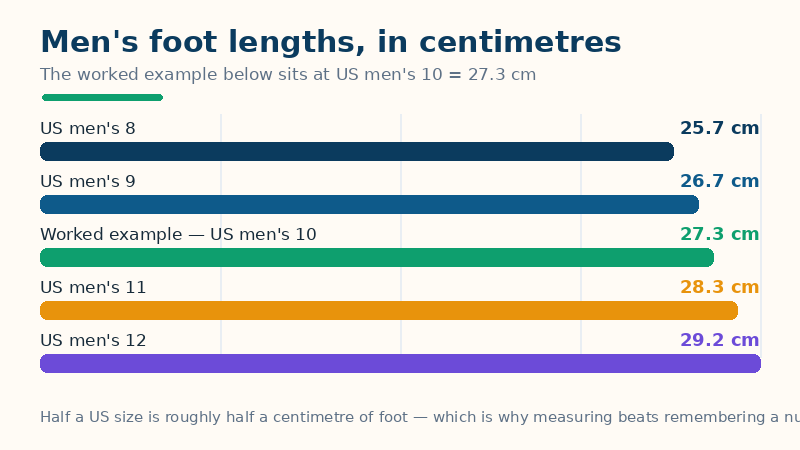
Worked example: men's US 10
Enter men's US 10 and the row reads: UK 9.5, EU 44, Japan 28, built for a foot 27.3 cm long. The UK figure follows the men's offset exactly (US 10 − 0.5 = UK 9.5); the EU figure does not follow any offset, it is simply the row the published tables pair with a 27.3 cm foot. The women's worked example runs the same way: women's US 8 gives UK 6 (US 8 − 2 = UK 6), EU 39, Japan 25, built for a foot 25 cm long. Notice that a women's US 8 and a men's US 7 are not the same shoe: the women's row is built for 25 cm while the men's US 7 row is built for 24.8 cm — the 1.5-size gender offset is a rule of thumb between the scales, not an identity between feet.
Men's size table
| US men | UK men | EU | Japan (cm) | Foot length (cm) |
|---|---|---|---|---|
| 6 | 5.5 | 38.5 | 24 | 24.1 |
| 6.5 | 6 | 39 | 24.5 | 24.4 |
| 7 | 6.5 | 40 | 25 | 24.8 |
| 7.5 | 7 | 40.5 | 25.5 | 25.4 |
| 8 | 7.5 | 41 | 26 | 25.7 |
| 8.5 | 8 | 42 | 26.5 | 26 |
| 9 | 8.5 | 42.5 | 27 | 26.7 |
| 9.5 | 9 | 43 | 27.5 | 27.1 |
| 10 | 9.5 | 44 | 28 | 27.3 |
| 10.5 | 10 | 44.5 | 28.5 | 27.9 |
| 11 | 10.5 | 45 | 29 | 28.3 |
| 11.5 | 11 | 45.5 | 29.5 | 28.6 |
| 12 | 11.5 | 46 | 30 | 29.2 |
| 12.5 | 12 | 47 | 30.5 | 29.5 |
| 13 | 12.5 | 47.5 | 31 | 29.8 |
| 14 | 13.5 | 48.5 | 32 | 30.5 |
| 15 | 14.5 | 49.5 | 33 | 31.3 |
| 16 | 15.5 | 50.5 | 34 | 32.2 |
Women's size table
| US women | UK women | EU | Japan (cm) | Foot length (cm) |
|---|---|---|---|---|
| 5 | 3 | 35.5 | 22 | 22 |
| 5.5 | 3.5 | 36 | 22.5 | 22.5 |
| 6 | 4 | 36.5 | 23 | 23 |
| 6.5 | 4.5 | 37.5 | 23.5 | 23.5 |
| 7 | 5 | 38 | 24 | 24 |
| 7.5 | 5.5 | 38.5 | 24.5 | 24.5 |
| 8 | 6 | 39 | 25 | 25 |
| 8.5 | 6.5 | 40 | 25.5 | 25.5 |
| 9 | 7 | 40.5 | 26 | 26 |
| 9.5 | 7.5 | 41 | 26.5 | 26.5 |
| 10 | 8 | 42 | 27 | 27 |
| 10.5 | 8.5 | 42.5 | 27.5 | 27.5 |
| 11 | 9 | 43 | 28 | 28 |
| 11.5 | 9.5 | 44 | 28.5 | 28.5 |
| 12 | 10 | 44.5 | 29 | 29 |
How to read your result
The large line is your size in every system, and the table underneath adds the foot length the row is built for — the one number you can verify with a ruler. Three checks before ordering. First, measure, don't remember: stand on paper in the socks you will wear, mark heel and longest toe, and measure both feet at the end of the day, when feet are largest; use the larger foot, and if the length falls between two rows, take the larger size, especially for closed-toe shoes. Second, brands move around the table: lasts (the foot-shaped forms shoes are built on) differ by brand and by model, so two brands' EU 44 can differ by half a centimetre or more — the standard table is the starting point, the brand's own chart is the final word, and a size that is right everywhere else can still be wrong for one maker. Third, width is not in this table: length-based systems say nothing about narrow, regular or wide fits, so a correct length in a wrong width still pinches. Children's sizes are not covered here — toddler and youth scales restart their numbering and need their own table.
Related tools: Height Converter — Convert feet and inches to cm — and cm back — with the exact factor and a worked example; Unit Converter — Convert length, weight, temperature and volume — km to miles, kg to pounds, °C to °F, litres to gallons; Length Converter — Convert centimetres, inches, feet, miles, kilometres and more — every answer in all eleven units, through the exact international definitions.
Frequently asked questions
Why does the same foot get different numbers in different countries?
Because the systems were built on different scales at different times: US and UK sizes step in barleycorns of one-third of an inch from different starting points, EU sizes step in Paris points of two-thirds of a centimetre, and Japanese sizes are the foot length in centimetres. There is no single formula between them, only the published tables this page looks up.
Are men's and women's sizes the same?
No. US men's sizes run half a size above UK men's sizes, while US women's sizes run two sizes above UK women's sizes — and a women's US 8 (built for a 25 cm foot) is not the same shoe as a men's US 7 (built for 24.8 cm). Always convert within the right gender table, and note that EU sizes are unisex by foot length.
What if my foot falls between two sizes?
Take the larger size, especially for closed-toe shoes and boots, and fit the larger foot if your feet differ. There should be about a centimetre between your longest toe and the end of the shoe. If your exact size has no row in the table, the converter names the nearest sizes instead of guessing.
Do EU sizes differ between brands?
Yes — by up to a full size. The tables here are the commonly published standard conversions, but every brand builds on its own last, so the same EU 44 can fit differently from two makers. Check the brand's own size chart before ordering, and measure your foot in centimetres as the cross-check.
