Why one head gets four different numbers
Hat sizes are not measurements; they are labels for a measurement, and every country chose a different label. The measurement itself is simple: the circumference of your head, taken level around the widest part, about a centimetre above your eyebrows and ears. Europe labels the hat with that measurement directly, so a 58 cm head takes an EU 58. The United States and Britain label it with the fitted size, which is the diameter of the circle your head makes — circumference divided by π — so the same 58 cm head takes a US 7¼: 58 ÷ π = 18.46 cm of diameter, which is 7.27 inches, rounding to 7¼. Britain runs 1/8 smaller than the United States across this whole table, so that head is a UK 7⅛. Letter sizes are the loosest labels of all: each letter covers two centimetre rows, so M covers 57–58 cm and only a tape measurement picks the exact row inside it.
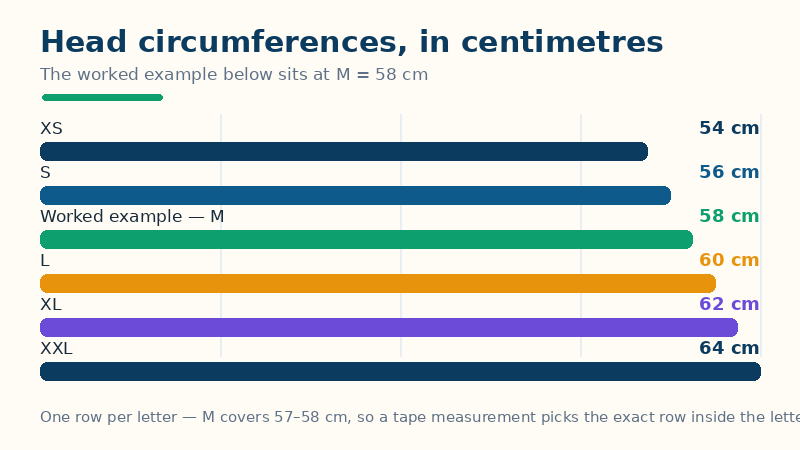
Worked example: a 58 cm head
Take a head measuring 58 cm. The table row reads US 7¼, UK 7⅛, EU 58, letter M, 22.8 inches — and both formulas check: 58 ÷ 2.54 = 22.83 inches, shown as 22.8, and 58 ÷ π ÷ 2.54 = 7.27 inches, rounding to the fitted size 7¼, with the UK figure exactly 1/8 below it at 7⅛. Two more rows prove the rules hold across the table rather than on one lucky row: a 56 cm head is a US 7, UK 6⅞, EU 56, S, 22.0 inches (56 ÷ 2.54 = 22.05, shown as 22.0), and a 60 cm head is a US 7½, UK 7⅜, EU 60, L, 23.6 inches (60 ÷ 2.54 = 23.62, shown as 23.6). A measurement within half a centimetre of a row snaps to that row — 58.6 cm reads as a 59 — while a head outside the table, 52 cm say, is answered by naming the adult range instead of inventing a row.
Hat size table
| EU (cm) | US | UK | Letter | Head (in) |
|---|---|---|---|---|
| 53 | 6⅝ | 6½ | XS | 20.9 |
| 54 | 6¾ | 6⅝ | XS | 21.3 |
| 55 | 6⅞ | 6¾ | S | 21.7 |
| 56 | 7 | 6⅞ | S | 22.0 |
| 57 | 7⅛ | 7 | M | 22.4 |
| 58 | 7¼ | 7⅛ | M | 22.8 |
| 59 | 7⅜ | 7¼ | L | 23.2 |
| 60 | 7½ | 7⅜ | L | 23.6 |
| 61 | 7⅝ | 7½ | XL | 24.0 |
| 62 | 7¾ | 7⅝ | XL | 24.4 |
| 63 | 7⅞ | 7¾ | XXL | 24.8 |
| 64 | 8 | 7⅞ | XXL | 25.2 |
| 65 | 8⅛ | 8 | XXXL | 25.6 |
How to read your result, and its limits
Three checks before ordering. First, measure, do not remember: wrap a soft tape level around the widest part of your head, about a centimetre above your eyebrows, snug but not tight, and measure two or three times — heads are rarely exactly on a row, and a remembered number from another brand is the commonest cause of a return. Second, some charts disagree at the boundary: a few makers label a 56 cm head UK 7 rather than UK 6⅞, treating the two fitted scales as equal from 7 up, while this table keeps the 1/8 gap across every row — if the brand you are buying publishes its own chart, that chart wins over this one. Third, shape beats size: a round head and a long oval head can share a circumference and still fit the same hat differently, and stiff hats (fedoras, straw hats) forgive less than stretch or adjustable caps, so between sizes always size up and tighten with sizing tape rather than squeezing into the smaller size. Children's heads fall below this table and need a children's chart.
Related tools: Shoe Size Converter — US, UK, EU and Japan shoe sizes — every system at once, men and women; Clothing Size Converter — Men's and women's clothing sizes between US, UK and EU — with the measurements behind them; Ring Size Converter — US, UK, EU and Japan ring sizes — plus diameter and circumference lookup.
Frequently asked questions
Are US and UK hat sizes the same?
Not in this table: UK sizes run 1/8 smaller than US sizes on every row, so a US 7¼ is a UK 7⅛ and a US 7 is a UK 6⅞. Some makers' charts treat the two scales as equal from size 7 up, which is why the brand's own chart is the final word when it differs from the standard table here.
How do I measure my head for a hat?
Wrap a soft tape measure level around the widest part of your head, about a centimetre above your eyebrows and ears, snug but not tight. Measure two or three times and use the average. If you have no tape, use a length of string, mark the overlap, and lay it against a ruler.
What is my EU hat size?
Your EU hat size is your head circumference in centimetres: a 58 cm head is an EU 58, a 56 cm head an EU 56. That is the one hat scale that needs no conversion at all — it is the measurement itself.
What if my head falls between two sizes?
Take the larger size. A hat that is slightly large can be tightened with a strip of sizing tape behind the sweatband, but a hat that is too small cannot be made bigger, and a tight hat leaves a mark and will not sit level.
