Three steps: watts, minutes, boils
The whole calculation is two multiplications. Watts divided by 1,000 is kilowatts; kilowatts times the boil time in hours is the energy of one boil; the boils a day times the energy per boil is the day's energy; the day's energy times 365 days is the year's energy; the year's energy times the price is the year's money. The month is the year divided by 12, not the day times 30 — the two differ by a few cents, and the year-divided-by-12 figure is the one this page uses, so it agrees with the yearly total exactly:
energy per boil (kWh) = watts ÷ 1,000 × minutes ÷ 60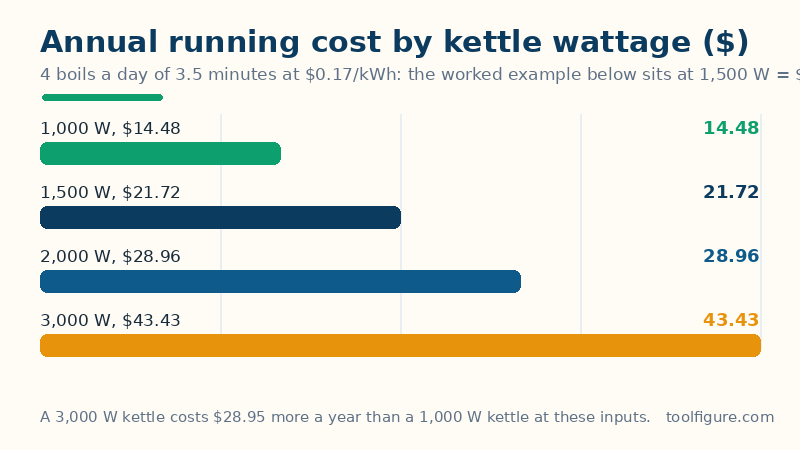
energy per day (kWh) = energy per boil × boils a dayannual cost ($) = energy per day × 365 × electricity priceThe one number that settles every argument about kettles is the physics floor. Heating a litre of water from 20°C to 100°C needs 4.186 kJ per kilogram per degree × 80 degrees = 334.9 kJ, which is 0.093 kWh — no kettle can boil a litre from a cold tap on less, whatever its watts. At 1,500 W that floor takes 0.093 ÷ 1.5 hours, about 3.7 minutes; at 3,000 W it takes about 1.9 minutes. So a 3 kW kettle boils the same litre in half the time on about the same energy — the watts set the speed, the water sets the cost. Typical kettles are 1,000 to 1,500 W in the US and 2,000 to 3,000 W in the UK, and a normal boil is 3 to 4 minutes at 1,500 W or about 2 minutes at 3,000 W.
Worked example: 1,500 W, 3½ minutes, 4 boils a day, $0.17/kWh
A 1,500 W kettle boiling for 3½ minutes uses 1.5 × 3.5 ÷ 60 = 0.0875 kWh a boil, costing 1.5¢. A day is 0.0875 × 4 = 0.35 kWh, costing $0.06. A month is 127.7 ÷ 12 = 10.6 kWh, costing $1.81. A year is 0.35 × 365 = 127.7 kWh, costing $21.72. The table above shows the same maths for the other kettle sizes at 4 boils a day of 3½ minutes: a 1,000 W kettle costs 1.0¢ a boil and $14.48 a year, a 2,000 W kettle costs 2.0¢ a boil and $28.96 a year, and a 3,000 W kettle costs 3.0¢ a boil and $43.43 a year. At 1 boil a day the worked example costs $5.43 a year, and at 6 boils a day $32.58. Four published cross-checks reproduce exactly: electricitybillcalculator's 3 kW kettle for 2 minutes uses 0.1 kWh — 2.63p at Ofgem's 26.32p per kWh — and 4 boils a day is 146 kWh a year, £38.43; a 1,500 W kettle for 3½ minutes uses 0.0875 kWh and $0.014 at 16 cents — electrickettlesguide prints 0.087 kWh and $0.014; a 3 kW kettle for 4 minutes uses 0.20 kWh, 6p at 30p — morphyrichards' figure, whose volume table gives 250 ml in 1 minute as 0.05 kWh and 1.5p, 500 ml in 2 minutes as 0.10 kWh and 3p, and 1 litre in 3 minutes as 0.15 kWh and 4.5p; and a 2 kW kettle for 4½ minutes uses 0.15 kWh, 3.75p at 25p — trimmybills' figure.
How to read your result, and its limits
Four cautions keep the number honest. First, the month is the year divided by 12: 127.7 kWh a year is 10.6 kWh a month and $1.81, while the day times 30 would give 10.5 kWh and $1.79 — a two-cent difference that is only a convention, and the year-divided-by-12 figure is the one that adds up to the yearly total. Second, the watts do not set the cost — the water does: a 3 kW kettle and a 1.5 kW kettle both need at least 0.093 kWh for a litre from a cold tap, so the faster kettle costs about the same per boil and only saves time. Third, boil only what you need: half a kettle at 1,500 W for 2 minutes is 0.05 kWh, about 0.9¢, against 0.0875 kWh and 1.5¢ for the worked example's boil — the biggest saving on the page is measuring the water, not buying a new kettle. Fourth, the electricity price is the all-in rate: the total on the bill divided by the kilowatt-hours on the bill, including delivery charges. For the coffee that goes with the water, the coffee maker cost calculator prices the brew and the warming plate separately; for the minutes on the clock, the microwave cost calculator prices the watts drawn from the socket; and for the cost of running anything else in the house, the electricity cost calculator prices any appliance by watts and hours.
Common mistakes
- Pricing the rated watts for an hour. A 3,000 W kettle for 3½ minutes is 0.175 kWh and 3.0¢, not 3 kWh and $0.51 — the watts only run for the minutes of the boil. Divide the minutes by 60 first: 3.5 ÷ 60 = 0.058 hours.
- Putting minutes in as hours. Three and a half minutes is 0.058 hours, not 3.5 — entering 3.5 as the hours would price sixty boils. Divide the minutes by 60 first.
- Multiplying the daily cost by 30 for the month. Thirty days is not a twelfth of a year: the day times 30 gives $1.79 a month at the worked example's inputs, while the year divided by 12 gives $1.81. Use the year-divided-by-12 figure, which is the one that adds up.
- Boiling a full kettle for one mug. One mug is about 250 ml, about 1 minute at 3,000 W or 2 minutes at 1,500 W — 0.05 kWh and about 0.9¢ — against 0.0875 kWh and 1.5¢ for the worked example's boil. Fill to the mark for the cups you are actually making.
- Adding the standing charge to every boil. The daily supply charge is payable whether the kettle runs or not. Only the per-kWh rate belongs in the per-boil maths — the fixed charge is a separate line on the bill.
Frequently asked questions
How much does it cost to boil a kettle?
A 1,500 W kettle boiling for 3½ minutes uses 0.0875 kWh and costs about 1.5¢ at $0.17 per kWh. A 3 kW kettle for 2 minutes uses 0.1 kWh — 2.63p at Ofgem's 26.32p per kWh — and a 3 kW kettle for 4 minutes uses 0.20 kWh, 6p at 30p.
How much does a kettle cost per month?
A 1,500 W kettle boiled 4 times a day for 3½ minutes at $0.17 per kWh uses 10.6 kWh a month and costs $1.81 — $21.72 a year. At 1 boil a day it costs $5.43 a year, and at 6 boils a day $32.58.
Does a higher-wattage kettle cost more to boil the same water?
No: the energy is set by the water, not the watts. Heating a litre from a cold tap to boiling needs at least 0.093 kWh whatever the kettle — a 3 kW kettle does it in about 1.9 minutes and a 1.5 kW kettle in about 3.7 minutes, both on about 0.093 kWh. The higher watts buy speed, not extra energy.
Should I boil only the water I need?
Yes — it is the biggest saving on the page. Half a kettle at 1,500 W for 2 minutes is 0.05 kWh, about 0.9¢, against 0.0875 kWh and 1.5¢ for a full 3½-minute boil. One mug is about 250 ml, about a minute at 3,000 W: 0.05 kWh and 1.5p at 30p per kWh.