What thermal conductivity is
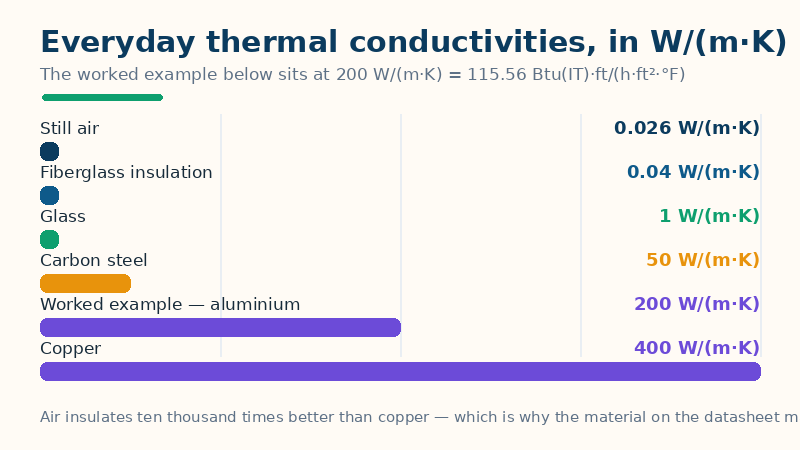
Thermal conductivity is how readily a material conducts heat through its bulk — how much heat passes through a unit thickness of material, per unit area, per degree of temperature difference. It is the material property behind every insulation rating and heat-sink choice: good insulators like fiberglass sit around 0.04 W/(m·K) and still air around 0.026 W/(m·K), while copper conducts at about 400 W/(m·K) and aluminium around 200 W/(m·K) — roughly ten thousand times the insulators. The SI unit is the watt per metre kelvin, but US insulation datasheets quote it in Btu (IT) inch per hour per square foot per Fahrenheit degree, older textbooks in calories per second per centimetre per degree Celsius, and European sheets in watts per centimetre per degree Celsius, so the same material arrives under half a dozen labels. This page restates any thermal conductivity in all ten units at once, worked through watts per metre kelvin with every factor defined, and answers the question the conversion alone cannot: at a temperature gradient you enter, how much heat does this material actually conduct?
The formula
answer = watts per metre kelvin ÷ (W/(m·K) in one "to" unit)
conducted flux = watts per metre kelvin × gradient
Three terms, all visible on the page. value is the number you enter. W/(m·K) in one "from" unit is the definition of the unit you are converting from: 1 for the watt per metre kelvin itself, 100 for the watt per centimetre degree Celsius, 1,000 for the kilowatt per metre kelvin, 418.68 for the calorie (IT) per second centimetre degree Celsius, 1.163 for the kilocalorie per hour metre degree Celsius, 0.1442278889 for the Btu (IT) inch per hour square foot Fahrenheit, 1.7307346668 for the Btu (IT) foot per hour square foot Fahrenheit, 519.2204 for the Btu (IT) inch per second square foot Fahrenheit, 0.1441314339 for the Btu (th) inch per hour square foot Fahrenheit, and 1.7295772055 for the Btu (th) foot per hour square foot Fahrenheit. answer is the result in the unit you asked for. gradient is the temperature gradient you enter in kelvin per metre, and the conducted-flux line multiplies the conductivity by it — Fourier's law, flux = k × gradient — so the watts per square metre a real wall conducts fall out of the conductivity on the datasheet.
Worked example
Convert 200 watts per metre kelvin to Btu (IT) foot per hour square foot Fahrenheit — aluminium's conductivity, restated for a US insulation sheet — the way the tool does it.
Step 1 — get to watts per metre kelvin. The input is already in watts per metre kelvin, so the base value is 200 W/(m·K) itself.
Step 2 — divide by the target factor. One Btu (IT) foot per hour square foot Fahrenheit is 1.7307346668 W/(m·K), so 200 ÷ 1.7307346668 = 115.56.
Step 3 — read the display. The headline reads 115.56 Btu(IT)·ft/(h·ft²·°F), and the detail line shows the working: 200 W/(m·K) = 115.56 Btu(IT)·ft/(h·ft²·°F) — worked through watts per metre kelvin: 200 W/(m·K) ÷ the Btu (IT) foot per hour square foot Fahrenheit factor. The full table for this example reads: 200 W/(m·K), 2 W/(cm·°C), 0.2 kW/(m·K), 0.4777 cal(IT)/(s·cm·°C), 171.97 kcal/(h·m·°C), 1,386.69 Btu(IT)·in/(h·ft²·°F), 115.56 Btu(IT)·ft/(h·ft²·°F), 0.3852 Btu(IT)·in/(s·ft²·°F), 1,387.62 Btu(th)·in/(h·ft²·°F) and 115.64 Btu(th)·ft/(h·ft²·°F). The conducted-flux line, at the default gradient of 10 K/m, reads 2,000 W/m²: 200 × 10 = 2,000 W/m².
Check it. Multiplying back, 115.56 Btu(IT)·ft/(h·ft²·°F) × 1.7307346668 = 200 W/(m·K) to the displayed rounding — the exact value multiplies back to 200 exactly, because every factor here is built from exact definitions. The conducted-flux line checks the same way: 2,000 W/m² ÷ 10 K/m = 200 W/(m·K), the conductivity we started from.
Conversion table
The conversions materials datasheets, insulation sheets and old textbooks reach for most, each one the same two steps as the example:
| From | To |
|---|---|
| 1 W/(m·K) | 6.9335 Btu(IT)·in/(h·ft²·°F) |
| 200 W/(m·K) | 115.56 Btu(IT)·ft/(h·ft²·°F) |
| 1 W/(m·K) | 0.5778 Btu(IT)·ft/(h·ft²·°F) |
| 0.04 W/(m·K) | 0.2773 Btu(IT)·in/(h·ft²·°F) |
| 400 W/(m·K) | 4 W/(cm·°C) |
| 1 cal(IT)/(s·cm·°C) | 418.68 W/(m·K) |
| 1 kcal/(h·m·°C) | 1.163 W/(m·K) |
| 1 Btu(IT)·in/(h·ft²·°F) | 0.1442 W/(m·K) |
| 1 Btu(IT)·ft/(h·ft²·°F) | 1.7307 W/(m·K) |
| 1 Btu(IT)·in/(s·ft²·°F) | 519.22 W/(m·K) |
| 1 Btu(th)·in/(h·ft²·°F) | 0.1441 W/(m·K) |
| 17.3073 W/(m·K) | 10 Btu(IT)·ft/(h·ft²·°F) |
Three everyday cross-checks for the scale, each one the same two steps: fiberglass insulation at 0.04 W/(m·K) is 0.2773 Btu(IT)·in/(h·ft²·°F); copper at 400 W/(m·K) is 231.12 Btu(IT)·ft/(h·ft²·°F); and still air at 0.026 W/(m·K) is 0.015 Btu(IT)·ft/(h·ft²·°F) — which is why a trapped air gap insulates almost as well as the fiberglass itself.
Reading the result, and its limits
Four distinctions keep this page honest. First, conductivity is not thermal resistance: k is a property of the material, while the resistance of a layer is R = thickness ÷ k, and a thick layer of a mediocre insulator can out-insulate a thin layer of a good one. Second, a kelvin of difference equals a Celsius degree of difference, but a Fahrenheit degree of difference is 5/9 of either: the Btu factors above already carry that 5/9, and converting an absolute temperature (20 °C to Fahrenheit) is a different operation from converting a difference. Third, Btu (IT) is not Btu (th): the two differ by about 0.07%, which is why this page carries both inch and foot versions of each, labelled, rather than silently rounding one into the other. Fourth, the conducted-flux line assumes steady, one-dimensional conduction through a uniform material: real walls have framing, fasteners, air films and moisture that change the actual heat loss, and a conductivity alone never describes a whole wall.
Related tools: Temperature Converter — Convert °C, °F, K, °R and °Ré — every answer in all five scales, formulas shown; Energy Converter — Joules to calories, kcal to kJ, kWh to joules and BTU — every answer in all ten units, through the exact definitions; Heat Flux Converter — W/m² to Btu/h·ft², kcal/h·ft², W/in² and more — every answer in all ten units.
Frequently asked questions
How do I convert W/m·K to Btu/h·ft·°F?
Divide by 1.7307346668. A conductivity of 200 W/(m·K) is 200 ÷ 1.7307346668 = 115.56 Btu(IT)/(h·ft·°F), the worked example on this page. To go the other way, multiply Btu(IT)/(h·ft·°F) by 1.7307346668 to get W/(m·K).
What is the difference between thermal conductivity and thermal resistance?
Conductivity (k) is a property of the material itself, in W/(m·K). Thermal resistance (R) is a property of a layer: R = thickness ÷ k, in m²·K/W. A thick layer of a mediocre insulator can out-insulate a thin layer of a good one, which is why datasheets quote both.
Is a Btu (IT) the same as a Btu (th)?
No, and the difference matters at laboratory precision. One Btu (IT) is 1,055.05585262 joules and one Btu (th) is 1,054.35026444 joules — about 0.07% smaller. This page carries both versions, labelled on every unit, so the figure you convert is the figure the table meant.
How do I find the heat conducted through a material?
Use Fourier's law: flux = conductivity × temperature gradient. In this page's units, a material at 200 W/(m·K) with a gradient of 10 K/m conducts 200 × 10 = 2,000 W/m². Enter any gradient in kelvin per metre and the conducted-flux line does that multiplication for you.
